UBER vs. GRAB: Which Ride-Hailing Stock Reigns Supreme Currently?
Uber Technologies UBER and Grab GRAB are both major players in ride-hailing and each has transformed transportation through ride-sharing-based business models.
That said, their footprints and strategies are not the same. Uber runs a global platform, while Grab is a dominant “super-app” across Southeast Asia, offering deliveries, mobility and digital financial services in eight countries: Cambodia, Indonesia, Malaysia, Myanmar, the Philippines, Singapore, Thailand and Vietnam. Ride-sharing remains Uber’s main business, but it has expanded over the years into food delivery and freight.
Because of these contrasts in regional reach and operating approach, it is worth comparing the two in depth to understand who has the advantage today and which stock may be the better investment right now.
The Case for UBER Stock
Uber, based in San Francisco, is benefiting from strong demand in both its ridesharing and delivery businesses. Rising platform usage, fresh growth initiatives and disciplined cost management are supporting solid operating momentum.
In the third-quarter 2025 report released last month, Uber once again topped earnings expectations, thereby continuing its streak of beating earnings expectations, showing resilience despite tough conditions.
Uber Technologies Price and EPS Surprise

Uber Technologies, Inc. price-eps-surprise | Uber Technologies, Inc. Quote
For the December quarter, Uber expects fourth-quarter 2025 gross bookings in the $52.25-$53.75 billion range, representing growth of 17% to 21% year over year on a constant currency basis. Our estimate is currently pegged at $52.4 billion. Management expects adjusted EBITDA to be in the range of $2.41-$2.51 billion. Our estimate is currently pegged at $2.45 billion.
Another growth driver is Uber’s push into the emerging robotaxi space via partnerships. To this end, recently Uber, along with WeRide WRD, a Chinese autonomous vehicle company, launched a commercial robotaxi service in Abu Dhabi. The rollout is the first commercial driverless robotaxi offering in the Middle East. Following the launch in Abu Dhabi, customers requesting UberX or Uber Comfort may be assigned a WeRide autonomous vehicle.
Also, Uber has recently launched a new robotaxi service in Dallas. For this purpose, Uber is deploying a fleet of autonomous vehicles developed by Avride, which is a wholly-owned subsidiary of Nebius Group N.V. NBIS. Nebius, based in the Netherlands, is a high-velocity pure play building AI-first infrastructure from the ground up. Avride develops and operates both autonomous cars and delivery robots. Driverless supply can reduce long-term trip costs, improve reliability during peak demand and offer a repeatable model for integrating more AV partners in new cities.
This partnership-driven strategy lets Uber participate in autonomous mobility without taking on the heavy R&D costs of building the technology entirely in-house. Uber’s capital-return plans add further support to the bull case. The company recently authorized up to $20 billion in additional share repurchases, signaling confidence in its long-term strategy while enhancing shareholder value.
This new buyback authorization builds on the $7 billion program unveiled in 2024. Uber completed a $1.5 billion accelerated repurchase under that program in the first quarter of 2025. In 2024, the company generated a record free cash flow of $6.9 billion and posted adjusted EBITDA of $6.5 billion, highlighting its strengthening financial profile.
Notably, Uber exited Southeast Asia in 2018 by selling its regional operations to Grab, but it still holds a sizable ownership stake in Grab.
The Case for GRAB Stock
Grab’s leadership in Southeast Asia stems from how effectively it tailors services to local market needs. The company’s evolution from a taxi-hailing app into a broad “everyday everything” platform — spanning food delivery, e-scooter rentals and digital payments — shows its intent to diversify and deepen engagement.
Grab is seeing healthy momentum in On-Demand Gross Merchandise Value (“GMV”), continued fintech expansion and higher user activity across its ecosystem. In the third quarter of 2025, On-Demand GMV (mobility plus deliveries) climbed 24% year over year. Grab expects 2025 revenues between $3.38 billion and $3.40 billion, up from the prior view of $3.33-$3.40 billion, indicating 21-22% year-over-year growth.
Grab, unlike Uber, does not have an impressive earnings history, having missed the consensus mark in two of the last four quarters. It matched the Zacks Consensus Estimate for earnings in the two other quarters. The average miss is 29.2%.
Grab Holdings Limited Price and EPS Surprise

Grab Holdings Limited price-eps-surprise | Grab Holdings Limited Quote
Grab is also reinforcing its competitive position by partnering with Amazon Web Services (“AWS”). AWS is now Grab’s preferred cloud provider, helping it scale mobility, deliveries and financial services, including the digital banking business. By leveraging AWS’s secure and flexible infrastructure, Grab has improved efficiency, reduced costs and rolled out new services faster.
In autonomous mobility, earlier in the year, Grab chose to make a strategic equity investment in WeRide. Grab and WeRide have announced plans to launch Autonomously Intelligent Ride (Ai.R). This is GRAB’s first AV service for consumers in Singapore. Grab has been selected by local authorities to operate two autonomous shuttle service routes in the Punggol area. Ai.R is the only service selected to run on two routes in Punggol and will start with a fleet of 11 vehicles.
Last month, WeRide and Grab achieved the first AV testing in Singapore’s Punggol district. By early 2026, Ai.R is expected to start taking its first batch of passengers, improving access to key amenities including supermarkets, schools and major transport nodes.
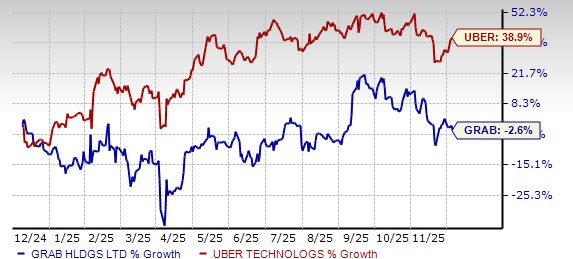
Uber Scores Over Grab on Price Performance
Shares of UBER have gained in excess of 38% in a year’s time. GRAB’s shares have declined in excess of 2% in the same time frame.
1-Year Price Comparison
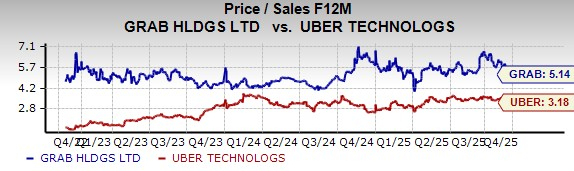
Grab Looks More Expensive Than Uber
Uber currently trades at a forward price-to-sales multiple of 3.18, giving it a Value Score of D. Grab appears pricier, with a Value Score of F and a forward sales multiple of 5.14.
Conclusion
Uber’s valuation relative to Grab is clearly appealing. Its ongoing diversification, partnership strategy and shareholder-friendly buybacks point to a company in strong financial shape. Uber’s much larger scale (market cap of $189.75 billion) also gives it greater resilience during uncertain macro periods. The company’s better price performance also works in its favor.
Grab, in contrast, operates within a narrower geographic base, leaving it more exposed to regional downturns. Economic uncertainty across key Southeast Asian markets — caused by inflation, shifting consumer trends and supply-chain challenges — has weighed on performance. The company also faces stiff competition in deliveries. With a smaller market cap of $20.9 billion, Grab has less financial flexibility and has been less aggressive in returning capital to shareholders than Uber.
Based on this comparison, Uber appears to be the stronger choice over Grab at present. Uber currently carries a Zacks Rank #3 (Hold) and Grab has a Zacks Rank #4 (Sell).
You can see the complete list of today’s Zacks #1 Rank (Strong Buy) stocks here.
Want the latest recommendations from Zacks Investment Research? Today, you can download 7 Best Stocks for the Next 30 Days. Click to get this free report
WeRide Inc. (WRD): Free Stock Analysis Report
Uber Technologies, Inc. (UBER): Free Stock Analysis Report
Grab Holdings Limited (GRAB): Free Stock Analysis Report
Nebius Group N.V. (NBIS): Free Stock Analysis Report
This article originally published on Zacks Investment Research (zacks.com).
Mentioned In This Article
Latest News
| Oct-09 | |
| Oct-09 | |
| Oct-09 | |
| Oct-09 | |
| Oct-08 | |
| Oct-08 | |
| Oct-08 | |
| Oct-08 | |
| Oct-08 | |
| Oct-08 | |
| Oct-08 | |
| Oct-08 | |
| Oct-07 | |
| Oct-07 | |
| Oct-07 |
