Trump Approved Nvidia's H200 Exports, but China's Limits Could Change Everything
Key Points
The U.S. will lift the export ban on Nvidia's H200 AI chips, allowing them to be sold in China.
President Trump made the announcement on Truth Social, stating that the U.S. government would receive 25% of each sale.
While this represents a significant opportunity, Chinese regulators may limit sales of these AI processors.
After months of uncertainty, President Donald Trump announced that the U.S. government would permit Nvidia (NASDAQ: NVDA) to sell its H200 processors to China. Trump announced the decision in a post on Truth Social, noting that he had informed President Xi Jinping of China of the decision, "under conditions that allow for continued strong National Security." He went on to say that President Xi "responded positively."
These high-end graphics processing units (GPUs), designed to facilitate artificial intelligence (AI), are among the company's most powerful chips and were previously subject to a U.S. export ban. The Trump Administration has now approved the sale of these AI chips to "approved customers in China," with the U.S. government taking a 25% cut from each sale. The Department of Commerce is said to be working out the details, and the same approach will apply to Advanced Micro Devices, Intel, and "other great American companies."
Where to invest $1,000 right now? Our analyst team just revealed what they believe are the 10 best stocks to buy right now, when you join Stock Advisor. See the stocks »
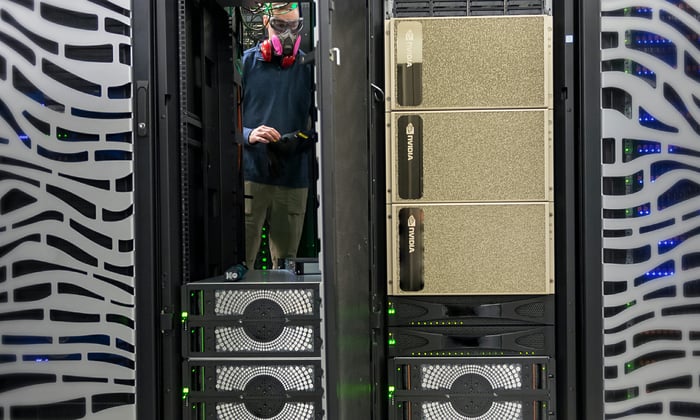
Image source: Nvidia.
Nvidia responded to the development, saying:
We applaud President Donald Trump's decision to allow America's chip industry to compete to support high-paying jobs and manufacturing in America. Offering H200 to approved commercial customers, vetted by the Department of Commerce, strikes a thoughtful balance that is great for America.
However, behind the scenes, Chinese authorities are prepared to place limits on the use of the chips, as Beijing has already been pushing companies to use locally produced semiconductors whenever possible, according to a report by the Financial Times, citing people familiar with the matter.
Those wishing to purchase the chips may be required to apply for government approval, although the details are still being finalized. China's National Development and Reform Commission and the Ministry of Industry and Information Technology -- the regulators formulating these policies -- could implement other conditions to encourage the use of local chips, according to the report.
The H200 chip, one of Nvidia's previous generation Hopper series, has already been replaced by the new, more powerful Blackwell chips and the soon-to-be-released Rubin processors, which Trump noted were not included as part of the deal.
The final outcome could have a material impact on Nvidia's financial results. The Trump Administration first announced the export restrictions for the H20 -- a previous generation chip specifically designed for export to China -- back in April. In response, Nvidia estimated that the ban would cost the company approximately $8 billion per quarter. The opportunity is likely much larger, since the H200 is a much more advanced -- and therefore more expensive -- AI chip. Nvidia estimates the total addressable market (TAM) in China to be worth as much as $50 billion.
While this is certainly a positive development, there's still a lot we don't know. Investors should rein in their enthusiasm until it is clear whether Chinese regulators will ultimately permit the sale of Nvidia's chips in the country.
That said, at 25 times next year's expected sales, Nvidia stock looks attractively priced.
Should you invest $1,000 in Nvidia right now?
Before you buy stock in Nvidia, consider this:
The Motley Fool Stock Advisor analyst team just identified what they believe are the 10 best stocks for investors to buy now… and Nvidia wasn’t one of them. The 10 stocks that made the cut could produce monster returns in the coming years.
Consider when Netflix made this list on December 17, 2004... if you invested $1,000 at the time of our recommendation, you’d have $521,982!* Or when Nvidia made this list on April 15, 2005... if you invested $1,000 at the time of our recommendation, you’d have $1,137,459!*
Now, it’s worth noting Stock Advisor’s total average return is 981% — a market-crushing outperformance compared to 194% for the S&P 500. Don’t miss out on the latest top 10 list, available when you join Stock Advisor.
*Stock Advisor returns as of December 8, 2025
Danny Vena, CPA has positions in Nvidia. The Motley Fool has positions in and recommends Advanced Micro Devices, Intel, and Nvidia. The Motley Fool has a disclosure policy.
Mentioned In This Article
Latest News
| 27 min | |
| 2 hours | |
| 9 hours | |
| 9 hours | |
| 11 hours | |
| 14 hours | |
| 16 hours | |
| 18 hours | |
| 19 hours | |
| Oct-10 | |
| Oct-10 | |
| Oct-10 | |
| Oct-10 | |
| Oct-10 | |
| Oct-10 |
