Can Tesla Robotaxis Get Fully Driverless by the End of 2025?
Tesla TSLA has tied a huge part of its long-term growth story to autonomous driving, and robotaxis sit at the center of that vision. The company began its first robotaxi service in Austin on June 22, but even today, every ride requires supervision. Safety monitors or remote operators are involved in each trip, which means Tesla is not yet running a truly driverless service.
But that may soon change. CEO Elon Musk reiterated yesterday that Tesla is close to removing safety monitors in Austin. In his words, “Unsupervised is pretty much solved at this point. So, there will be Tesla Robotaxis operating in Austin with no one in them… in about three weeks.” This is Musk’s fourth such projection in recent months, after similar comments in September, October and November.
Right now, Tesla’s system still requires human oversight. In Austin, monitors sit in the passenger seat on local roads and move to the driver’s seat for highway trips. In the Bay Area, a monitor remains in the driver’s seat at all times.
If Musk’s timeline holds, Austin could see fully driverless Teslas on public roads by year-end. That would be a major milestone, even if it happens in a controlled or limited form. But investors have seen Tesla set ambitious deadlines before, especially in autonomy.
Tesla had aimed to serve half the U.S. population by the end of the year, yet its actual deployment remains limited to Texas, California and Arizona. Expansion to Las Vegas, Dallas, Houston and Miami is planned next, depending on regulatory approvals and safety validation across each region. The company’s progress—over 550,000 robotaxi miles so far, mainly in Austin and the Bay Area—shows meaningful traction, yet it remains well behind the pace implied by Tesla’s early claims.
So, can Tesla achieve fully driverless robotaxis by the end of 2025? It’s possible, but not assured. The technology is improving, the platform is expanding, and Musk is pushing hard, but regulators and real-world challenges will ultimately decide how fast Tesla can get there.
Key Competitors of TSLA in the Robotaxi Space
Tesla faces tough competition in the robotaxi race, and the most advanced rival today is Alphabet’s GOOGL Waymo. Waymo has been operating truly driverless vehicles for years and recently crossed 450,000 weekly paid rides, almost double the 250,000 it reported in April. It continues to widen its lead with new expansions, including freeway operations in three cities and autonomous service in markets like Miami, Dallas, Houston, San Antonio and Orlando. Its entire fleet runs without safety drivers, giving it a strong edge over Tesla.
Baidu BIDU is another major player, though its progress is concentrated in China. Its Apollo Go service already offers fully driverless robotaxi operations in cities such as Beijing, Wuhan and Shenzhen, and it is spreading internationally in markets like Dubai and Switzerland. With operations in 22 cities and fully driverless coverage across key mainland regions, Baidu is building a scale and density that only a few competitors can match.
The Zacks Rundown on Tesla
Shares of Tesla have risen roughly 10% year to date, underperforming the industry.

From a valuation standpoint, TSLA trades at a forward price-to-sales ratio of 13.97, way above the industry. It carries a Value Score of D.

See how the Zacks Consensus Estimate for TSLA’s earnings has been revised over the past 90 days.
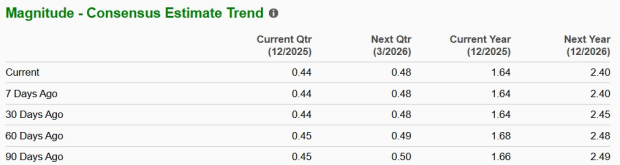
Tesla stock currently carries a Zacks Rank #3 (Hold).
You can see the complete list of today’s Zacks #1 Rank (Strong Buy) stocks here
Want the latest recommendations from Zacks Investment Research? Today, you can download 7 Best Stocks for the Next 30 Days. Click to get this free report
Baidu, Inc. (BIDU): Free Stock Analysis Report
Tesla, Inc. (TSLA): Free Stock Analysis Report
Alphabet Inc. (GOOGL): Free Stock Analysis Report
This article originally published on Zacks Investment Research (zacks.com).
Mentioned In This Article
Latest News
| 2 hours | |
| 2 hours | |
| 3 hours | |
| 3 hours | |
| Oct-09 | |
| Oct-09 | |
| Oct-09 | |
| Oct-09 | |
| Oct-09 | |
| Oct-09 | |
| Oct-09 | |
| Oct-09 | |
| Oct-09 | |
| Oct-09 |
Tesla's China Retail Sales Fall 9% Even as Shanghai Exports Surge 58%
TSLA
Benzinga Prediction Markets
|
| Oct-09 |
