LOW vs. HD: Which Home Improvement Giant Is Making the Bigger AI Bet?
In the rapidly evolving world of retail, the two dominant players in U.S. home improvement, The Home Depot, Inc. HD and Lowe’s Companies, Inc. LOW, are both investing heavily in artificial intelligence (AI). As digital tools reshape how consumers research, plan and execute home improvement projects, AI has become less about experimentation and more about competitive necessity. For retailers operating at a massive scale, the ability to embed intelligence into customer interactions, supply chains and professional services can materially influence growth, efficiency and long-term market share.
While both companies see AI as a strategic priority, their approaches reveal meaningful differences in emphasis and ambition. Home Depot is leaning into a disciplined, execution-first model, deploying AI to enhance core operations and reinforce existing strengths. Lowe’s, by contrast, is positioning AI as foundational infrastructure, using it to reimagine customer guidance, empower associates and redesign how the business operates end-to-end. Together, these strategies offer a clear view into how two industry leaders are leveraging the AI boom to shape the future of home improvement retail.
How HD Is Leveraging the AI Boom
Home Depot is proving that AI does not need hype to be transformative; it needs scale, discipline and execution. Rather than pitching AI as a futuristic overhaul, the retailer is embedding it directly into the moments that matter most: how customers shop, how products move and how professionals plan complex projects. This pragmatic approach treats AI as core infrastructure, quietly compounding advantages across a trillion-dollar home improvement market.
On the customer-facing side, Home Depot’s generative AI suite, known as Magic Apron, is redefining digital retail assistance. Launched in early 2025 and now embedded across millions of product pages on its website and mobile app, it functions like a digital store associate — answering product questions, summarizing reviews, comparing products and offering how-to guidance rooted in proprietary data. The goal is higher engagement and conversion without disrupting the trusted shopping experience.
Behind the scenes, AI is strengthening operations. Machine-learning systems, such as its “ship-from-best-location” model, optimize fulfillment, while computer vision and inventory algorithms streamline restocking and order picking across more than 2,300 stores.
The most strategic use of AI lies in Home Depot’s expanding Pro ecosystem. AI-powered Blueprint Takeoffs automate material lists and cost estimates from construction plans, turning a once-manual process into a scalable advantage. Together, these tools position Home Depot as a true end-to-end partner for contractors.
Lowe’s: Building an AI-First Retail Engine for Long-Term Advantage
Lowe’s is emerging as a clear retail beneficiary of the AI boom by treating artificial intelligence as a core infrastructure, not a bolt-on feature. Its Total Home strategy embeds AI across customer planning, associates’ expertise and enterprise operations, creating a unified intelligence layer that connects digital experiences, physical stores and decision-making at scale.
At the customer level, Lowe’s is using generative AI to reshape how home improvement guidance is delivered. Tools like MyLowe act as an always-available expert — helping shoppers move from inspiration to execution with tailored recommendations, step-by-step advice and contextual product guidance. By reducing friction in complex categories, Lowe’s boosts confidence, basket size and project completion rates, turning AI into a direct revenue driver.
Internally, Lowe’s is using AI to amplify human expertise rather than replace it. MyLowe Companion equips associates with real-time access to product intelligence, inventory data and expert insights, improving service across more than 1,700 stores. Meanwhile, machine learning enhances forecasting, pricing and inventory planning, lifting margins and in-stock performance.
Looking ahead, Lowe’s outlook is defined by ambition. Through partnerships with OpenAI, NVIDIA, Palantir and Apple, Lowe’s is accelerating into spatial commerce, digital twins and simulation-driven retail design. These technologies strengthen a competitive moat built on intelligence and execution.
HD vs. LOW: How Do Estimates Stack Up?
The Zacks Consensus Estimate for Home Depot’s fiscal 2025 projects a 3.2% increase in sales but a 4.5% decline in EPS compared to last year's results. For fiscal 2026, the consensus estimate indicates a 4.4% rise in sales and 4.1% growth in EPS. The consensus estimate for EPS for fiscal 2025 and 2026 has fallen by 17 cents and 51 cents to $14.51 and $15.10, respectively, in the past 30 days.
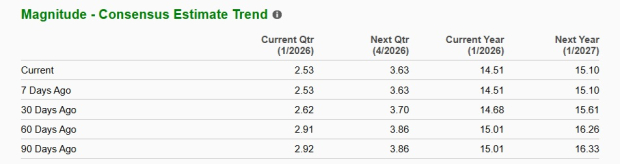
Image Source: Zacks Investment Research
The Zacks Consensus Estimate for Lowe’s fiscal 2025 sales and EPS implies growth of 2.9% and 2.2%, respectively, from the year-ago period’s actuals. For fiscal 2026, the consensus estimate indicates an 8.7% rise in sales and 6.2% growth in EPS. The consensus estimate for EPS for fiscal 2025 and 2026 has fallen by 1 cent and 10 cents to $12.26 and $13.01, respectively, in the past 30 days.
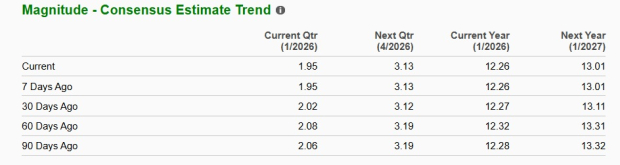
Image Source: Zacks Investment Research
Price Performance & Valuation of HD & LOW
In the past six months, Home Depot’s shares have declined 3.9%, significantly lagging Lowe’s, which climbed 10%.
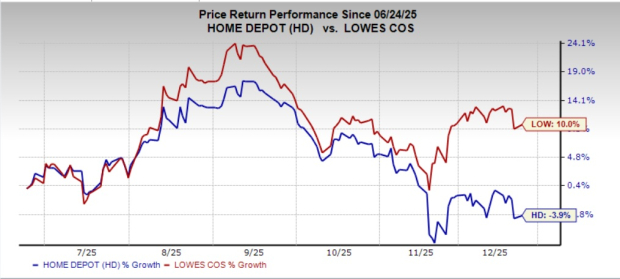
Image Source: Zacks Investment Research
From a valuation standpoint, Home Depot is trading at a forward 12-month price-to-earnings (P/E) ratio of 23.03X, below its one-year median of 24.00X. Meanwhile, Lowe’s forward P/E ratio stands at 18.72X, above its median of 18.62X.
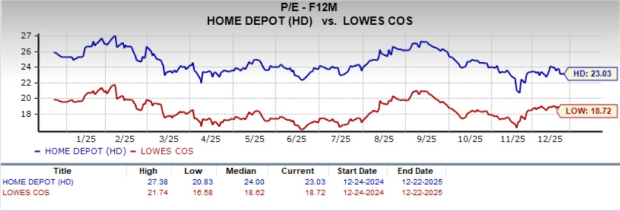
Image Source: Zacks Investment Research
Conclusion
The contrast between Home Depot and Lowe’s reflects two distinct but credible paths in adopting advanced technology. Home Depot is reinforcing its leadership by integrating intelligence into execution, logistics and professional services, while Lowe’s is reshaping its operating model around a more unified, intelligence-driven framework. In an increasingly complex retail environment, both approaches underscore that smart, scalable technology is now central to competitiveness. Ultimately, the long-term winner will be the company that most effectively embeds AI into everyday decision-making, translating insight into consistent customer value and sustainable growth.
While Lowe’s carries a Zacks Rank #3 (Hold) at present, Home Depot has a Zacks Rank #4 (Sell).
You can see the complete list of today’s Zacks #1 Rank (Strong Buy) stocks here.
Want the latest recommendations from Zacks Investment Research? Today, you can download 7 Best Stocks for the Next 30 Days. Click to get this free report
Lowe's Companies, Inc. (LOW): Free Stock Analysis Report
The Home Depot, Inc. (HD): Free Stock Analysis Report
This article originally published on Zacks Investment Research (zacks.com).
Mentioned In This Article
Latest News
| 10 hours | |
| 13 hours | |
| Oct-16 | |
| Oct-15 | |
| Oct-15 | |
| Oct-15 | |
| Oct-15 | |
| Oct-15 | |
| Oct-15 | |
| Oct-15 | |
| Oct-15 | |
| Oct-15 | |
| Oct-14 | |
| Oct-13 | |
| Oct-12 |
