Interactive Brokers vs. RJF: Which Brokerage Has the Edge Today?
Despite having completely different operating models, Interactive Brokers Group IBKR and Raymond James Financial RJF are two prominent brokerage firms that generate revenues from trading-related activity and client accounts. Since both firms emphasize risk management, regulatory compliance and disciplined capital allocation, they have been able to navigate periods of market volatility and maintain investor confidence.
However, both firms represent two different approaches to winning in the financial services arena, making them a compelling face-off for investors. IBKR is a technology-driven brokerage known for low costs, global market access, and appeal to active and institutional traders, while RJF is a more traditional, advisor-led firm built around long-term client relationships and diversified wealth management services.
Comparing these two firms highlights the trade-off between scale and automation versus stability and relationship-based growth. Thus, in an evolving trading market, let us find out which of the two offers better upside potential. In order to understand this, it is important to break down their fundamentals, financial performance and growth prospects.
The Case for Interactive Brokers
IBKR’s greatest strength in the brokerage space stems from its deep, multi-asset global market access, which remains unmatched by most retail and even many institutionally focused competitors. The firm enables clients to trade across more than 160 markets, dozens of currencies and a wide range of asset classes, including equities, options, futures, foreign exchange, bonds and funds, from a single unified platform.
At the beginning of this month, IBKR announced that eligible clients outside of Brazil can now trade Brazilian equities through B3, the Brazil Stock Exchange. Also, it announced the introduction of United Arab Emirates equities through two leading exchanges. A few months ago, the company launched zero-commission U.S. stock trading in Singapore and NISA accounts to help Japanese investors build wealth tax-free. IBKR has continuously been undertaking such initiatives to enhance its global presence.
This global breadth not only differentiates IBKR from brokers that are predominantly U.S.-centric, but also positions it as the preferred choice for sophisticated investors, hedge funds, proprietary traders and internationally active retail clients. Further, the company has been emphasizing developing proprietary software to automate broker-dealer functions, leading to a steady rise in revenues. Over the last five years (2019-2024), total net revenues witnessed a compound annual growth rate (CAGR) of 21.8%, with the upward momentum continuing in the first nine months of 2025.
IBKR also has a robust Daily Average Revenue Trades (DARTs) number, which, along with a favorable trading backdrop, is expected to keep driving the top line. The company’s continued product diversification efforts are expected to strengthen its market share amid stiff competition and help diversify operations.
In October 2025, IBKR launched the Karta Visa card for its clients to make purchases globally with a card linked to their IBKR account. In August, it introduced Connections, a feature designed to help investors discover trading opportunities and evaluate investments by highlighting related ideas across global markets. Also, it has pioneered nearly 24-hour overnight trading on U.S. stocks and ETFs, launched commission-free IBKR Lite, and introduced the Impact Dashboard for sustainable investing. Other notable launches include the IBKR Desktop platform and low-cost cryptocurrency trading through Paxos Trust Company.
The Case for Raymond James
RJF has always focused on providing personalized, comprehensive financial solutions tailored to a wide range of financial goals. The company delivers value through diversified revenue streams that include advisory and management fees, commissions from trades and interest income from lending activities.
In an intensely competitive environment, most of Raymond James' businesses are performing relatively well. The Private Client Group segment has been one of the best performers. Net revenues in the segment witnessed a CAGR of 11.4% over the last four fiscal years (2021-2025).
RJF has accomplished several opportunistic deals over the past years, which have helped it expand into Europe and Canada. In October 2025, it announced the acquisition of a majority interest in GreensLedge Holdings to strengthen its capital markets platform. In May 2024, the company announced that it forayed into the lucrative private credit business through a partnership with Eldridge Industries. In fiscal 2023, Raymond James acquired Canada-based Solus Trust Company Limited. In fiscal 2022, it acquired SumRidge Partners, TriState Capital Holdings and the U.K.-based Charles Stanley Group PLC. In fiscal 2021, it acquired Cebile Capital and a boutique investment bank, Financo. These deals, along with several past ones, have positioned Raymond James well for growth.
The company’s investment banking (IB) fees (in the Capital Markets segment) declined 4% year over year in fiscal 2022 and 41% in fiscal 2023, with subdued M&A activity. Nonetheless, the trend reversed in fiscal 2024 and fiscal 2025, with IB fees growing 7% and 26%, respectively, as clarity on several macroeconomic matters and interest rate cuts globally drove deal-making activities. RJF will likely continue to witness a solid improvement in IB fees going forward, driven by a healthy pipeline and active M&A market.
Supported by a robust capital position, Raymond James has been enhancing shareholder value through efficient capital deployments. The company has a record of regularly raising dividends over the last decade. The last dividend hike of 8% was announced in December 2025. In the same month, RJF authorized the repurchase of shares worth up to $2 billion.
IBKR & RJF: Price Performance, Valuation & Other Comparisons
In the past six months, shares of Interactive Brokers have gained 19.4%, whereas the RJF stock has rallied 7.8%. Hence, in terms of investor sentiments, IBKR has the edge.
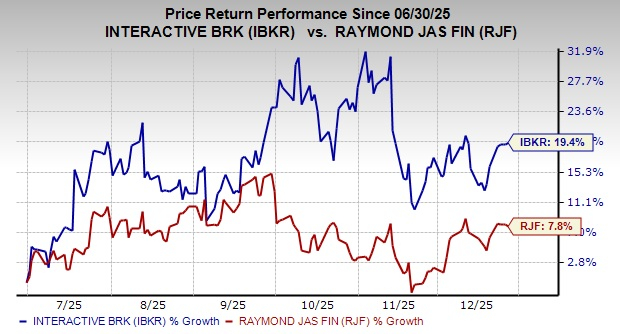
Image Source: Zacks Investment Research
Valuation-wise, IBKR is currently trading at a 12-month forward price-to-earnings (P/E) of 29.68X. The RJF stock, conversely, is trading at a P/E (F12M) of 13.42X. Thus, Raymond James is relatively inexpensive compared with Interactive Brokers.
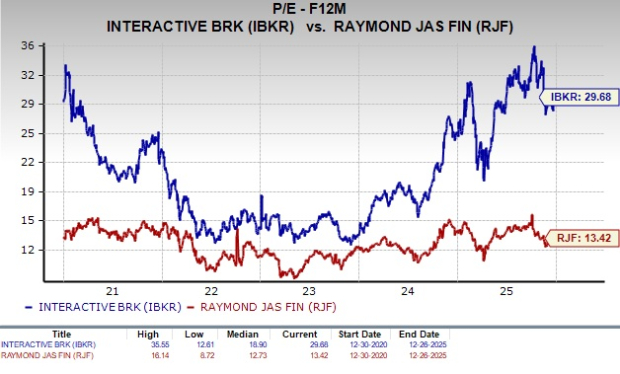
Image Source: Zacks Investment Research
IBKR’s return on equity (ROE) of 5.03% is way below RJF’s 18.19%. This reflects that Raymond James uses shareholder funds more efficiently to generate profits than Interactive Brokers.
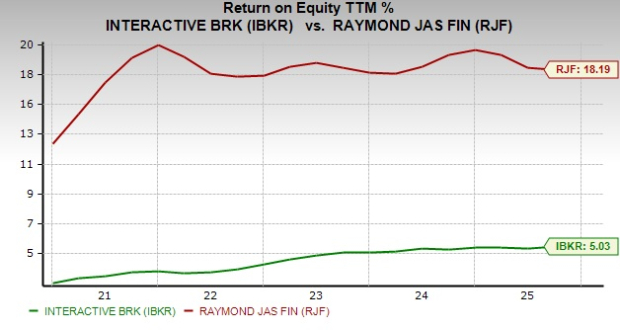
Image Source: Zacks Investment Research
Interactive Brokers & RJF’s Earnings & Sales Prospects
The Zacks Consensus Estimate for IBKR’s 2025 and 2026 revenues is pegged at $5.94 billion and $6.27 billion, respectively. These estimates imply year-over-year growth rates of 13.7% and 5.7%.
The Zacks Consensus Estimate for IBKR’s 2025 earnings is pegged at $2.06, which indicates year-over-year growth of 17.1%. Earnings estimate for 2026 of $2.23 indicates 8.1% growth. Over the past 60 days, estimates for both 2025 and 2026 have been revised upward.
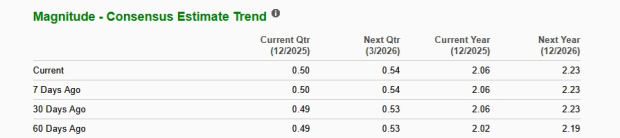
Image Source: Zacks Investment Research
On the contrary, the Zacks Consensus Estimate for RJF’s current-fiscal-year and next-year revenues is pegged at $15.41 billion and $16.65 billion, implying year-over-year growth rates of 9.6% and 8%, respectively.
The consensus estimate for RJF’s fiscal current-year earnings is $11.87, which indicates 11.4% year-over-year growth. For the next fiscal year, earnings estimate is pegged at $13.68, which implies a year-over-year rally of 15.3%. Earnings estimates for the current fiscal year have been revised higher and that for the next fiscal year has been unchanged over the past 60 days.
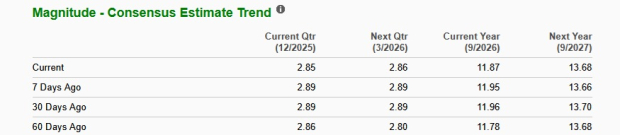
Image Source: Zacks Investment Research
Thus, while IBKR and RJF have encouraging revenue growth expectations, it seems that analysts are more optimistic regarding IBKR’s earnings growth potential.
IBKR or Raymond James: Which Stock Offers Better Upside?
Interactive Brokers remains a dominant, tech-driven brokerage, favored by professional and institutional investors. Its global reach, low-cost model and powerful trading tools continue to support consistent revenue growth. Its innovation in areas like Forecast Contracts, GlobalTrader and IBKR Desktop is impressive.
Conversely, Raymond James’ organic and inorganic growth efforts to diversify operations, along with its robust balance sheet, will keep aiding financials. Its differentiated revenue streams provide stability in less volatile markets. Since RJF has a more favorable valuation compared with IBKR, Raymond James seems like an attractive option for more conservative investors. A better ROE is another positive for the company.
However, although IBKR has a premium valuation, the company remains well-positioned for growth in the current volatile operating environment, supported by its strong technological capabilities and diversified product offerings. Analysts’ bullish sentiments add another layer of optimism. Thus, for those focused on long-term potential, Interactive Brokers appears to be a better option now.
At present, both Interactive Brokers and Raymond James carry a Zacks Rank #3 (Hold). You can see the complete list of today’s Zacks #1 Rank (Strong Buy) stocks here.
Want the latest recommendations from Zacks Investment Research? Today, you can download 7 Best Stocks for the Next 30 Days. Click to get this free report
Interactive Brokers Group, Inc. (IBKR): Free Stock Analysis Report
Raymond James Financial, Inc. (RJF): Free Stock Analysis Report
This article originally published on Zacks Investment Research (zacks.com).
Mentioned In This Article
Latest News
| Oct-13 | |
| Oct-13 | |
| Oct-12 | |
| Oct-12 | |
| Oct-08 | |
| Oct-08 | |
| Oct-08 | |
| Oct-05 | |
| Oct-02 | |
| Oct-01 | |
| Oct-01 | |
| Oct-01 | |
| Sep-29 | |
| Sep-25 | |
| Sep-24 |
