QuantumScape vs. SES AI: Which Battery Stock Looks Better Now?
QuantumScape Corp. QS and SES AI Corp. SES are both competing to shape the next generation of lithium-based batteries, but their strategies differ sharply.
QuantumScape is focused squarely on fully solid-state batteries for electric vehicles (EVs), aiming to improve energy density, charging speed and safety compared with today’s lithium-ion technology. SES AI, by contrast, is pursuing a lithium-metal approach supported by artificial intelligence (AI), positioning itself as both a battery developer and an AI-driven materials platform. Its ambitions stretch beyond EVs into areas such as energy storage, drones and robotics.
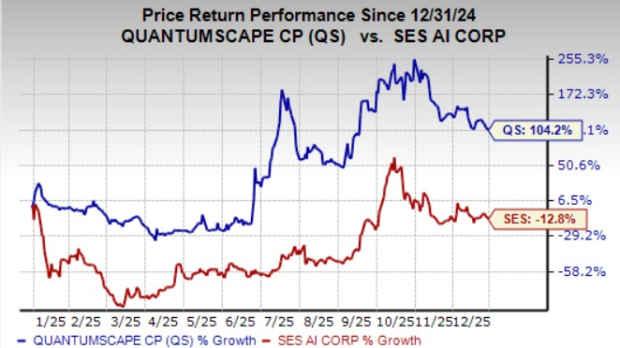
QuantumScape shares are up about 104% year to date, while SES AI has fallen roughly 13%, reflecting very different investor expectations and confidence levels. Let’s take a closer look at the fundamentals, technology progress and execution risks at both companies to assess which stock currently offers a better opportunity in the battery landscape.
The Case for QuantumScape
QuantumScape has become one of the most closely watched names in the solid-state battery race. The company is betting on a fully solid-state design that could deliver lighter batteries, faster charging, longer life, and much lower safety risks than today’s lithium-ion packs. For electric vehicles, the combination represents a breakthrough.
In June 2025, QuantumScape reached an important milestone with the launch of its Cobra manufacturing process for solid-state separators. Cobra is a major upgrade from the earlier Raptor system. It is roughly 25 times faster and far more compact, making it better suited for large-scale, cost-efficient production. It shipped its final Raptor-based B0 samples in the second quarter and began delivering B1 samples produced with Cobra in the third quarter. Several leading automakers are now evaluating these new cells, signaling growing confidence in the technology.
Momentum was further highlighted at the IAA Mobility show in Munich. QuantumScape and Volkswagen’s PowerCo demonstrated the world’s first real-world use of anode-free solid-state lithium-metal batteries. The QSE-5 cells powered Ducati’s V21L electric motorcycle and delivered strong performance, including 844 Wh/L energy density and ultra-fast charging from 10% to 80% in just over 12 minutes.
Partnerships remain central to QuantumScape’s strategy. In July, Volkswagen’s PowerCo agreed to provide up to $131 million in milestone-based payments over the next two years to support the QSE-5 pilot line in San Jose, following an earlier $130 million licensing deal. Beyond Volkswagen, the company signed a new joint development agreement with two major global automakers. It also deepened collaborations with Corning and Murata to scale ceramic separator production. Meanwhile, its Eagle Line pilot facility continues to advance, with most high-volume equipment now installed.
Financially, QuantumScape recorded $12.8 million in customer billings for the first time in the third quarter — a small but meaningful step toward commercialization. With rising OEM interest and tangible manufacturing progress, the company appears closer to turning solid-state batteries into a commercial reality.
The Zacks Consensus Estimate for 2025 and 2026 loss per share has narrowed over the past 90 days.

The Case for SES AI
SES is taking a different route in the battery race. Instead of focusing only on hardware, the company is blending lithium-metal batteries with artificial intelligence. That combination is central to its long-term story.
On the technology side, SES focuses on lithium-metal batteries, which offer higher energy density than conventional lithium-ion cells. While this makes them attractive for electric vehicles, drones, and energy storage, lithium-metal batteries remain difficult to manufacture at scale, especially for automotive applications, and SES is still in the early stages of commercialization.
The company’s Molecular Universe (MU) platform uses AI to discover and optimize battery materials. The latest versions, MU-1 and MU-1.5, aim to shorten material discovery timelines dramatically. SES plans to monetize MU through software subscriptions, materials supply and battery products. While this creates multiple revenue paths, it also adds complexity and relies heavily on customer adoption of new software tools.
SES is also broadening its addressable market. The acquisition of UZ Energy marks its entry into the energy storage systems (ESS) space, giving it exposure to Europe, Australia and Asia. By combining UZ’s hardware and marketing reach with its AI-driven material discovery, SES is positioning itself to grab a slice of a $300 billion ESS opportunity. The company must successfully merge UZ’s hardware business while proving that its AI-driven material advantages translate into real ESS sales.
Partnerships add another layer to the strategy. Its joint venture with Hisun New Materials supports the commercial supply of AI-discovered materials. Meanwhile, collaboration with Top Materials aims to expand cell manufacturing in Korea targeting drones and urban air mobility, including compliance with U.S. defense requirements. SES plans to nearly triple capacity at its Chungju plant to about one million AI-enabled cells annually. Even so, scaling lithium-metal batteries from lab-scale to large pilot production for automotive OEMs remains a key challenge.
Financially, SES AI is still early but showing traction. Revenues reached $16.4 million in the first nine months of 2025, with a $20–$25 million full-year target. With $214 million in cash, it has room to invest. Still, execution, scaling and cash burn remain key risks for investors.
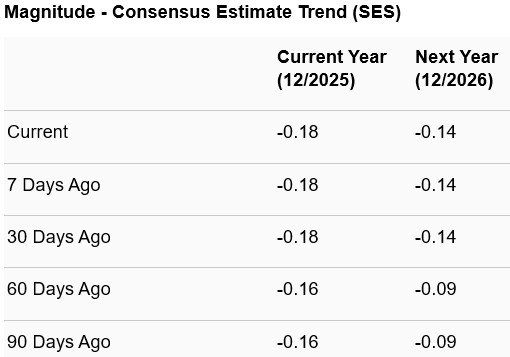
The Zacks Consensus Estimate for 2025 and 2026 loss per share has widened over the past 90 days.
QS Holds an Edge Over SES
At this stage, the choice between the two stocks comes down to execution visibility and risk. SES AI is trying to do many things at once, spanning batteries, AI software, materials, and energy storage. Though it creates long-term potential, it increases execution risk when revenues are still limited.
QuantumScape’s strategy is more focused on bringing a single solid-state battery architecture to market. Its recent manufacturing upgrades, structured customer testing, and continued OEM financial support suggest a clearer path from development to scale.
While solid-state batteries remain a long-term bet, QuantumScape’s path forward is easier to track today. With a Zacks Rank #3 (Hold), QS looks like the better option for investors seeking exposure to next-generation batteries compared with SES AI, which is #4 Ranked (Sell).
You can see the complete list of today’s Zacks #1 Rank (Strong Buy) stocks here.
Want the latest recommendations from Zacks Investment Research? Today, you can download 7 Best Stocks for the Next 30 Days. Click to get this free report
SES AI Corporation (SES): Free Stock Analysis Report
QuantumScape Corporation (QS): Free Stock Analysis Report
This article originally published on Zacks Investment Research (zacks.com).
Mentioned In This Article
Latest News
| Oct-22 | |
| Oct-22 | |
| Oct-22 | |
| Oct-22 | |
| Oct-21 | |
| Oct-21 | |
| Oct-21 | |
| Oct-19 | |
| Oct-08 | |
| Oct-08 | |
| Oct-08 | |
| Sep-30 | |
| Sep-29 | |
| Sep-28 | |
| Sep-28 |
