Nvidia's $65 Billion Forecast Sends a Clear Message About the AI Boom
Key Points
The artificial intelligence industry has seen rapid growth, leading to speculation that the AI sector may be in a bubble.
Nvidia has been generating strong sales of its AI accelerators, and expects that to continue in its fiscal 2026 Q4 with estimated revenue of $65 billion.
According to Nvidia's CEO, major platform shifts in technology are driving the AI sector's growth.
The artificial intelligence (AI) sector has expanded rapidly since ChatGPT creator OpenAI unleashed its AI chatbot near the end of 2022. But after several years of phenomenal growth, some onlookers have grown concerned that the entire AI sector, and the stocks of the businesses dependent on the tech, could be in a bubble.
What might be in store for the AI industry in 2026? One way to gauge its outlook would be to examine semiconductor chip leader Nvidia (NASDAQ: NVDA).
Where to invest $1,000 right now? Our analyst team just revealed what they believe are the 10 best stocks to buy right now, when you join Stock Advisor. See the stocks »
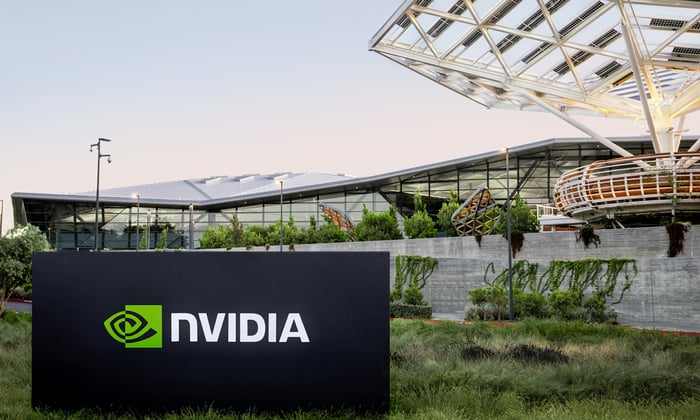
Image source: Nvidia.
A look at Nvidia's Q4 forecast
Nvidia is predicting that in its current quarter -- fiscal 2026 Q4 -- its revenue will hit $65 billion. But what are the implications of that forecast for the AI space more broadly?
First, a bit of context. Nvidia demonstrated once again why it's a leader in the AI sector when it released its fiscal Q3 results. For the period, which ended Oct. 26, it booked record revenues of $57 billion, a 62% year-over-year increase.
With that for context, its forecast for $65 billion in fiscal Q4 sales shows its revenue growth is accelerating: It's guiding for a massive 65% jump from the prior-year period's revenue of $39.3 billion, which was a record at the time.
Nvidia's anticipated Q4 sales growth demonstrates that the stupendous demand for its data center solutions is not slowing down. "Demand for AI infrastructure continues to exceed our expectations," said CFO Colette Kress on the earnings call.
In fact, Nvidia's AI chip platforms, Blackwell and its successor, Vera Rubin (which is set to launch in the second half of 2026), are experiencing strong customer orders.
"We currently have visibility to half a trillion dollars in Blackwell and Rubin revenue from the start of this year through the end of calendar year 2026," Kress also said on the call.
Nvidia's rebuttal to the idea of an AI bubble
Given Nvidia's outsized success, it's no wonder the company's stock rose by about 39% in 2025. But that kind of speedy share price growth has contributed to the concerns about the valuations in the AI market.
CEO Jensen Huang directly addressed these concerns on the fiscal Q3 call, stating: "There's been a lot of talk about an AI bubble. From our vantage point, we see something very different."
He went on to explain how AI is enabling three major platform shifts that will power industry growth for years to come. The first shift is that legacy technology is no longer sufficient and requires an upgrade. The computing sector was built largely around CPUs, but much of this older architecture must transition to accelerated computing to deliver the parallel processing horsepower needed in the AI age.
Next is the transition to the generative AI era ushered in by ChatGPT. Governments and businesses are pursuing this breakthrough technology, and figuring out how best to employ it.
Finally, the emergence of agentic AI alongside real-world applications -- dubbed physical AI, and encompassing robots and self-driving vehicles -- is just getting started. This level of AI usage, according to Huang, "will be revolutionary, giving rise to new applications, companies, products and services."
Are Nvidia and AI destined for multiyear prosperity?
Huang's viewpoint is backed up by the performance of other AI businesses. For instance, OpenAI's weekly user base has grown to 800 million in 2025. That's an incredible increase from the 300 million users it had at the end of 2024.
News reports note that AI company Anthropic is projecting an annualized revenue run rate of $9 billion for 2025, up from $1 billion at the start of the year. And it is said to be expecting its run rate to skyrocket to as much as $26 billion in 2026.
These examples explain why AI industry forecasts predict years of spectacular growth. According to a report from United Nations Trade and Development, the global AI market could expand by a whopping 25-fold within a decade, from $189 billion in 2023 to $4.8 trillion by 2033. That kind of forecast underscores Huang's perspective and supports the idea that the AI boom is poised to continue.
Not all businesses touting AI capabilities are going to succeed over the long term. But in Nvidia's case, it has positioned itself to be a central player in the AI industry, with strategic investments in the likes of OpenAI and Anthropic, in addition to ongoing advances in its AI offerings, as illustrated by its upcoming Vera Rubin processors.
Consequently, Nvidia is one of the businesses likely to enjoy sustained prosperity as technology inexorably moves toward an AI-powered world.
Should you buy stock in Nvidia right now?
Before you buy stock in Nvidia, consider this:
The Motley Fool Stock Advisor analyst team just identified what they believe are the 10 best stocks for investors to buy now… and Nvidia wasn’t one of them. The 10 stocks that made the cut could produce monster returns in the coming years.
Consider when Netflix made this list on December 17, 2004... if you invested $1,000 at the time of our recommendation, you’d have $490,703!* Or when Nvidia made this list on April 15, 2005... if you invested $1,000 at the time of our recommendation, you’d have $1,157,689!*
Now, it’s worth noting Stock Advisor’s total average return is 966% — a market-crushing outperformance compared to 194% for the S&P 500. Don't miss the latest top 10 list, available with Stock Advisor, and join an investing community built by individual investors for individual investors.
*Stock Advisor returns as of January 3, 2026.
Robert Izquierdo has positions in Nvidia. The Motley Fool has positions in and recommends Nvidia. The Motley Fool has a disclosure policy.
Mentioned In This Article
Latest News
| 1 hour | |
| 1 hour | |
| 1 hour | |
| 1 hour | |
| 2 hours | |
| 3 hours | |
| 3 hours | |
| 3 hours | |
| 4 hours | |
| 4 hours | |
| 4 hours | |
| 4 hours | |
| 5 hours | |
| 5 hours | |
| 6 hours |
