After a 47% Run in 2025, is the VALE Stock Still a Buy in 2026?
Vale S.A VALE shares gained 46.9% in the past year, outperforming the broader Zacks Basic Materials sector’s 29.2% growth and the S&P 500’s climb of 16.8%.
VALE’s YTD Price Performance vs. Sector & S&P
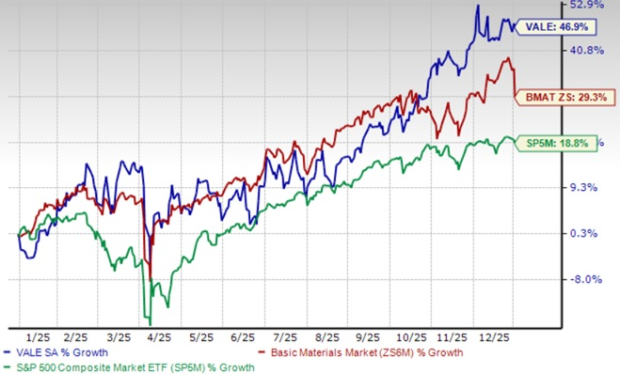
Image Source: Zacks Investment Research
Vale has also outpaced iron miners like Rio Tinto Group RIO, Fortescue Ltd FSUGY and BHP Group Limited BHP, which have gained 36.1%, 29.1% and 23.6% respectively. in the past year.
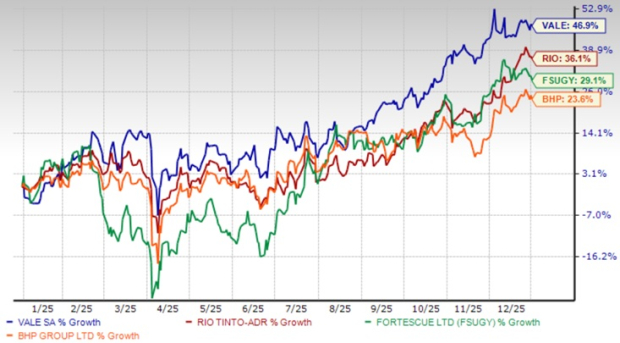
Vale shares are trading above both the 50-day and 200-day moving averages, signaling a sustained bullish trend.
VALE's Price Movement vs. 50-Day & 200-Day Moving Averages
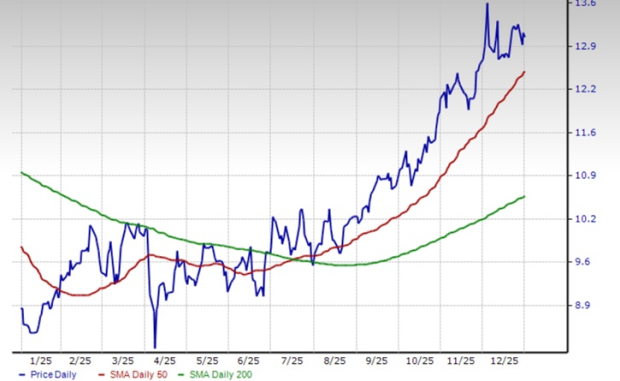
Image Source: Zacks Investment Research
While the rally in the VALE stock may tempt investors, it is important to assess the underlying drivers and their sustainability, as well as the company’s growth prospects and potential risks, before making any investment decision.
Vale’s 2025 Production Hits Top End of Management Guidance
Vale recently stated that iron ore production for 2025 was around 335 Mt, at the higher end of its targeted 325-335 Mt. Copper output was around 370 kt in 2025, also meeting the high end of its targeted 340-370 kt. Nickel output was reported at 175 kt compared with the company’s target of 160-175 kt.
Vale’s Project Pipeline Underpins Multi-Year Growth Outlook
The company has budgeted capital expenditure for the Iron Ore Solutions Business at $4 billion in 2026 and $3.9 billion from 2027 onward. The company plans to increase its iron ore production capacity to 335-345 Mt in 2026 and 360 Mt by 2030.
The Vargem Grande 1 (VGR1) project and the Capanema Maximization project are expected to play a key role in attaining these targets. The VGR1 project is expected to add 15 Mtpy (metric tons per year) of iron ore capacity, with 11 Mt targeted in 2026. Ramp up is expected to be concluded in the second half of 2026.
The first shipment of the Capanema project was made in the second quarter of 2025. The project will add 15 Mtpy of net iron ore capacity, with ramp-up completion expected in the second quarter of 2026. Other approved projects are Compact Crushing at S11D (capacity: 50 Mtpy, start-up in the second half of 2026) and Serra Sul (capacity: 20 Mtpy and start-up in the second half of 2026).
Vale’s Focus on Energy Transition Metals Add to Long-Term Story
Vale is also investing heavily in the base metals business to benefit from the global energy transition. The company’s capex plans for the business are $1.6 billion in 2026 and $2 billion from 2027 onward.
In 2026, Vale's copper production is expected between 350 kt and 380 kt, and reach 420-500 kt as of 2030 and 700 kt by 2035. With these projections, Vale promises a 7% CAGR over 2024-2035 versus the 4% average for peers.
The Bacaba project will extend the life of the Sossego Mining Complex, contributing an average annual copper output of 50 ktpy over an eight-year mine life. Production is expected to start in the first half of 2028. Other projects, such as Salobo Coarse Particle Flotation (CPF), Alemão and Cristalino, will increase Vale’s copper production capacity.
Vale recently signed an agreement with Glencore Canada (“Glencore”) to jointly evaluate a potential brownfield copper development project at their adjacent properties in the Sudbury Basin, with an expected start-up in 2030. Vale plans to hit 700 kt levels by 2035, primarily through the accelerated development of assets in the North and South hubs in the Carajás region.
For 2026, Vale expects its nickel production between 175 kt and 200 kt, reflecting replenishment projects in Canada, exposure to Pomalaa and Morowali, and the start-up of the second furnace at Onça Puma. For 2030, nickel production is anticipated at 210-250 kt, with input from projects such as Thompson Ultramafics, Sorowako HPAL, partnership projects and offtake.
Vale’s Cost Focus Driving Competitiveness in All Businesses
Fixed costs are 60-70% of its total costs. From levels of $6.3 billion a few years ago, the company has managed to lower it to $5.8 billion of fixed costs in 2025 and is targeting $5.7 billion for next year.
Over 2023-2025, it has managed to lower costs by 6% in its iron business, 6% in the copper business and 16% in the nickel business.
VALE’s Earnings Estimates Indicate Y/Y Growth, Trend Upward
The Zacks Consensus Estimate for Vale’s fiscal 2025 earnings is pegged at $2.00 per share, indicating 9.9% year-over-year growth. The estimate for fiscal 2026 is at $2.02, suggesting a 1.25% rise.
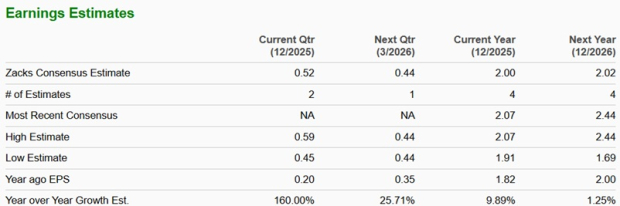
Image Source: Zacks Investment Research
The Zacks Consensus Estimate for fiscal 2025 and 2026 has moved north over the past 60 days.
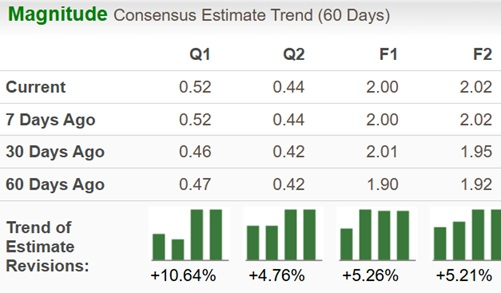
Image Source: Zacks Investment Research
Supportive Commodity Price Environment Ahead to Aid Vale
Iron ore prices have started 2026 on a strong note and are currently around $106 per ton, buoyed by strong demand and ongoing supply constraints in China. Steelmakers are restocking ahead of the Lunar New Year holiday in February, with tight domestic supplies lending support.
Going forward, rising steel demand, fueled by strong economic development and urbanization in India, Southeast Asia and the Middle East/North Africa, will lead to high demand for iron ore and support prices. In developed markets, reindustrialization and renewable energy infrastructure will aid demand.
Copper futures are currently at above $6 per pound, at record highs amid expectations of a further tightening in global supply this year. The long-term outlook for copper is positive as copper demand is expected to grow, partly driven by electric vehicles, and renewable energy and infrastructure investments.
Nickel prices have also gained lately as Indonesia, the world's top nickel producer, proposed a 34% reduction in nickel output to tackle growing concerns of oversupply. Nickel in electric vehicle batteries will become an increasingly important source of demand growth and boost prices in the future.
Vale’s Sector-Leading Dividend Yield, Higher Returns Add to Appeal
The company’s current dividend yield of 6.93% is higher than the sector’s 2.01% and the S&P 500’s 1.06%. Its payout rate is at 43.45%. Vale paid out $3.4 billion in dividends in 2025. The company recently announced dividends of $2.8 billion to be paid out in 2026, of which $1 billion will be paid out as extraordinary dividends.
VALE’s return on equity, a profitability measure of how prudently the company is utilizing its shareholders’ funds, is at 18.6%, higher than the sector’s average of 11.41%.
VALE’s Valuation Remains Attractive Versus Peers
The company is trading at a forward 12-month price/sales ratio of 1.48X at a discount to the sector’s 2.49X.
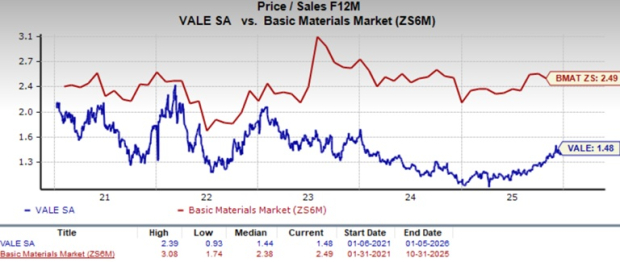
Image Source: Zacks Investment Research
The stock is also cheaper than Rio Tinto, Fortescue and BHP Group, which are trading at 1.83X, 3.00X and 3.09X, respectively.
Our Final Take on the VALE Stock
Vale is well-positioned for sustained growth, with iron ore demand set to benefit from global urbanization, copper and nickel supported by the energy transition, and a deep and high-quality project pipeline. Its cost discipline, sector-leading dividend yield, improving earnings outlook and attractive valuation strengthen the investment case. Backed by positive estimate revisions and a Zacks Rank #1 (Strong Buy), VALE stands out as a convincing buy for investors.
You can see the complete list of today’s Zacks #1 Rank stocks here.
Want the latest recommendations from Zacks Investment Research? Today, you can download 7 Best Stocks for the Next 30 Days. Click to get this free report
BHP Group Limited Sponsored ADR (BHP): Free Stock Analysis Report
VALE S.A. (VALE): Free Stock Analysis Report
Rio Tinto PLC (RIO): Free Stock Analysis Report
Fortescue Ltd. Sponsored ADR (FSUGY): Free Stock Analysis Report
This article originally published on Zacks Investment Research (zacks.com).
Mentioned In This Article
Latest News
| Oct-16 | |
| Oct-14 | |
| Oct-14 | |
| Oct-14 | |
| Oct-14 | |
| Oct-14 | |
| Oct-14 | |
| Oct-14 | |
| Oct-08 | |
| Oct-08 | |
| Oct-07 | |
| Oct-07 | |
| Oct-06 | |
| Oct-05 | |
| Oct-05 |
