UBER vs. BIDU: Which Stock Is Better Placed in the Promising AV Space?
The robotaxi market presents substantial growth opportunities. According to Statista, the global autonomous vehicle (“AV”) market is expected to rise from approximately $106 billion in 2021 to more than $2.3 trillion by 2030. This rapidly growing and highly attractive sector has drawn the interest of companies such as China-based Baidu BIDU and San Francisco-headquartered ride-hailing giant Uber Technologies UBER. Below, we analyze and compare the autonomous vehicle strategies of both firms.
Uber’s Autonomous Vehicle Strategy
Uber aims to establish a strong foothold in the robotaxi space through a partnership-focused approach. By working with third-party autonomous technology developers, the company sidesteps the heavy research and development costs required to build proprietary self-driving systems. Although Uber sold its autonomous driving division in 2020, it continues to pursue the broader vision of becoming a comprehensive mobility super app. Its AV strategy follows a hybrid model that combines human drivers with autonomous vehicles, robotics and external AV partners, allowing for greater operational adaptability.
The company has signed several strategic partnerships that demonstrate its commitment to incorporating advanced autonomous solutions into its platform. This collaboration-driven model allows Uber to remain active in the robotaxi ecosystem without shouldering the substantial capital investments and R&D expenses typically associated with autonomous technology development.
Uber’s dominant position in the global ride-hailing market further enhances its competitive advantage. Supported by a vast network of riders and drivers, the company is well-equipped to scale autonomous services quickly once the technology reaches broader commercial readiness. Its platform is designed to integrate vehicles from multiple AV partners, ensuring a smooth and flexible user experience.
Uber’s autonomous initiatives are increasingly showing tangible progress through scalable deployments across multiple markets. Despite ongoing regulatory and macroeconomic hurdles, the company’s ability to grow the core mobility and delivery segments alongside automation efforts strengthens its long-term growth prospects. Additionally, Uber is focusing on suburban and lower-density regions, where autonomous vehicles could help generate incremental demand.
Examining Baidu’s Position in the Robotaxi Market
Baidu is a key player in the robotaxi sector. Even though most of its advancements are currently centered in China, the company is gradually taking the operations global. The country is quickly becoming a global hub for autonomous driving, with local companies testing self-driving vehicles in a wide range of real-world settings — from crowded metropolitan areas like Beijing to less dense suburban and regional routes.
Baidu’s Apollo Go platform already offers fully driverless robotaxi services in major cities such as Beijing, Wuhan and Shenzhen, while also expanding internationally into locations including Dubai and Switzerland. With operations spanning more than 20 cities and broad, fully driverless coverage across key areas of mainland China, Baidu has achieved a scale and level of operational depth that few global competitors can match.
The company has also partnered with Uber, reinforcing its ambitions in the autonomous vehicle space. Under an agreement signed last year, Baidu plans to deploy its driverless vehicles on Uber’s platform in select markets across Asia and the Middle East.
This partnership combines Baidu’s advanced artificial intelligence and autonomous driving expertise with Uber’s extensive global ride-hailing infrastructure, offering a clear avenue to expand robotaxi services beyond China.
How Do UBER And BIDU’s Key Metrics Stack Up?
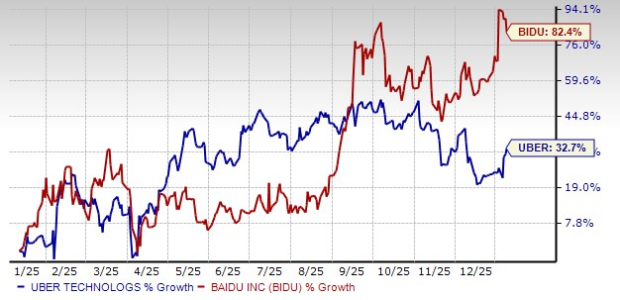
Shares of UBER have gained in excess of 32% over the past year. BIDU’s shares have performed even better, gaining in excess of 82% in the same time frame.
1-Year Price Comparison
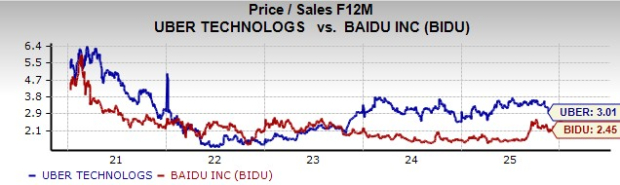
Baidu trades at a forward price-to-sales ratio of 2.45X compared with Uber’s 3.01X. Baidu currently carries a Value Score of C, while Uber holds a Value Score of D. This valuation gap reflects the fact that Uber’s scale and business diversity are largely priced in at current levels, while Baidu’s more focused exposure provides a modest valuation edge.
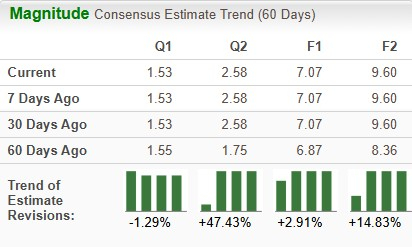
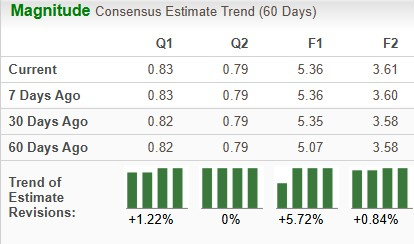
Baidu’s earnings outlook for 2026 is brighter than Uber’s. This can be seen by the fact that the Zacks Consensus Estimate for 2026 has seen a double-digit percentage upward revision over the past 60 days for BIDU compared with the marginal upward revision for UBER.
BIDU's Earnings Estimate Revisions
UBER's Earnings Estimate Revisions
End Note
Both Baidu and Uber carry a Zacks Rank #3 (Hold) at present. You can see the complete list of today’s Zacks #1 Rank (Strong Buy) stocks here.
China is emerging as a major force in the field of autonomous driving. Companies such as Baidu have already tested self-driving vehicles in a wide range of environments, from congested city streets in Beijing to calmer suburban areas. They are now moving to the next phase — deploying robotaxi fleets not only within China, but internationally. In the near future, people in cities throughout the Middle East, Europe and Southeast Asia will be able to book driverless rides directly from their smartphones.
Baidu stands at the forefront of this transformation, supported by expanding fleets, cutting-edge technology and strong global partnerships. Through these efforts, the company is helping to turn robotaxis from a futuristic idea into a practical mode of transportation worldwide.
Even though Uber’s AV ambitions are commendable, Baidu’s favorable valuation picture, brighter 2026 earnings outlook and better price performance place the Chinese company on a more solid footing than the former.
Based on our analysis, we can safely conclude that Baidu emerges as a winner and appears to be a better investment option than Uber at the moment.
Want the latest recommendations from Zacks Investment Research? Today, you can download 7 Best Stocks for the Next 30 Days. Click to get this free report
Baidu, Inc. (BIDU): Free Stock Analysis Report
Uber Technologies, Inc. (UBER): Free Stock Analysis Report
This article originally published on Zacks Investment Research (zacks.com).
Mentioned In This Article
Latest News
| 9 hours | |
| Oct-09 | |
| Oct-09 | |
| Oct-09 | |
| Oct-08 | |
| Oct-08 | |
| Oct-08 | |
| Oct-08 | |
| Oct-08 | |
| Oct-08 | |
| Oct-07 | |
| Oct-07 | |
| Oct-06 | |
| Oct-06 | |
| Oct-06 |
