Cadence & Microsoft Redefine Data Center Memory With Advanced Solutions
Cadence Design Systems Inc. CDNS recently announced the development of the industry’s first LPDDR5X 9600Mbps memory IP system solution for enterprise and data center applications, in collaboration with Microsoft MSFT. This represents a major inflection point in memory architecture evolution. The solution combines Cadence’s LPDDR5X IP with Microsoft’s RAIDDR error correction code (ECC) technology to deliver high performance, low power efficiency and strong reliability. Microsoft is the first customer to adopt this system.
As AI infrastructure expands, LPDDR5X is increasingly used in data centers for its energy efficiency and strong performance in AI and HPC workloads. However, hyperscalers have so far had to trade off power, performance and area benefits against the higher reliability and serviceability of DDR5. Built on production-proven LPDDR5X IP and enhanced by Microsoft’s RAIDDR ECC, the solution brings enterprise-class RAS capabilities to low-power memory systems without compromising performance, power, or area (PPA).
This innovation enables data center architects to deploy LPDDR5X at scale while maintaining the reliability levels required for mission-critical workloads. At the core of this breakthrough is Microsoft’s RAIDDR ECC coding schema, a next-generation error correction algorithm designed specifically for enterprise DRAM deployments. RAIDDR delivers reliability approaching single device data correction (SDDC), offering industry-leading fault detection and correction with minimal logic overhead.
Key Technical Capabilities of CDNS’ LPDDR5X 9600Mbps System
Cadence’s LPDDR5X 9600Mbps system solution offers a robust set of features tailored for enterprise and hyperscale deployments. It supports 40-bit LPDDR5X channels, delivers 9600 Mbps performance with low power use and offers enterprise-grade RAS with DDR5-style symbol-based ECC. It also includes sideband ECC for full channel bandwidth and a compact form factor for space-constrained systems.
Apart from LPDDR5X, Cadence offers one of the industry’s most comprehensive portfolios of silicon-proven, PPA-optimized IP for high-performance computing. Its offerings span LPDDR, DDR5 and HBM memory interfaces, PCIe, UCIe, UALink and high-speed Ethernet, Ultra Ethernet and chiplet-ready solutions, including 3D-IC support and Verification IP and system-level integration capabilities. This end-to-end approach allows customers to accelerate time-to-market while confidently scaling performance and reliability.
Notably, Cadence has already demonstrated its strategic roadmap with the introduction of LPDDR6 memory IP operating at 14.4Gbps in July 2025. This positions the company as a key enabler of next-generation memory subsystems for AI and HPC. Recently, it unveiled Chiplet Spec-to-Packaged Parts ecosystem, a decisive move to turn chiplets from a niche strategy into a mainstream design paradigm. The initiative addresses one of the biggest bottlenecks in chiplet adoption — engineering complexity and integration risk. By delivering a spec-driven, pre-integrated and standards-compliant chiplet platform, Cadence is positioning itself at the forefront of next-generation silicon systems.
Cadence Design Systems, Inc. Price and Consensus

Cadence Design Systems, Inc. price-consensus-chart | Cadence Design Systems, Inc. Quote
Cadence is gaining momentum from strong demand for its AI-focused solutions, supported by robust design activity across the semiconductor industry. Long-term trends such as 5G, hyperscale computing and autonomous driving are driving design wins, while the rapid rise of Generative, Agentic and Physical AI is sharply increasing computing needs and fueling innovation. To tap this growth, Cadence is working closely with major players like Qualcomm and NVIDIA on next-generation AI chips for both training and inference.
Its Cadence.AI portfolio, built on autonomous silicon agents and the JedAI platform powered by NVIDIA’s accelerated computing, is also opening doors to new markets such as life sciences through OpenEye drug discovery tools. Expanding collaborations with foundry partners like TSMC, Intel and Arm further strengthen its position, and rising customer R&D spending on AI automation should support future growth.
At the same time, Cadence faces mounting competitive pressure from rivals such as Synopsys and Siemens, which is weighing on pricing power and margins. Higher R&D spending, especially in verification and digital design, could further limit operating margin expansion. In addition, the company’s growing focus on AI increases its exposure to intense competition and the cyclical nature of AI infrastructure spending.
CDNS’ Zacks Rank & Stock Price Performance
CDNS currently has a Zacks Rank #2 (Buy). Shares of the company have gained 7.4% in the past year compared with the Zacks Computer-Software industry’s growth of 6.2%.
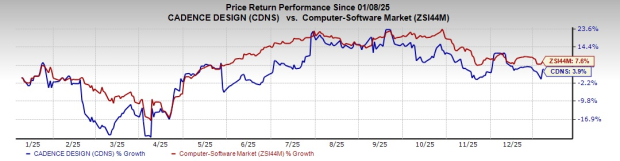
Image Source: Zacks Investment Research
Other Key Picks From the Computer and Technology Space
Some other top-ranked stocks from the broader technology space are Ubiquiti Inc. UI, Motorola Solutions MSI. UI sports a Zacks Rank #1 (Strong Buy), while MSI carries a Zacks Rank #2. You can see the complete list of today’s Zacks #1 Rank stocks here.
UI’s earnings beat the Zacks Consensus Estimate in each of the trailing four quarters, with the average surprise being 54.15%. In the last reported quarter, Ubiquiti delivered an earnings surprise of 39.52%. Its shares have surged 42.8% in the past year.
Motorola’s earnings beat the consensus estimate in each of the trailing four quarters, with the average surprise being 5.5%. MSI’s long-term earnings growth rate is 9.07%. Its shares have declined 15% in the past year.
Want the latest recommendations from Zacks Investment Research? Today, you can download 7 Best Stocks for the Next 30 Days. Click to get this free report
Microsoft Corporation (MSFT): Free Stock Analysis Report
Motorola Solutions, Inc. (MSI): Free Stock Analysis Report
Cadence Design Systems, Inc. (CDNS): Free Stock Analysis Report
Ubiquiti Inc. (UI): Free Stock Analysis Report
This article originally published on Zacks Investment Research (zacks.com).
Mentioned In This Article
Latest News
| 38 min | |
| 46 min | |
| 1 hour | |
| 1 hour | |
| 1 hour | |
| 1 hour | |
| 1 hour | |
| 2 hours | |
| 2 hours | |
| 3 hours | |
| 3 hours | |
| 4 hours | |
| 4 hours | |
| 11 hours | |
| Oct-05 |
