Does Chegg's B2B Focus Reduce Exposure to Traffic Volatility?
Chegg, Inc. CHGG is reshaping its business model to address rising uncertainty in student-driven online traffic. The company is shifting focus toward a business-to-business model, where revenues rely more on enterprise partnerships than on search-based student visits. This move aims to reduce exposure to traffic volatility that has weighed heavily on the legacy academic platform.
The core academic business has been under pressure due to the rapid adoption of generative Artificial Intelligence and changes in online search behavior. AI-powered tools now offer instant academic help, reducing the need for traditional study platforms. In addition, lower visibility on Google search has further weakened traffic trends. These factors have made the direct-to-consumer model less predictable and more dependent on external platforms.
In the third quarter of 2025, total revenues declined 42% year over year. The decline was caused by reduced traffic across legacy academic services and lower advertising-related revenues. The company indicated that the core academic segment recorded a revenue drop of more than 40% year over year in the third quarter of 2025. Legacy traffic fell by nearly 50% as of the third quarter of 2025, reflecting the combined impact of AI disruption and search-related challenges.
To counter this pressure, the company is prioritizing its B2B skilling operations, which serve enterprises and workforce partners. This model depends more on contracted relationships, seat-based usage and retention rather than search traffic, offering better revenue visibility and lower sensitivity to traffic swings. While risks remain, the B2B focus meaningfully reduces reliance on volatile consumer traffic and could help stabilize performance as digital education continues to evolve.
Chegg’s Competitive Position in the EdTech Market
Chegg operates in a highly competitive landscape, with renowned names like Duolingo, Inc. DUOL and Udemy, Inc. UDMY operating beside it in the ed tech market.
Duolingo dominates the language-learning niche with its gamified app and AI-driven engagement. With a strong mobile presence and daily user engagement, Duolingo has built a brand synonymous with accessible, bite-sized learning. On the other hand, Udemy operates across both consumer and enterprise markets, positioning its platform around professional skill development, AI enablement and workforce transformation. This dual exposure allows Udemy to participate in long-term learning trends while steadily improving revenue quality and visibility.
CHGG Stock’s Price Performance & Valuation Trend
Shares of this California-based education technology company have sunk 38.9% in the past six months, underperforming the Zacks Internet-Software industry, the Zacks Computer and Technology sector and the S&P 500 index.
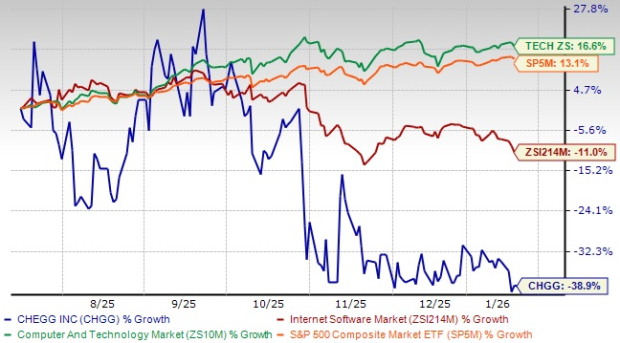
Image Source: Zacks Investment Research
CHGG stock is currently trading at a discount compared with the industry peers, with a forward 12-month price-to-sales (P/S) ratio of 0.33, as evidenced by the chart below.
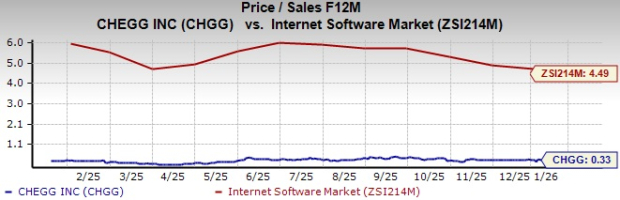
Image Source: Zacks Investment Research
Earnings Estimate Trend of CHGG
The 2026 earnings per share estimate has remained unchanged at 18 cents over the past 60 days. Earnings for 2026 are expected to grow a whopping 228.6%.

Image Source: Zacks Investment Research
Chegg currently carries a Zacks Rank #3 (Hold). You can see the complete list of today’s Zacks #1 (Strong Buy) Rank stocks here.
Want the latest recommendations from Zacks Investment Research? Today, you can download 7 Best Stocks for the Next 30 Days. Click to get this free report
Chegg, Inc. (CHGG): Free Stock Analysis Report
Duolingo, Inc. (DUOL): Free Stock Analysis Report
Udemy, Inc. (UDMY): Free Stock Analysis Report
This article originally published on Zacks Investment Research (zacks.com).
Mentioned In This Article
Latest News
| 3 hours | |
| Oct-07 | |
| Oct-06 | |
| Oct-05 | |
| Oct-01 | |
| Sep-29 | |
| Sep-23 | |
| Sep-18 | |
| Sep-09 | |
| Sep-02 | |
| Sep-01 | |
| Sep-01 | |
| Sep-01 | |
| Sep-01 | |
| Sep-01 |
