3 Reasons to Buy Alibaba Stock Like There's No Tomorrow
Key Points
Alibaba Cloud has become a key growth area for the Chinese e-commerce and fintech giant.
China is shifting its tone toward the tech industry to promote economic growth across industries.
Alibaba is trading at a low valuation compared to American big tech companies in similar industries.
It's been a roller-coaster ride for investors in Alibaba Group (NYSE: BABA). Luckily, the last section of the ride has been positive, with the company's stock up over 100% in the past 12 months (as of Jan. 13). That was a much-needed performance for a stock that hasn't performed well in recent years. Its stock is still down over 31% in the past five years.
While everything hasn't been peachy keen with Alibaba in recent years, there are glimmers of hope going forward. If you're considering investing in Alibaba, here are three reasons to do so.
Where to invest $1,000 right now? Our analyst team just revealed what they believe are the 10 best stocks to buy right now, when you join Stock Advisor. See the stocks »
Image source: Alibaba.
1. Alibaba's cloud business is picking up steam
Alibaba is known for its e-commerce business, holding a 41% market share in e-commerce in China. However, its cloud platform, Alibaba Cloud, has grown impressively recently as artificial intelligence (AI) developments have resulted in much higher demand.
In the latest quarter, Alibaba's Cloud Intelligence Group (CIG) segment grew 34% year over year, outpacing total revenue, e-commerce revenue, and its other business segments. Its AI-related product revenue grew by triple digits, helping to bring its total revenue to $34.8 billion, up 15% excluding its disposed Sun Art and Intime businesses.
A key advantage for Alibaba has been its AI model, Qwen. Unlike models like OpenAI's GPTs, Qwen is an open-source model that lets developers work on it and integrate it into their own apps. Alibaba recently announced that the models surpassed 700 million downloads on Hugging Face, a platform where developers share models. This are more downloads than the next eight models combined.
Last year, Alibaba announced it would invest around $53 billion in AI infrastructure over the next two to three years, with most of it presumably going toward expanding its data centers and strengthening the appeal of Alibaba Cloud.
2. Chinese regulations are easing
It's hard to talk about Alibaba's business without mentioning the impact Chinese regulations have had on it. Beginning around 2020, China began a crackdown on its tech sector that had a large impact on Alibaba's business. It came with intense antitrust scrutiny (and a roughly $2.8 billion fine), changed how many platforms operated, and slowed growth.
Now, the Chinese government seems to be shifting its tone with its 15th five-year plan (2026 to 2030). In the plan, which is expected to be reviewed and approved in March, China has placed an emphasis on digitizing and transforming industries like logistics, manufacturing, healthcare, energy, education, and more.
This is great news for Alibaba because its key businesses -- e-commerce, cloud computing, and AI -- are exactly what the government is trying to build on to modernize its economy and boost productivity. By no means will Alibaba be able to operate freely or without oversight, but the government will become more like a "strategic partner" and treat Alibaba and other tech companies as essential for China's advancement.
3. Alibaba is trading at a good value for long-term investors
Alibaba's valuation has surged over the past 12 months, going from trading at around 11.6 times its earnings 12 months ago to now trading close to 23 times its earnings. Although I wouldn't consider it undervalued, it's an attractive entry point for long-term investors. Not only is it cheaper than its average over the past five years (27.6), but it's also cheaper than American tech companies like Amazon, Microsoft, and Alphabet that also have a lot of cloud exposure and similar overlap in certain industries.
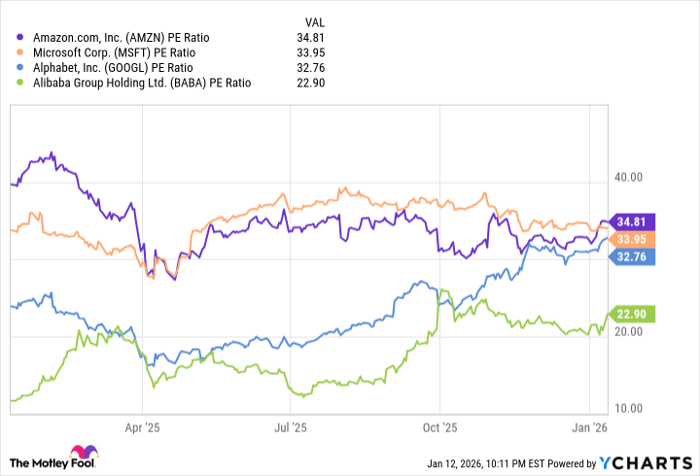
AMZN PE Ratio data by YCharts
That's not to say that Alibaba deserves to be valued like those companies because there are more external risks to Alibaba, but you're getting a premier tech company for relatively cheap. There will inevitably be volatility along the way, but the trajectory seems to be up for the company.
Should you buy stock in Alibaba Group right now?
Before you buy stock in Alibaba Group, consider this:
The Motley Fool Stock Advisor analyst team just identified what they believe are the 10 best stocks for investors to buy now… and Alibaba Group wasn’t one of them. The 10 stocks that made the cut could produce monster returns in the coming years.
Consider when Netflix made this list on December 17, 2004... if you invested $1,000 at the time of our recommendation, you’d have $477,544!* Or when Nvidia made this list on April 15, 2005... if you invested $1,000 at the time of our recommendation, you’d have $1,122,686!*
Now, it’s worth noting Stock Advisor’s total average return is 952% — a market-crushing outperformance compared to 195% for the S&P 500. Don't miss the latest top 10 list, available with Stock Advisor, and join an investing community built by individual investors for individual investors.
*Stock Advisor returns as of January 16, 2026.
Stefon Walters has positions in Microsoft. The Motley Fool has positions in and recommends Alphabet, Amazon, and Microsoft. The Motley Fool recommends Alibaba Group and recommends the following options: long January 2026 $395 calls on Microsoft and short January 2026 $405 calls on Microsoft. The Motley Fool has a disclosure policy.
Mentioned In This Article
Latest News
| Oct-10 | |
| Oct-09 | |
| Oct-08 | |
| Oct-08 | |
| Oct-07 | |
| Oct-07 | |
| Oct-07 | |
| Oct-06 | |
| Oct-05 | |
| Oct-05 | |
| Oct-03 | |
| Oct-02 | |
| Oct-02 | |
| Oct-02 | |
| Oct-01 |
