Bitcoin Weakness Weighs on Coinbase: Diversification Offers Support?
Coinbase Global COIN is a major custodian of Bitcoin, making its financial performance highly sensitive to fluctuations in Bitcoin prices. Continued volatility and recent downside pressure in Bitcoin—now in its fourth consecutive session of decline—have weighed on COIN’s stock performance. As the leading cryptocurrency exchange in the United States, Coinbase’s business remains closely tied to broader crypto market cycles, induces market volatility, and suppresses trading activity, directly impacting Coinbase’s core revenue streams. Transaction fees have historically been Coinbase’s primary source of revenue, accounting for approximately 63% of total revenues in 2024, with Bitcoin-related trading contributing about 30% of that figure.
Crypto asset price risk adversely affects operating results. A decline in the market price of Bitcoin not only affects earnings but also the carrying value of crypto assets and future cash flows. This may also affect liquidity and the ability to meet ongoing obligations.
COIN is thus steadily expanding its subscriptions and services revenues to diversify income and enhance business resilience. Subscription and services revenues have shown consistent growth, with USDC-related stablecoin income becoming an increasingly important driver. Rising average USDC balances across both customer and corporate accounts are expected to enhance stablecoin revenues, while higher prices for Solana and Ethereum are likely to boost earnings from blockchain rewards. Aiming to be the industry’s ‘everything exchange’, COIN also continued strengthening ties between traditional finance and digital assets, focusing on real-world asset (RWA) perpetuals, specialized exchanges and trading terminals, next-generation DeFi infrastructure, and the integration of AI and robotics.
What About COIN’s Peers?
Crypto asset prices play a critical role in shaping the growth of COIN’s peers like Robinhood Markets HOOD and Interactive Brokers Group. IBKR.
For Robinhood, rising crypto valuations fuel retail trading, increase transaction revenues and attract new users, while downturns reduce volumes and customer activity. Robinhood’s business performance mirrors crypto market cycles, exposing it to volatility.
On the other hand, Interactive Brokers benefits when higher crypto prices attract institutional and professional clients, driving trading commissions and asset-based fees. During soft markets, Interactive Brokers faces muted demand for digital assets.
Crypto prices thus act as key growth catalysts for both Robinhood and Interactive Brokers.
COIN’s Price Performance
Shares of COIN have lost 18.3% in a year, underperforming the industry.
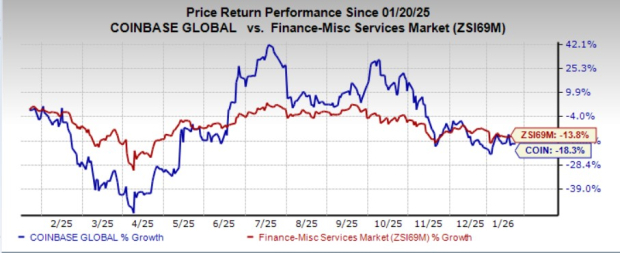
Image Source: Zacks Investment Research
COIN’s Expensive Valuation
COIN trades at a price-to-earnings value ratio of 42.13, significantly above the industry average of 22.48. It carries a Value Score of F
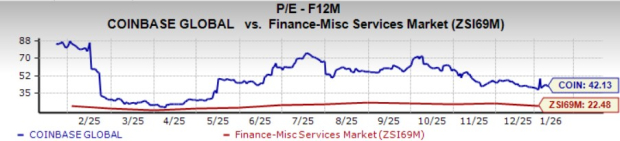
Image Source: Zacks Investment Research
Estimates for COIN
The Zacks Consensus Estimate for COIN’s fourth-quarter 2025 and first-quarter 2026 EPS has witnessed southbound revision in the past seven days. The same holds true for full-year 2025 and 2026 EPS estimates.
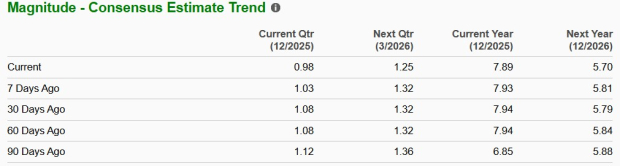
Image Source: Zacks Investment Research
The consensus estimate for COIN’s 2025 and 2026 revenues indicates a year-over-year increase. Though the consensus estimate for the company’s 2025 EPS indicates a year-over-year increase, the same for 2026 suggests a decline.
COIN stock currently carries a Zacks Rank #3 (Hold). You can see the complete list of today’s Zacks #1 Rank (Strong Buy) stocks here.
Want the latest recommendations from Zacks Investment Research? Today, you can download 7 Best Stocks for the Next 30 Days. Click to get this free report
Interactive Brokers Group, Inc. (IBKR): Free Stock Analysis Report
Coinbase Global, Inc. (COIN): Free Stock Analysis Report
Robinhood Markets, Inc. (HOOD): Free Stock Analysis Report
This article originally published on Zacks Investment Research (zacks.com).
Mentioned In This Article
Latest News
| 3 hours | |
| 5 hours | |
| 9 hours | |
| 12 hours | |
| 13 hours | |
| 14 hours | |
| 15 hours | |
| 15 hours | |
| Oct-08 | |
| Oct-08 | |
| Oct-08 | |
| Oct-08 | |
| Oct-08 | |
| Oct-08 | |
| Oct-08 |
