Dycom vs. Primoris: Which Specialty Contractor is the Better Buy?
Strong secular demand from broadband and network expansion is driving growth for utility and telecom infrastructure services in the United States. Firms operating in this market, including Dycom Industries, Inc. DY and Primoris Services Corporation PRIM, are exceptionally benefiting from this positive trend.
Amid the ongoing favorable market trends, the lowering of the interest rate by the Federal Reserve is a welcome addition. On Dec. 10, 2025, the Federal Reserve slashed its interest rates by another 0.25 percentage points, setting the benchmark between 3.5% and 3.75%. The reduction in borrowing rate catalyzes the ongoing favorable market trends, boosting more project initiations and leading to a promising future.
Dycom is a specialty contracting firm operating in the telecom industry, gaining from opportunities across fiber and digital infrastructure, backed by increased data center projects. On the other hand, Primoris is a Texas-based specialty construction and infrastructure company that is currently focused on executing cost control initiatives and disciplined capital management amid the favorable market fundamentals.
Let’s dive deep and closely compare the fundamentals of the two stocks to determine which one is a better investment now.
The Case for Dycom Stock
This North America-based specialty contracting firm operating in the telecom industry is benefiting from strength in digital infrastructure linked to AI. Hyperscalers continue to increase capital spending to support data-heavy applications and AI workloads. Robust telecommunications market driven by fiber-to-the-home programs, wireless activity and fiber infrastructure work for hyperscalers is encouraging. As of October 2025, Dycom’s total backlog grew 4.7% year over year to $8.22 billion, with the next 12-month backlog rising 11.4%.
Apart from the ongoing demand tailwinds, the long-term prospects of Dycom seem promising thanks to the optimism surrounding the Broadband Equity, Access and Deployment (BEAD) program. The program represents a significant multi-year catalyst, with $29.5 billion in expected state and territory spending and approximately $26 billion directed specifically toward fiber or HFC infrastructure, an area directly aligned with DY’s core capabilities. The company’s early positioning appears strong, suggesting substantial upside as states convert awards to contracts. This trend is paving the way for new contracts, project starts and meaningful revenue contribution beginning in Dycom’s second quarter of fiscal 2027.
Owing to the ongoing market optimism, in fiscal 2026, Dycom expects total contract revenues to be in the range of $5.35-$5.425 billion (prior expectation was $5.290-$5.425 billion), representing a 13.8-15.4% year-over-year increase.
However, despite strong market fundamentals, ongoing trade tensions and tariff-related cost pressures are concerning. Besides, the company’s services are highly cyclical and remain vulnerable to economic downturns. During times of economic downturn, volatility in credit and equity markets reduces the availability of debt or equity financing, which, in turn, reduces capital spending on the part of clients.
The Case for Primoris Stock
Primoris has been witnessing robust demand trends across the power delivery, gas operations, communications, renewable energy and industrial markets for some time now. The increased federal and state funding initiatives are fueling the infrastructure project demand in the United States, which is expected to continue for a few more years. Besides these strong market trends, PRIM’s cost control efforts and disciplined capital management are aiding its growth prospects.
Notably, the company’s internal execution is an encouraging trait despite a challenging macro environment and supportive public spending. Adjusted EPS for the first nine months of 2025 rose 65.7% year over year to $4.54, driven by revenue growth, lower interest expense and reduced SG&A. Confident in its diversified markets and solid fundamentals, the company raised its 2025 adjusted EPS outlook to $5.35-$5.55, up from $4.90-$5.10 and well above the 2024 figure of $3.87.
The passing of the One Big Beautiful Bill Act is a cherry on the cake. This act highlights tax incentives like bonus depreciation across infrastructure investments and allocates about $150 billion of mandatory defense spending. This strategic move is in favor of Primoris as it has enabled its customers to have a substantial volume of projects lined up for the next few years.
However, PRIM continues to face margin pressures across both operating segments, raising concerns about its ability to sustain profitability despite cost controls and efficiency efforts. Third-quarter 2025 margins contracted 120 basis points to 10.8%, reflecting lower higher-margin storm work, fewer favorable impacts from renewables and industrial projects compared with 2024 and increased costs on certain renewables projects due to adverse weather and project delays.
Stock Performance & Valuation
As witnessed from the chart below, in the past three months, Dycom’s share price performance has outperformed Primoris’ growth, alongside Zacks Building Products - Heavy Construction industry and the broader Construction sector.
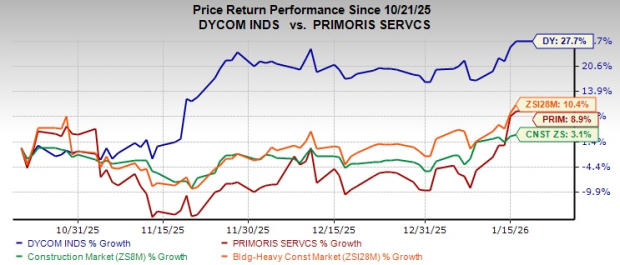
Image Source: Zacks Investment Research
Considering valuation, Dycom has been trading above Primoris on a forward 12-month price-to-earnings (P/E) ratio basis.

Image Source: Zacks Investment Research
From these technical indicators, it can be inferred that DY stock exhibits an incremental growth trend, albeit with a premium valuation, whereas PRIM stock displays a diminishing growth trend, accompanied with a discounted valuation.
Comparing EPS Estimate Trends: DY vs. PRIM
The Zacks Consensus Estimate for DY’s fiscal 2026 EPS indicates 26.9% year-over-year growth, with the fiscal 2027 estimate indicating a rise of 35%. The EPS estimates for fiscal 2026 and fiscal 2027 have increased over the past 60 days.
DY's EPS Trend

Image Source: Zacks Investment Research
The Zacks Consensus Estimate for PRIM’s 2025 EPS indicates 41.9% year-over-year growth, with the 2026 estimate indicating an improvement of 5.7%. The 2025 EPS estimates have remained stable, while the 2026 estimates inched down over the past 60 days.
PRIM's EPS Trend

Image Source: Zacks Investment Research
Return on Equity (ROE) of DY & PRIM Stocks
Dycom’s trailing 12-month ROE of 22.2% significantly exceeds Primoris’ average, underscoring its efficiency in generating shareholder returns.

Image Source: Zacks Investment Research
Which Stock Should Investors Choose: DY or PRIM?
Strong broadband, fiber and network expansion trends continue to support U.S. infrastructure contractors, benefiting both Dycom and Primoris. However, their risk-reward profiles diverge meaningfully.
Dycom stands out as a more direct beneficiary of AI-driven data center networking, fiber-to-the-home deployments and the multiyear BEAD funding program. Although Dycom trades at a valuation premium and remains exposed to tariff risks and economic cyclicality, its higher ROE and focused telecom exposure support a more balanced risk profile.
Conversely, Primoris benefits from diversified exposure across power, gas, renewables and communications, with strong EPS growth, disciplined cost management and recent tax incentives indicating a sustained project flow. However, persistent margin pressure, weather-related disruptions and downward revisions to longer-term earnings estimates raise concerns about profitability sustainability. These headwinds, coupled with weaker stock performance, weigh on the near-term outlook of Primoris.
Thus, Dycom stock, currently carrying a Zacks Rank #3 (Hold), offers clearer growth visibility and stronger execution metrics, compared with Zacks Rank #4 (Sell) Primoris stock. It is prudent to consider DY stock a comparatively better investment option over PRIM stock now. You can see the complete list of today’s Zacks #1 Rank (Strong Buy) stocks here.
Want the latest recommendations from Zacks Investment Research? Today, you can download 7 Best Stocks for the Next 30 Days. Click to get this free report
Dycom Industries, Inc. (DY): Free Stock Analysis Report
Primoris Services Corporation (PRIM): Free Stock Analysis Report
This article originally published on Zacks Investment Research (zacks.com).
Mentioned In This Article
Latest News
| Oct-20 | |
| Sep-28 | |
| Sep-11 | |
| Sep-10 | |
| Aug-31 | |
| Aug-26 | |
| Aug-26 | |
| Aug-26 | |
| Aug-26 | |
| Aug-26 | |
| Aug-26 | |
| Aug-26 | |
| Aug-26 | |
| Aug-26 | |
| Aug-19 |
