SOFI's Operating Leverage is Finally Showing: What You Should Know
SoFi Technologies SOFI is entering a different phase of its lifecycle, where operating leverage is becoming a visible driver of the story. The company spent years investing heavily in product breadth, regulatory infrastructure, and member acquisition. That upfront cost burden is now stabilizing, allowing incremental revenues to fall more efficiently to the bottom line.
What stands out is not just revenue expansion, but the pace at which expenses are growing more slowly than sales. As SoFi scales its financial services ecosystem, banking, lending and fee-based products, the fixed-cost base is being spread across a larger revenue pool. This is a classic sign of a platform transitioning toward sustainable profitability rather than chasing headline growth.
SoFi’s operating leverage is also supported by a better revenue mix. Fee-based income and cross-sold financial services reduce reliance on pure lending spreads, making earnings less cyclical. As more members use multiple products, customer acquisition costs per dollar of revenue decline, reinforcing margin expansion.
Why This Factor Matters Now
Operating leverage is a forward-looking signal. It suggests SoFi can grow earnings faster than revenues over time without needing aggressive cost cuts. That dynamic strengthens confidence in the business model and shifts investor focus from “when profitability?” to “how scalable is profitability?”, a meaningful re-rating catalyst if execution remains steady.
Peer Comparison: How SoFi Stacks Up
LendingClub LC remains a digital-first financial platform, but its operating leverage is more tightly linked to credit cycles. It benefits when loan demand is strong, yet its earnings flexibility narrows during slower periods. Unlike SoFi, LendingClub has fewer cross-selling levers, which limits margin expansion. As a result, LendingClub shows profitability, but with less structural scalability.
Upstart UPST operates with a technology-led lending model, but operating leverage has been inconsistent. Upstart depends heavily on partner lending volume, which introduces volatility. While Upstart can scale quickly in favorable markets, cost absorption weakens during downturns. Compared to SoFi, Upstart lacks a diversified ecosystem, making Upstart more sensitive to macro shifts.
SOFI’s Price Performance, Valuation and Estimates
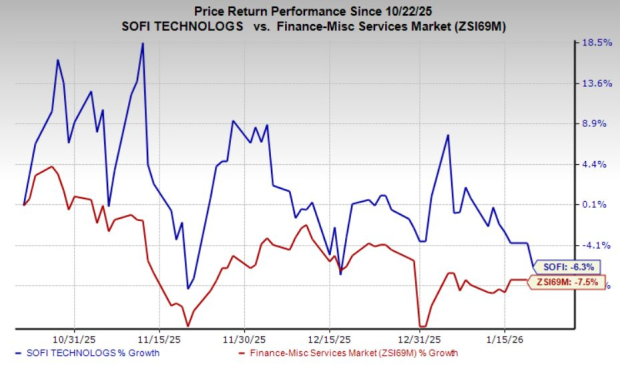
The stock has declined 6.3% in the past three months compared with the industry’s 7.5% decline.
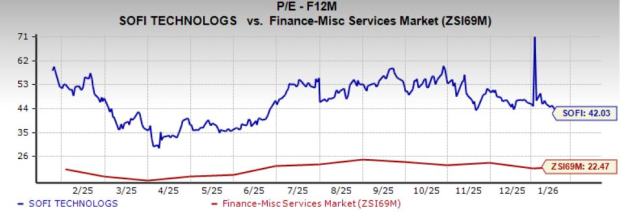
From a valuation standpoint, SOFI trades at a forward price-to-earnings ratio of 42X, well above the industry’s 22.5X. It carries a Value Score of F.
The Zacks Consensus Estimate for SOFI’s 2025 earnings has been on the rise over the past 30 days.
SOFI stock currently carries a Zacks Rank #3 (Hold). You can see the complete list of today’s Zacks #1 Rank (Strong Buy) stocks here.
Want the latest recommendations from Zacks Investment Research? Today, you can download 7 Best Stocks for the Next 30 Days. Click to get this free report
LendingClub Corporation (LC): Free Stock Analysis Report
Upstart Holdings, Inc. (UPST): Free Stock Analysis Report
SoFi Technologies, Inc. (SOFI): Free Stock Analysis Report
This article originally published on Zacks Investment Research (zacks.com).
Mentioned In This Article
Latest News
| Oct-22 | |
| Oct-22 | |
| Oct-22 | |
| Oct-22 |
SoFi partners with Prudential to offer term life insurance in its app
SOFI
Life Insurance International
|
| Oct-22 | |
| Oct-22 | |
| Oct-22 | |
| Oct-21 | |
| Oct-21 | |
| Oct-21 | |
| Oct-16 | |
| Oct-16 | |
| Oct-16 | |
| Oct-16 | |
| Oct-16 |
