Visa vs. Mastercard: Which Payments Giant Looks More Attractive Now?
The world of payments is increasingly shifting toward digital, cross-border and real-time transactions, reshaping how money moves between consumers, merchants and financial institutions. In this dynamic environment, Visa Inc. V and Mastercard Incorporated MA are at the forefront of global financial transaction services, managing extensive global payment networks that handle trillions of dollars each year. Both companies run asset-light, high-margin payment systems that grow alongside transaction volumes, positioning them as key players in the long-term expansion of electronic payments.
Despite similar models, differences in scale and regional revenue mix create subtle distinctions in how each company captures global payment activity. Both companies are working on expanding their value-added services, but the relative contribution and focus of these offerings vary, leading to unique growth trajectories.
Let’s dive deep and closely compare the fundamentals of the two stocks to determine which stock is more attractive now.
The Case for Visa
Visa’s greatest strength lies in its unparalleled global reach. With a market cap of $593.6 billion, it stands as one of the largest payment networks in the world, and benefits from deep penetration across consumer, commercial and cross-border transactions. This scale advantage allows it to process growing transaction volumes even during uneven economic cycles, making revenues relatively resilient.
Visa has continued to benefit from steady consumer spending and improving international travel, supporting cross-border volumes, which improve the overall revenue mix. On a constant-dollar basis, its payments volume climbed 9% year over year in the fiscal fourth quarter, supported by strength across the United States, Europe, CEMEA and LAC markets. Processed transactions reached 67.7 billion, up 10% from a year ago. Cross-border volume remained a standout highlight, growing 12% year over year. It beat earnings in each of the past four quarters with an average surprise of 2.7%.
Visa Inc. Price, Consensus and EPS Surprise

Visa Inc. price-consensus-eps-surprise-chart | Visa Inc. Quote
Visa is shifting its focus beyond just being a traditional card network. The company has been leaning into areas such as AI-driven fraud prevention, tokenization and new digital commerce use cases. Its value-added services now account for nearly 30% of revenues and are growing in the mid-20s. Its work with stablecoins and blockchain-linked settlement infrastructure reflects an intent to remain relevant even if payment rails evolve. Instead of seeing new technologies as threats, Visa is looking to leverage them as valuable extensions of its network.
Also, V’s strong cash position enables substantial share buybacks and dividend payouts and supports inorganic growth and financial stability. With $17.2 billion in cash, the company maintains a solid capital position. Its long-term debt-to-capital of 34.1% is lower than the industry’s average of 37.8% and MA’s 70.6%. Visa returned $6.1 billion to its shareholders through share repurchases and dividends in the fiscal fourth quarter.
However, escalating operating expenses and higher rebates and client incentives will likely impact its growth potential. In the fourth quarter of fiscal 2025, adjusted operating expenses rose 13.1% year over year. Also, both Visa and Mastercard are facing regulatory and legal risks. In the United States, the Department of Justice earlier accused both these companies of using their dominance to overcharge merchants. European and U.K. regulators are also investigating cross-border and merchant fees, potentially leading to fee caps or new compliance requirements, which could dent revenue growth in the region.
The Case for Mastercard
Mastercard, with a market cap of $477.5 billion, runs a top-notch global payments network that links consumers, banks, merchants and digital platforms. Its robust infrastructure makes transactions secure, seamless and widely accessible, supporting commerce across both mature and emerging markets.
In the third quarter of 2025, the company’s net revenues rose 17% year over year, along with 12% growth in payment network net revenues. The top line benefited from increased gross dollar volume, cross-border volumes, strong demand for value-added services and growth in switched transactions backed by robust consumer spending. Value-added services and solutions net revenues rose 25% year over year in the quarter, driven by strategic buyouts and the strong performance of security and digital authentication solutions, as well as customer acquisition and engagement services. It beat earnings estimates in each of the past four quarters, with an average surprise of 3.1%.
Mastercard Incorporated Price, Consensus and EPS Surprise

Mastercard Incorporated price-consensus-eps-surprise-chart | Mastercard Incorporated Quote
The company continues to focus on and invest in areas like tokenization, cybersecurity, stablecoins, digital identity, open banking and real-time payments, reinforcing its position in a landscape where alternatives are rapidly expanding. MA is also emphasizing AI-powered solutions. Its series of new and renewed partnerships strengthens its long-term relationships while also solidifying its global network and supporting consistent transaction growth.
MA balances investments in innovation with shareholder returns through dividends and buybacks, supporting sustainable long-term growth despite regulatory and competitive pressures. However, its dividend yield of 0.65% is lower than Visa’s 0.82%. Mastercard maintains a solid capital position with $10.4 billion in cash and no short-term debt.
However, escalating operating expenses and higher rebates and incentives are affecting growth potential. In the third quarter of 2025, its adjusted operating expenses rose 15% year over year. We expect the metric to increase 15.8% in 2025. Its adjusted net margin was 46% in the third quarter. In comparison, Visa reported an adjusted net margin of 54.1% in the fourth quarter of fiscal 2025.
How Do Estimates Compare for V & MA?
The consensus estimate for V’s fiscal 2026 earnings indicates an 11.7% increase from a year ago, while the same for revenues suggests 11.1% growth. It has witnessed one positive earnings estimate revision over the past seven days against no downward revisions.
The Zacks Consensus Estimate for Mastercard’s 2025 EPS indicates 12.5% year-over-year growth, and the same for revenues signals a 16.3% rise. It has witnessed no earnings estimate revisions over the past seven days. Further, for 2026 EPS, the consensus mark indicates a 15.9% increase.
Valuation: V vs. MA
Both Visa and Mastercard trade at premium forward P/E ratios, which are reflective of their wide moats and volumes. However, Visa’s valuation is more attractive than Mastercard’s. While V trades at a forward P/E of 24.44X, MA trades at 27.68X, and the industry average is at 19.76X.
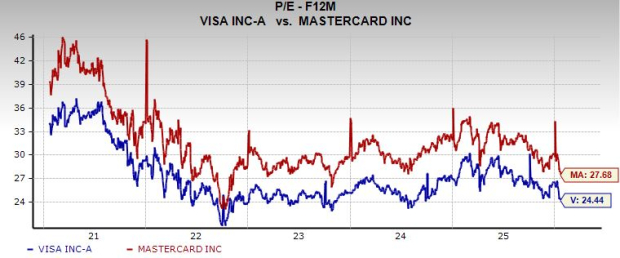
Image Source: Zacks Investment Research
Price Performance Comparison
Over the past three months, Visa has shed less value than Mastercard and the broader industry. However, the S&P 500 increased 2.7% during this time.
3M Price Performance – V, MA, Industry & S&P 500
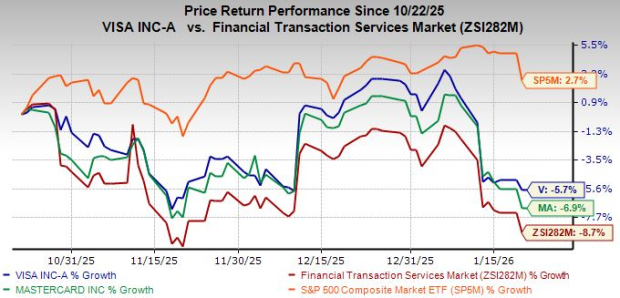
Image Source: Zacks Investment Research
Conclusion
Both Visa and Mastercard remain dominant players in the global payments landscape, benefiting from strong networks, growing transaction volumes and investments in digital innovation. However, considering Visa’s larger scale, higher margins, dividend yield and slightly more attractive valuation, it has more room for growth at the moment, even though both companies currently carry a Zacks Rank #3 (Hold).
You can see the complete list of today’s Zacks #1 Rank (Strong Buy) stocks here.
Want the latest recommendations from Zacks Investment Research? Today, you can download 7 Best Stocks for the Next 30 Days. Click to get this free report
Mastercard Incorporated (MA): Free Stock Analysis Report
Visa Inc. (V): Free Stock Analysis Report
This article originally published on Zacks Investment Research (zacks.com).
Mentioned In This Article
Latest News
| 2 hours | |
| 3 hours | |
| 4 hours | |
| Oct-26 | |
| Oct-26 | |
| Oct-26 | |
| Oct-26 | |
| Oct-26 | |
| Oct-26 | |
| Oct-25 | |
| Oct-25 | |
| Oct-25 | |
| Oct-24 | |
| Oct-23 | |
| Oct-23 |
