RTX vs. General Dynamics: Which Defense Stock Offers More Upside?
Rising defense budgets in the United States and its allied nations, driven by escalating geopolitical tensions worldwide, are strengthening demand for advanced military research, development and procurement. This environment is supporting the growth outlook of leading defense contractors such as RTX Corp. RTX and General Dynamics GD, both of which benefit from large, multi-billion-dollar contracts for combat-tested missiles, radars, ships and other critical defense systems. Their participation in the commercial aerospace market also adds diversification and helps provide more stable revenue streams.
RTX offers a broad and well-balanced product portfolio, spanning commercial and military aircraft engines, aerostructures and advanced missiles, sensors, radars and interceptors. General Dynamics, best known for its naval shipbuilding capabilities, also produces business jets, munitions and a range of wheeled and tracked combat vehicles.
Global defense spending is expected to rise steadily in response to increasing cross-border and internal conflicts.
Given this backdrop, investors seeking exposure to long-term growth opportunities in the defense sector may closely evaluate stocks such as RTX and GD. This sets the stage for a detailed comparison of the two companies, focusing on their financial strength, key growth drivers and potential investment risks.
Tailwinds for RTX
RTX’s recent performance has been supported by strategic contract wins across its aerospace, defense and space businesses, strengthening its long-term growth outlook and customer relationships.
In January 2026, Collins Aerospace expanded its aftermarket and logistics capabilities through multi-year distribution agreements to support wheels and brakes for the C-130 Hercules, improving lifecycle support for international operators and fleet upgrade customers.
Earlier in the month, RTX’s subsidiary Blue Canyon Technologies supported the launch of a Saturn-200 minisatellite for a NASA science mission, highlighting its growing presence in small satellite manufacturing and mission services.
Also in January, Collins Aerospace secured a major contract from the Federal Aviation Administration to support the Radar System Replacement program, reinforcing RTX’s role in long-term aviation infrastructure modernization efforts.
Tailwinds for GD
General Dynamics’ recent performance has been supported by contract awards across defense modernization and cybersecurity, reinforcing its role in mission-critical government programs.
In January 2026, General Dynamics’ unit General Dynamics Information Technology (“GDIT”) secured a major contract to modernize and integrate C5ISR systems across multiple U.S. Navy platforms, supporting fleet readiness and mission continuity.
Earlier, in December 2025, GDIT was awarded a contract by the Commonwealth of Virginia to enhance statewide cybersecurity infrastructure through services such as vulnerability management, zero-trust implementation and 24/7 security operations.
These awards highlight General Dynamics’ strengths in defense systems integration and cybersecurity, supporting long-term revenue visibility.
How Does the Zacks Consensus Estimate Compare for RTX & GD?
The Zacks Consensus Estimate for RTX’s 2026 sales and earnings per share (EPS) implies an improvement of 6.6% and 8.9%, respectively, from the year-ago quarter’s reported figures. However, RTX’s EPS estimates for 2026 have remained the same over the past 60 days.

Image Source: Zacks Investment Research
The Zacks Consensus Estimate for General Dynamics’ 2026 sales implies a year-over-year rise of 4.1%, and the same for earnings implies growth of 11.5%. The stock’s 2026 bottom-line estimates have moved south over the past 60 days.

Image Source: Zacks Investment Research
Stock Price Performance: RTX vs. GD
In the past year, RTX has outperformed GD. While RTX’s shares surged 56.4%, GD rose 35.9%.
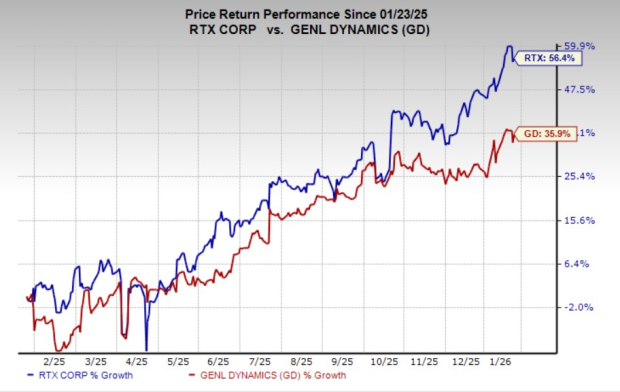
Image Source: Zacks Investment Research
RTX’s Valuation More Attractive Than GD
On a trailing 12-month Price to Book (P/B) basis, RTX is valued at 3.99X, which is slightly lower than General Dynamics’ multiple of 4.03X.

Image Source: Zacks Investment Research
ROE: RTX vs. GD
The image below reflects the return on equity (ROE) for RTX and General Dynamics. This shows that GD is better at converting its equity financing into profits compared with RTX.

Image Source: Zacks Investment Research
Final Call
While both RTX and General Dynamics benefit from rising defense budgets and exposure to commercial aerospace, RTX appears better positioned due to its stronger stock price performance, better sales growth and relatively more attractive valuation. RTX’s diversified portfolio across defense, commercial aerospace and space, supported by recent contract wins, provides better visibility into long-term growth opportunities.
Although General Dynamics reports a higher return on equity, reflecting efficient capital utilization, recent downward revisions to its earnings estimates weigh on its near-term outlook. In contrast, RTX’s stable estimates, combined with its valuation advantage, make it a more compelling choice for investors seeking balanced growth and value in the defense sector.
Both RTX and General Dynamics currently carry a Zacks Rank #3 (Hold).
You can see the complete list of today’s Zacks Rank #1 (Strong Buy) stocks here.
Want the latest recommendations from Zacks Investment Research? Today, you can download 7 Best Stocks for the Next 30 Days. Click to get this free report
General Dynamics Corporation (GD): Free Stock Analysis Report
RTX Corporation (RTX): Free Stock Analysis Report
This article originally published on Zacks Investment Research (zacks.com).
Mentioned In This Article
Latest News
| Oct-09 | |
| Oct-09 | |
| Oct-09 | |
| Oct-09 | |
| Oct-09 | |
| Oct-09 | |
| Oct-08 | |
| Oct-08 | |
| Oct-08 | |
| Oct-08 | |
| Oct-08 | |
| Oct-07 | |
| Oct-07 | |
| Oct-07 | |
| Oct-05 |
