Intel Stock Plunges: Time To Buy the Dip?
Key Points
Intel edged past estimates in the fourth-quarter report, even though revenue fell 4%.
Due in part to supply constraints, Intel issued weak guidance for the first quarter.
Investors will have to be patient with the turnaround.
After trading near a 15-year low for much of 2025, Intel (NASDAQ: INTC) started an impressive breakout last August. It began with an $8.9 billion investment from the U.S., which was followed by Nvidia taking a $5 billion stake in the company the following month.
Since then, expectations have continued to increase for Intel under new CEO Lip-Bu Tan, who has promised to streamline the company, build an engineering-first culture, and strengthen the balance sheet after years of free cash flow losses as the company invested in its foundry buildout.
Where to invest $1,000 right now? Our analyst team just revealed what they believe are the 10 best stocks to buy right now, when you join Stock Advisor. See the stocks »
After the stock had jumped more than 150% since August, Intel's comeback story hit a wall on Friday after it reported fourth-quarter earnings the night before. The stock was down 16% in late-morning trading on Friday as the company's first-quarter guidance missed the mark.
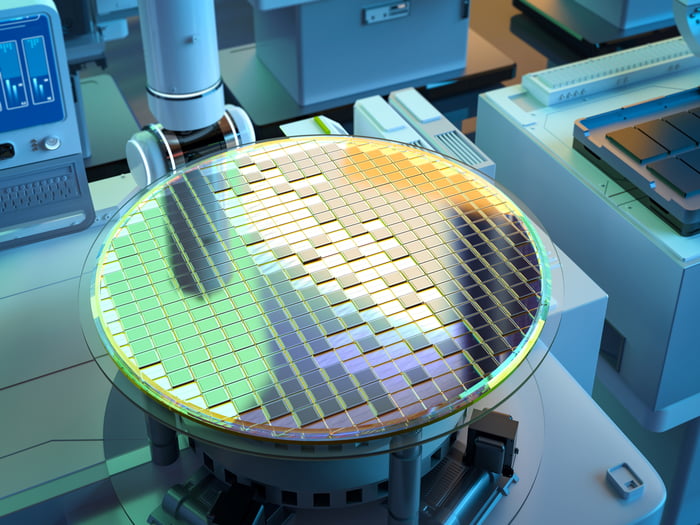
Image source: Getty Images.
Intel's latest update
Investors had modest expectations for the fourth quarter, and Intel matched those. Revenue fell 4% to $13.7 billion, which includes the deconsolidation of Alterra after the company sold a 51% stake in the Field-Programmable Gate Array (FPGA) subsidiary. Its result topped estimates at $13.4 billion.
On the bottom line, meanwhile, the company's adjusted operating income fell from $1.37 billion to $1.21 billion, but reported adjusted earnings per share increased from $0.13 to $0.15, beating expectations at $0.08 a share.
Looking ahead, management said supply constraints would impact the first-quarter performance as CFO David Zinsner said, "We expect our available supply to be at its lowest level in Q1 before improving in Q2 and beyond."
For the first quarter, the company expects revenue of $11.7 billion-$12.7 billion, which is down 4.7% at the midpoint from the quarter a year ago. It also called for break-even adjusted earnings per share, compared to a per-share profit of $0.13 in the quarter a year ago and below the consensus at $0.05.
An expectations/reality gap
Intel shares had surged coming into the report, but the results show there seems to be a gap between expectations for the company and the reality of where it is in its turnaround.
It's true that Intel has a lot of upside potential, especially with its domestic manufacturing base and preferred treatment from the federal government, but it could take several years for the business to gain momentum and capitalize on the new 18A process. Analysts expect single-digit revenue growth to continue through 2027, meaning investors will have to be patient, and that forecast also comes with the semiconductor industry in an epic boom driven by AI.
At this point, the stock seems fully priced even with today's dip, as its price-to-earnings ratio is well above most of its peers, showing that high expectations are still baked in.
Should you buy stock in Intel right now?
Before you buy stock in Intel, consider this:
The Motley Fool Stock Advisor analyst team just identified what they believe are the 10 best stocks for investors to buy now… and Intel wasn’t one of them. The 10 stocks that made the cut could produce monster returns in the coming years.
Consider when Netflix made this list on December 17, 2004... if you invested $1,000 at the time of our recommendation, you’d have $450,525!* Or when Nvidia made this list on April 15, 2005... if you invested $1,000 at the time of our recommendation, you’d have $1,133,107!*
Now, it’s worth noting Stock Advisor’s total average return is 937% — a market-crushing outperformance compared to 195% for the S&P 500. Don't miss the latest top 10 list, available with Stock Advisor, and join an investing community built by individual investors for individual investors.
*Stock Advisor returns as of January 23, 2026.
Jeremy Bowman has positions in Nvidia. The Motley Fool has positions in and recommends Intel and Nvidia. The Motley Fool has a disclosure policy.
Mentioned In This Article
Latest News
| 3 hours | |
| Oct-09 | |
| Oct-09 | |
| Oct-09 | |
| Oct-09 | |
| Oct-09 | |
| Oct-09 | |
| Oct-09 | |
| Oct-09 | |
| Oct-08 | |
| Oct-08 | |
| Oct-08 | |
| Oct-08 | |
| Oct-08 | |
| Oct-08 |
