Americans Grow More Risk Averse and Financially Stressed, New F&G Survey Finds, as Affordability Pressures Threaten Retirement Preparedness
In Sixth Annual Study, 77% of Americans Pull Back on Risk as Healthcare, Inflation and AI Fuel Financial Fears
DES MOINES, Iowa, Jan. 28, 2026 /PRNewswire/ -- American investors1 are becoming increasingly risk averse as affordability pressures erode financial confidence and reshape retirement planning, according to a new survey from F&G Annuities & Life, Inc. (NYSE: FG) (F&G), a leading provider of insurance solutions serving retail annuity and life customers and institutional clients.
F&G's sixth annual Risk Tolerance Tracker asked American investors how the events of the past 12 months have impacted their views on retirement and risk, as well as the financial issues they are concerned about for the year ahead. More than three-quarters (77%) of Americans say the events of the past 12 months have made them more financially cautious, up four percentage points from last year, as affordability and uncertainty around long-term financial security continue to weigh on household confidence.
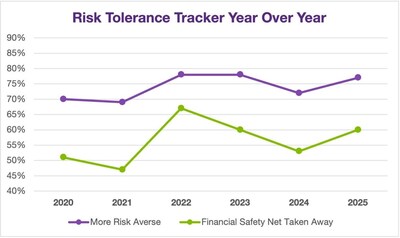
"Affordability pressures are no longer a short-term challenge; they can have lasting effects on how Americans prepare for retirement," said Chris Blunt, Chief Executive Officer of F&G. "As households manage higher everyday living costs, many are feeling more financially stressed at a time when long-term security and planning should be a priority. Our sixth annual survey underscores how many Americans are recalibrating risk and rethinking their plans, as well as the importance of taking meaningful steps to build a more confident financial future."
Affordability Pressures Drive Rising Financial Stress Among Those in Their 40s
Financial anxiety is widespread, but it is most pronounced among Americans in their 40s. In fact, 81% report becoming more risk averse, signaling mounting financial pressure at a critical stage defined by housing costs, family obligations and retirement planning demands.
Two-thirds (66%) of Americans overall say they are worried about their retirement income as a result of recent economic conditions, and nearly a third (31%) are not confident Social Security will be available when they retire. These concerns are particularly pronounced among Americans in their 40s, a critical planning decade, with 40% expressing doubts about the future of Social Security. Anxiety also runs high among Gen X more broadly, with nearly half (46%) voicing similar concerns, compared with far fewer Baby Boomers (20%), highlighting a growing generational divide and underscoring the need for greater focus on preparedness and planning in the years leading up to retirement.
Healthcare Costs Surge as a Top Financial Worry
As Americans look ahead to 2026, their financial worries are shifting. Inflation remains the top concern overall, cited by 48% of respondents, though it has declined modestly year over year (6%). Healthcare and long-term care costs, however, have surged from the sixth to the second highest ranked concern, rising eight percentage points from last year to 31%.
Other leading worries include rising taxes (25%), energy and gas prices (24%), recession fears (23%), Social Security availability (22%) and housing costs (21%), reflecting a broad set of pressures impacting financial confidence.
AI and Job Market Anxiety Add to Economic Uncertainty
Emerging risks are also gaining traction. More than half of Americans (56%) are worried about the negative impact of artificial intelligence on their finances, up six percentage points from last year, while nearly half (49%) cite concerns about a tightening job market, also up six percentage points from last year.
Notably, these were the two areas of concern that increased the most year over year, signaling growing unease about the future of work and income stability. Meanwhile, 70% of Americans continue to worry about the U.S. entering a recession.
Shifting Financial Behaviors Highlight Ongoing Advice Gaps
Despite heightened uncertainty and financial stress, many Americans continue to navigate these challenges without professional guidance. More than half (54%) of respondents do not currently work with a financial professional.
At the same time, investor behavior is evolving, pointing to changing habits and opening the door to a broader discussion around guaranteed income products, including annuities. Nearly half (48%) of respondents say they are more likely to explore new financial products, while openness is even higher among Gen X, with a majority (53%) indicating a willingness to consider new offerings, up from 44% last year. This shift is accompanied by taking proactive steps such as increasing savings, adjusting retirement plans, supplementing income and creating budgets.
Younger generations are leading this shift: 73% of Millennials say they have made changes in the past three to six months to be more cautious or make their investments more recession-resistant, compared with 55% of Gen X and 37% of Boomers. By contrast, just 34% of retirees report making changes over the same period, suggesting that many may be taking a more passive approach at a time when ongoing planning and refinement remains important. Those who work with a financial professional were far more likely to make changes (67%) than those who do not (39%).
"As our survey has demonstrated over the years, in environments defined by economic uncertainty, the need for a comprehensive plan backed by a financial professional has never been more important," said Ron Barrett, Chief Distribution Officer of F&G. "Whether investors are in the earlier stages of planning or approaching retirement, a trusted advisor can help investors cut through the noise and realistically assess risk. They can also guide an ongoing retirement strategy that balances protection, growth and guaranteed income, so investors can move forward with greater confidence amid volatile times."
For more information on F&G's latest survey, please visit fglife.com/research.
Survey Methodology
The research was conducted by Censuswide, among a sample of 1,601 U.S. respondents (aged 30+) who have at least $10,000 in financial products/investable assets and must either be a financial decision-maker for the household or share responsibility for financial decisions. The data was collected between November 14 and November 26, 2025.
About F&G
F&G Annuities & Life, Inc. is committed to helping Americans turn their aspirations into reality. F&G is a leading provider of insurance solutions serving retail annuity and life customers and institutional clients and is headquartered in Des Moines, Iowa. For more information, please visit fglife.com.
Media Contact
Gabrielle Simon
pro-F&G@prosek.com
413.695.3818
Investors Contact:
Lisa Foxworthy-Parker
SVP of Investor & External Relations
515.330.3307
Investor.relations@fglife.com
1 Survey fielded among a nationally representative sample of 1,601 U.S. adults 30 years of age and older who have sole or shared financial decision-making responsibility for their household, and own financial products valued at $10,000 or more.

SOURCE F&G Annuities & Life, Inc.

Mentioned In This Article
Latest News
| Sep-16 | |
| Sep-08 | |
| Sep-03 | |
| Aug-19 | |
| Aug-06 | |
| Aug-06 | |
| Aug-05 | |
| Aug-05 | |
| Aug-05 | |
| Aug-04 | |
| Jul-22 | |
| Jul-22 | |
| Jun-16 | |
| May-20 | |
| May-13 |
