Time to Buy Ford Stock? Not Until These 2 Things Change.
Key Points
Ford set an unfortunate record for recalls in 2025 with 153 spanning nearly 13 million vehicles.
As a result, Ford's warranty costs as a percentage of revenue have been on the rise.
Reversing significant electric vehicle losses will boost the bottom line.
There are a host of reasons to be drawn to shares of Ford Motor Company (NYSE: F) these days.
Some investors might decide to scoop them up because they see the stock as a value proposition with a price-to-earnings ratio of only 11. Others could be lured by Ford's lucrative dividend which yields almost 4.5%, with annual special dividends sprinkled in when cash flow is strong.
Where to invest $1,000 right now? Our analyst team just revealed what they believe are the 10 best stocks to buy right now. Continue »
Still other investors might bet on Ford's strength in highly profitable full-size trucks, SUVs, and its commercial Ford Pro business that generates recurring revenue. And finally, some may see long-term potential through artificial intelligence and driverless vehicles.
Whatever the reason, Ford investors should also keep an eye on two challenges that the automaker needs to fix. Here's what they are.
An award no auto wants
Recalls are simply part of the business in the automotive industry and companies are no stranger to spending capital on warranty and recall costs. Unfortunately for Ford investors, the automaker has grown increasingly accustomed to recalls and not only recorded a significant 89 recalls in 2024 but obliterated that with its newly set record of 153 recalls last year that spanned roughly 13 million vehicles.
These recall developments have been known to rear their ugly head during Ford's earning reports, including during the second quarter of 2024 when Ford's warranty costs spiked $800 million and caused the automaker to miss Wall Street estimates. Further, beyond the direct numbers, leading the industry in recalls for numerous years has a detrimental impact on the company's brand image and ability to "conquest" customers from a competing brand -- one of the most difficult and expensive things to do in the loyal automotive industry.
While Ford has increased its efforts on quality in recent years after CEO Jim Farley made it a focus, and most of the issues are blamed on much older vehicles in the global fleet, you can see the chart shows it's been a trend for some time.
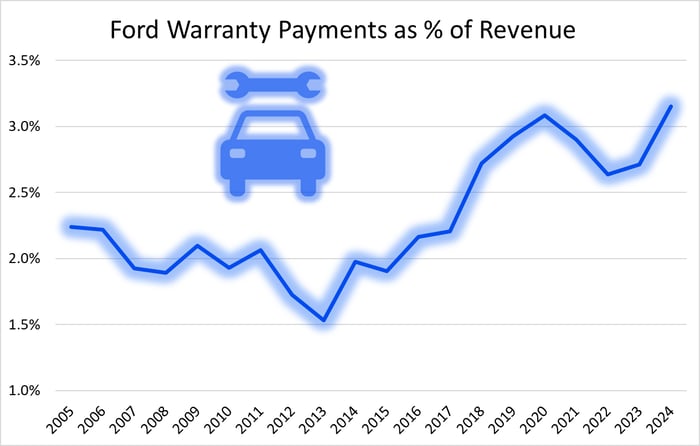
Data source: Ford SEC filings. Chart by author.
Reversing steep losses
After seeing markets in Europe and China surge ahead in electric vehicle adoption, the U.S. industry jumped on the opportunity to hype EVs and the future. Companies touted multibillion-dollar investments in electrification, battery development, and infrastructure buildout, but the market didn't gain traction nearly as quick as automakers hoped.
The lack of a quickly developing market has dinged many automakers on the bottom line, with Ford's Model-e division, responsible for its EVs, losing over $5 billion in 2024 alone. That's a massive loss, but also a massive opportunity for investors if Ford can quickly reverse those losses into profits.
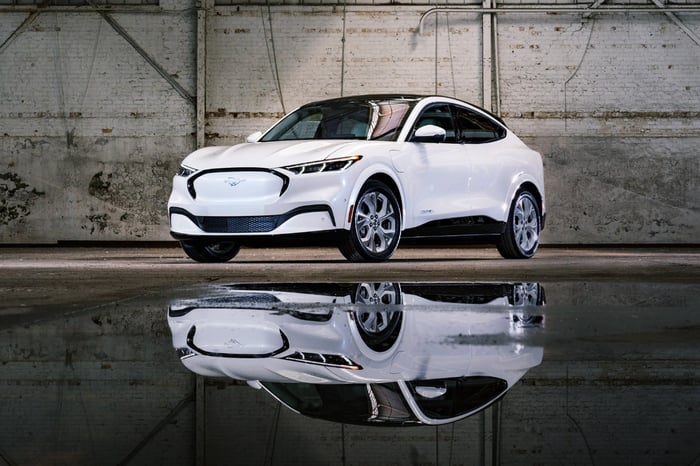
Image source: Ford Motor Company.
Ford intends to do just that, and through assembly line innovations as well as a new low-cost Universal EV Platform, it will launch a more affordable midsize electric pickup in 2027 with a price tag of around $30,000. The crucial part of that development is that Ford expects the new pickup to be profitable early in its life cycle.
Further, Ford took a large $19.5 billion special charge to pivot its strategy away from full-electric vehicles until they are more profitable, and instead focus on hybrids that can sometimes be even more profitable than their gasoline-powered counterparts.
What it all means
There are plenty of reasons for investors to take a hard look at Ford as a long-term investment. It has a solid balance sheet, a lucrative dividend, and high upside with a future increasingly linked to AI and driverless vehicles. But investors need to keep an eye on current events, too, such as Ford's costly recalls and heavy EV losses in the near term. As Ford turns those problems around, it'll be a more sound long-term investment.
Should you buy stock in Ford Motor Company right now?
Before you buy stock in Ford Motor Company, consider this:
The Motley Fool Stock Advisor analyst team just identified what they believe are the 10 best stocks for investors to buy now… and Ford Motor Company wasn’t one of them. The 10 stocks that made the cut could produce monster returns in the coming years.
Consider when Netflix made this list on December 17, 2004... if you invested $1,000 at the time of our recommendation, you’d have $450,256!* Or when Nvidia made this list on April 15, 2005... if you invested $1,000 at the time of our recommendation, you’d have $1,171,666!*
Now, it’s worth noting Stock Advisor’s total average return is 942% — a market-crushing outperformance compared to 196% for the S&P 500. Don't miss the latest top 10 list, available with Stock Advisor, and join an investing community built by individual investors for individual investors.
*Stock Advisor returns as of February 1, 2026.
Daniel Miller has positions in Ford Motor Company. The Motley Fool has no position in any of the stocks mentioned. The Motley Fool has a disclosure policy.
Mentioned In This Article
Latest News
| Oct-17 | |
| Oct-15 | |
| Oct-14 | |
| Oct-14 | |
| Oct-13 | |
| Oct-13 | |
| Oct-08 | |
| Oct-07 | |
| Oct-07 | |
| Oct-07 | |
| Oct-07 | |
| Oct-05 | |
| Oct-05 | |
| Oct-05 | |
| Oct-05 |
