Natera Files Signatera CDx PMA With FDA for Bladder Cancer MRD Test
Natera NTRA recently announced the submission of a premarket approval (PMA) application to the FDA for its Signatera CDx test, a personalized molecular residual disease (MRD) assay for patients with muscle-invasive bladder cancer (MIBC).
The application is supported by positive phase 3 IMvigor011 trial data, which showed improved survival outcomes in MRD-positive patients treated with Tecentriq, while MRD-negative patients had a low risk of recurrence without additional therapy, underscoring the value of Signatera in personalized cancer care.
NTRA Stock's Trend Following the News
Following the announcement, shares of Natera traded flat at yesterday’s closing. Over the past six months, the stock has surged 69.2% compared with the industry’s 18.1% growth and the S&P 500’s 12.4% rise.
If approved, Signatera CDx could be a meaningful long-term growth catalyst for Natera by expanding the clinical and commercial role of its MRD platform beyond monitoring into treatment decision-making. Companion diagnostic status would likely deepen adoption among oncologists, strengthen partnerships with pharma players and support broader reimbursement coverage, all of which can drive higher testing volumes and more durable revenue streams. Over time, this also reinforces Natera’s competitive moat in precision oncology and positions Signatera as a standard-of-care tool across additional solid tumor indications.
NTRA currently has a market capitalization of $31.97 billion.
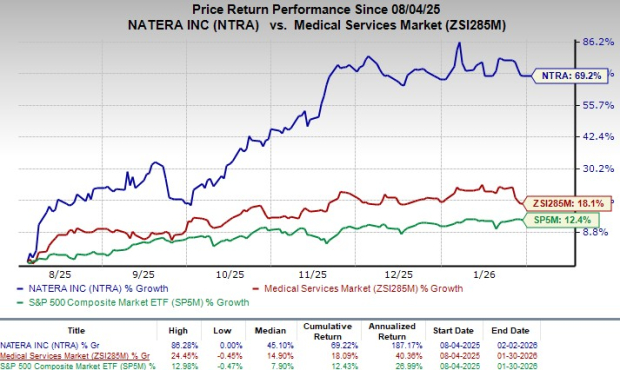
Image Source: Zacks Investment Research
More on the News
The PMA submission marks a major regulatory milestone for Natera, as Signatera CDx is positioned as a companion diagnostic to help guide adjuvant immunotherapy decisions in MIBC, an area with limited tools for personalized risk assessment. The filing is backed by robust evidence from the randomized, double-blind phase 3 IMvigor011 trial, sponsored by Genentech, part of the Roche Group, which validated a molecular residual disease–guided treatment approach.
In the study, patients who tested positive for MRD using Signatera and received Tecentriq experienced statistically significant and clinically meaningful improvements in both disease-free survival and overall survival versus placebo, reinforcing the clinical utility of the test.
Equally important from an adoption and cost-effectiveness standpoint, the trial showed that MRD-negative patients had a low risk of recurrence without adjuvant immunotherapy, supporting the idea that treatment can be safely avoided in a sizable subset of patients. The data were strong enough to be featured in a Presidential Symposium at the ESMO Congress and published concurrently in The New England Journal of Medicine, adding credibility and visibility within the oncology community.
If approved by the FDA, Signatera CDx could become one of the first MRD-based companion diagnostics to directly influence treatment decisions in solid tumors, potentially accelerating clinical uptake and strengthening Natera’s position in precision oncology over the long term.
Industry Prospects Favoring the Market
Per a report by Grand View Research, the global precision oncology market size was estimated at $115.80 billion in 2024 and is projected to reach $201.96 billion by 2030, expanding at a CAGR of 8.05% from 2025 to 2030.
The market is expected to expand meaningfully, driven by technological advancements, rising demand for diagnostic solutions that deliver clinically actionable insights, reduced treatment-related side effects for cancer patients and the ability to avoid or limit drug resistance.
Other News
Natera also highlighted recent business updates, including a partnership with Exelixis to support the phase 3 STELLAR-316 trial, which will evaluate Exelixis’ oral cancer drug zanzalintinib, with and without immunotherapy, in patients with resected stage II or III colorectal cancer.
Separately, the company announced the launch of an expanded version of its Fetal Focus non-invasive prenatal test, now covering 21 genes, backed by EXPAND trial data showing 96% overall accuracy and a 98% accuracy rate in ruling out unaffected pregnancies, reinforcing Natera’s strength across both oncology and women’s health diagnostics.
NTRA’s Zacks Rank & Stocks to Consider
NTRA carries a Zacks Rank #4 (Sell) at present.
Some better-ranked stocks in the broader medical space are IDEXX Laboratories IDXX, Boston Scientific BSX and STERIS STE. Each stock presently carries a Zacks Rank #2 (Buy). You can see the complete list of today’s Zacks #1 Rank (Strong Buy) stocks here.
Estimates for IDEXX’s 2025 earnings per share (EPS) have remained constant at $12.93 in the past 30 days. Shares of the company have risen 12.6% in the past year compared with the industry’s 11.1% growth. IDXX’s earnings surpassed estimates in each of the trailing four quarters, the average surprise being 7.1%. In the last reported quarter, it delivered an earnings surprise of 8.3%.
Boston Scientific shares have gained 2.9% in the past year. Estimates for the company’s 2025 EPS have remained constant at $3.04 in the past 30 days. BSX’s earnings beat estimates in each of the trailing four quarters, delivering an average surprise of 7.4%. In the last reported quarter, it posted an earnings surprise of 5.6%.
STERIS shares have risen 9.1% in the past year. Estimates for the company’s 2025 EPS have increased by 2 cents to $10.23 in the past 30 days. STE’s earnings topped estimates in three of the trailing four quarters and matched on one occasion, delivering an average surprise of 2.6%. In the last reported quarter, it posted an earnings surprise of 2.6%.
Want the latest recommendations from Zacks Investment Research? Today, you can download 7 Best Stocks for the Next 30 Days. Click to get this free report
Boston Scientific Corporation (BSX): Free Stock Analysis Report
IDEXX Laboratories, Inc. (IDXX): Free Stock Analysis Report
STERIS plc (STE): Free Stock Analysis Report
Natera, Inc. (NTRA): Free Stock Analysis Report
This article originally published on Zacks Investment Research (zacks.com).
Mentioned In This Article
Latest News
| Oct-09 |
Boston sues J&J subsidiary over alleged patent infringement for cardiology device
BSX
Medical Device Network
|
| Oct-09 | |
| Oct-09 | |
| Oct-09 | |
| Oct-08 | |
| Oct-07 | |
| Oct-07 | |
| Oct-07 | |
| Oct-06 | |
| Oct-06 | |
| Oct-06 | |
| Oct-05 | |
| Oct-05 | |
| Oct-01 | |
| Sep-30 |
