Johnson & Johnson vs. AbbVie: A Growth Showdown Amid Patent Cliffs
Johnson & Johnson JNJ and AbbVie ABBV are leading drugmakers with strong franchises in immunology, oncology and neuroscience. Beyond these areas, J&J also markets therapies for cardiovascular and metabolic diseases, pulmonary hypertension and infectious diseases, and maintains a sizable medical devices business. AbbVie, meanwhile, expanded into the aesthetics business through its 2020 acquisition of Allergan, the maker of Botox.
J&J’s key growth drivers include blockbuster drugs like Stelara and Darzalex, while AbbVie relies on Humira and newer immunology assets Skyrizi and Rinvoq. However, both face patent headwinds — AbbVie from Humira biosimilars and J&J from Stelara’s loss of exclusivity (LOE) — making pipeline execution and business development critical for sustained growth.
The stock that looks more attractive now can be determined based on balance sheet strength, pipeline depth and the pace of post-patent recovery. Let’s break down.
The Case for J&J
J&J’s biggest strength is its diversified business model, as it operates through pharmaceuticals and medical devices divisions. It has more than 275 subsidiaries and boasts 28 platforms or products with more than $1 billion in annual sales. Its diversification helps it to withstand economic cycles more effectively. It also boasts strong cash flows and has consistently increased its dividends for 63 consecutive years.
J&J’s Innovative Medicine unit is showing a growth trend. The segment’s sales rose 4.1% on an organic basis in 2025 despite Stelara LOE and the negative impact of the Part D redesign. Growth was driven by J&J’s key drugs like Darzalex, Erleada and Tremfya. New drugs like Carvykti, Tecvayli, Talvey, Rybrevant and Spravato also contributed significantly to growth.
J&J’s MedTech business has improved in the past three quarters, driven by the acquired cardiovascular businesses, Abiomed and Shockwave, as well as Surgical Vision and wound closure in Surgery. Improvements in J&J’s electrophysiology business also drove growth. MedTech sales rose 4.3% on an organic basis in 2025.
J&J also rapidly advanced its pipeline in 2025, attaining significant clinical and regulatory milestones that will help drive growth through the back half of the decade. In 2025, it gained approval for new products like Inlexzoh/TAR-200, a first-of-its-kind drug-releasing system, for treating high-risk non-muscle invasive bladder cancer and Imaavy (nipocalimab) for treating generalized myasthenia gravis. In 2025, J&J invested more than $32 billion in R&D and M&A, including the acquisitions of Intra-Cellular Therapies and Halda Therapeutics.
J&J believes 10 of its new products/pipeline candidates in the Innovative Medicine segment have the potential to deliver peak sales of $5 billion, including Talvey, Tecvayli, Imaavy, Caplyta, Inlexzo, Rybrevant, plus Lazcluze and Icotyde.
However, J&J faces its share of headwinds like the legal battle surrounding its talc lawsuits, the Stelara patent cliff, the upcoming LOE of key drugs Opsumit and Simponi and softness in MedTech China.
The Case for AbbVie
AbbVie has successfully navigated the LOE of its blockbuster drug, Humira, which once generated more than 50% of its total revenues. It has accomplished this by launching two other successful new immunology medicines, Skyrizi and Rinvoq, which are performing extremely well, bolstered by approvals in new indications, and should support top-line growth in the next few years.
Skyrizi and Rinvoq generated combined sales of $26.0 billion in 2025, exceeding expectations and representing year-over-year growth of more than 40%. In 2026, AbbVie expects combined Skyrizi and Rinvoq sales of more than $31 billion, which is $0.5 billion more than its 2027 long-term guidance of $31 billion.
AbbVie’s neuroscience portfolio is also contributing to top-line growth. Sales of its neuroscience drugs increased almost 20% to $10.8 billion in 2025, driven by higher sales of Botox Therapeutic, depression drug Vraylar and newer migraine drugs Ubrelvy and Qulipta.
Its oncology segment generated combined revenues of $6.6 billion in 2025, up 1.5% year over year as higher sales of Venclexta and contributions from new drugs, Elahere and Epkinly, partially offset the decline in Imbruvica sales.
AbbVie has been on an acquisition spree in the past couple of years to bolster the early-stage pipeline that should drive long-term growth. Particularly, it is signing several M&A deals in the immunology space, its core area, and also inking some early-stage deals in oncology and neuroscience areas. In 2025, AbbVie invested more than $5 billion to acquire innovative pipeline candidates.
However, the company faces some near-term headwinds like Humira’s biosimilar erosion, increasing competitive pressure on cancer drug Imbruvica and declining sales of its Aesthetics unit due to continued macro challenges and weakened consumer sentiment. Global sales of the aesthetics portfolio declined 0.6% in 2024 and 5.9% in 2025.
How Do Estimates Compare for JNJ & ABBV?
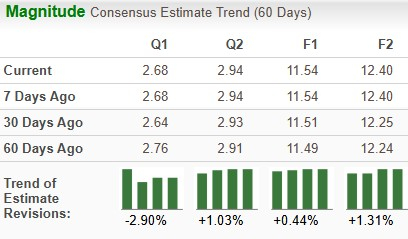
The Zacks Consensus Estimate for J&J’s 2026 sales and EPS imply a year-over-year increase of 6.5% and 7.0%, respectively. The Zacks Consensus Estimate for 2026 earnings has risen from $11.51 to $11.54 over the past 30 days, while that for 2027 has gone up from $12.25 per share to $12.40 per share over the same timeframe.
JNJ Estimate Movement
The Zacks Consensus Estimate for AbbVie’s 2026 sales and EPS implies a year-over-year increase of 9.4% and 8.74%, respectively. The Zacks Consensus Estimate for 2026 earnings has risen from $14.37 to $14.49 per share over the past 30 days, while that for 2027 has declined from $16.28 per share to $16.22 per share over the same timeframe.
ABBV Estimate Movement

Price Performance and Valuation of J&J & ABBV
Stocks of both JNJ and ABBV have risen in the past year. While J&J’s stock has risen 48.1%, AbbVie’s stock has risen 10.2% compared with the industry’s increase of 12.1%

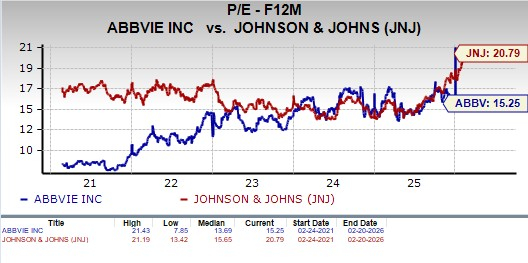
AbbVie looks more attractive than JNJ from a valuation standpoint. Going by the price/earnings ratio, AbbVie’s shares currently trade at 15.25 forward earnings, lower than 18.46 for the industry, but higher than its 5-year mean of 13.69. J&J’s shares currently trade at 20.79 forward earnings, which is higher than the industry as well as the stock’s 5-year mean of 15.65.
ABBV offers a slightly higher yield. J&J’s dividend yield is 2.1%, while AbbVie’s is around 3.1%.

JNJ or ABBV: Which is a Better Pick?
AbbVie and J&J have a Zacks Rank #3 (Hold) each, which makes choosing one stock a difficult task. You can see the complete list of today’s Zacks #1 Rank (Strong Buy) stocks here.
AbbVie delivered robust net sales growth in 2025, which is just the second full year following the Humira LOE in the United States. Sales of AbbVie’s ex-Humira drugs rose more than 14% (on a reported basis) in the fourth quarter, which was above its expectations, driven by Skyrizi, Rinvoq and neuroscience.
It expects a high single-digit revenue growth through 2029, as the company has no significant LOE events for the rest of this decade. A substantial portion of this growth is expected to be driven by the robust performance of Skyrizi and Rinvoq. With no significant LOEs in this decade, AbbVie enjoys the flexibility to invest more in R&D to continue to acquire external innovation.
Similarly, J&J’s stock has shown steady revenue and EPS growth for years. J&J outperformed financial expectations in 2025 and looks optimistic for continued strong momentum in 2026 with a target to generate around $100 billion in revenues in the year. J&J expects sales growth in both segments to be higher in 2026.
As you can see, both companies have done well in 2025 and look optimistic for continued growth in 2026. J&J has a slight edge over AbbVie simply on the basis of a better stock performance and stronger estimate revisions, which reflect analysts’ optimistic outlook for future growth. AbbVie’s stock has been suppressed post fourth-quarter results despite beating estimates. This has been due to a decline in sales of its oncology drugs in the fourth quarter, weakness in the aesthetics segment and overall market caution about growth sustainability.
Want the latest recommendations from Zacks Investment Research? Today, you can download 7 Best Stocks for the Next 30 Days. Click to get this free report
Johnson & Johnson (JNJ): Free Stock Analysis Report
AbbVie Inc. (ABBV): Free Stock Analysis Report
This article originally published on Zacks Investment Research (zacks.com).
Mentioned In This Article
Latest News
| 2 hours |
Boston sues J&J subsidiary over alleged patent infringement for cardiology device
JNJ
Medical Device Network
|
| 5 hours | |
| Oct-08 | |
| Oct-08 | |
| Oct-08 | |
| Oct-08 | |
| Oct-08 | |
| Oct-07 | |
| Oct-07 | |
| Oct-07 | |
| Oct-07 | |
| Oct-06 | |
| Oct-06 | |
| Oct-06 | |
| Oct-06 |
