PPL Gains 2.1% in Three Months: Worth Including in Your Portfolio?
PPL Corporation PPL shares have gained 2.1% over the past three months compared with the Zacks Utility-Electric Power industry’s rally of 2.6%. The company is expanding its footprint through new generation, transmission, and distribution projects, while its strategic investments in clean energy are positioning it to achieve carbon neutrality by 2050.

Image Source: Zacks Investment Research
Some other companies from the same industry like FirstEnergy Corp. FE and Dominion Energy D have gained 6.5% and 4.3%, respectively, during the same period. FirstEnergy continues to benefit from strategic investments, grid modernization and decarbonization efforts. FE’s ongoing investments will further fortify its transmission and distribution operations and increase grid reliability. Dominion Energy is strengthening its electric and natural gas infrastructure through long-term investments, expanding renewables to support its 2050 carbon-neutral goal, and benefiting from rising demand, particularly from large data centers.
Given the current underperformance in price, should you consider adding PPL stock to your portfolio? Let's examine the factors in detail and assess the investment prospects.
Factors Driving the Performance of PPL Stock
PPL benefits from its focus on infrastructure construction projects for generation, transmission and distribution. Customers have been experiencing far fewer outages, courtesy of the company’s initiative to further strengthen its infrastructure.
PPL is working on its “Utility of the Future” strategy and has initiated an IT transformation to implement common systems across the company, while developing standardized design and operational practices across its utilities. This includes more robust engineering and construction specifications to strengthen and automate the grid to mitigate increasing weather and storm risks. These measures are expected to enhance the resilience of PPL’s services and enable the company to meet rising customer demand more efficiently.
PPL has increased its planned capital expenditures to $23 billion for the 2026-2029 period from $20 billion for 2025-2028, reflecting a stronger commitment to expanding and modernizing its infrastructure, including generation, transmission and distribution assets. This higher investment plan is expected to drive a 10.3% compound annual growth rate in its rate base.
PPL’s subsidiaries are enjoying the benefits of economic developments in their service regions, driven by increasing demand from the data centers. The company is experiencing load growth, driven by data center demand. In Pennsylvania, nearly 25.2 GW (up from 20.5 GW) of potential data center demand is in the advanced stages. In the Kentucky segment, the Economic development queue holds potential load growth of 9.3 GW through 2032.
The company continued its leadership in driving down controllable costs for customers, exceeding its cumulative annual operating and maintenance (O&M) savings target and realizing $170 million in annualized savings from 2021 baseline. PPL achieved nearly all of its $175 million annualized savings target one year ahead of schedule.
PPL Stock’s Earnings Estimate
The Zacks Consensus Estimate for 2026 earnings per share (EPS) indicates an increase of 7.73% year over year. PPL’s long-term (three to five years) earnings growth rate is 7.34%.

Image Source: Zacks Investment Research
The Zacks Consensus Estimate for FirstEnergy’s 2026 EPS indicates an increase of 6.67% year over year. FE’s long-term earnings growth rate is 6.46%. The bottom-line estimate for Dominion Energy’s 2026 EPS indicates an increase of 5.82% year over year. D’s long-term earnings growth rate is 10.26%.
PPL Stock’s Earnings Surprise History
PPL beat on earnings in two of the trailing four quarters and missed in the other two, delivering an average surprise of 0.42%.

Image Source: Zacks Investment Research
PPL’s Dividend History
PPL has a long history of dividend payments and plans to increase its annual dividend by 4-6%, subject to approval by its board of directors. Currently, its quarterly dividend is 28.5 cents per share, resulting in an annualized dividend of $1.14 per share.
PPL’s targeted dividend payout ratio is expected to be in the range of 50-60%. The company is expected to continue increasing its dividend, supported by sustained earnings and cash flow growth. Check PPL’s dividend history here.
PPL’s ROE Lower Than the Industry
PPL’s trailing 12-month return on equity of 9.29% is lower than the industry average of 10.7%. Return on equity, a profitability measure, reflects how effectively a company utilizes its shareholders’ funds to generate income.
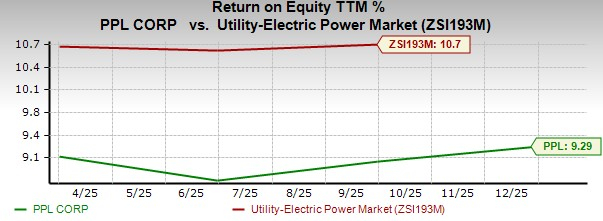
Image Source: Zacks Investment Research
PPL Stock’s Valuation
PPL is currently trading at a discount compared to its industry on a forward 12-month P/S basis.

Image Source: Zacks Investment Research
Summing Up
PPL is strengthening its grid through major infrastructure investments, IT transformation and a higher $23 billion capex plan, driving a 10.3% rate base CAGR while improving reliability and resilience. The company is also benefiting from rising data center-driven load growth and has exceeded its cost-saving targets, achieving annualized O&M savings ahead of schedule.
Given its earnings growth projection, regular dividends and discounted valuation, new investors might consider adding PPL stock to their portfolio right now. PPL currently has a Zacks Rank #2 (Buy). You can see the complete list of today’s Zacks #1 Rank (Strong Buy) stocks here.
Want the latest recommendations from Zacks Investment Research? Today, you can download 7 Best Stocks for the Next 30 Days. Click to get this free report
PPL Corporation (PPL): Free Stock Analysis Report
FirstEnergy Corporation (FE): Free Stock Analysis Report
Dominion Energy Inc. (D): Free Stock Analysis Report
This article originally published on Zacks Investment Research (zacks.com).
Mentioned In This Article
Latest News
| Oct-08 | |
| Oct-08 | |
| Oct-07 | |
| Oct-07 | |
| Oct-07 | |
| Oct-06 | |
| Oct-06 | |
| Oct-05 | |
| Oct-04 | |
| Oct-02 | |
| Oct-01 | |
| Sep-30 | |
| Sep-29 | |
| Sep-29 | |
| Sep-25 |
