Options Corner: DoorDash Just Received A Surprising Boost From Ark Invest's Cathie Wood
DoorDash Inc (NASDAQ:DASH) has been one of the clear laggards in the broader internet sector, with the food ordering and delivery service losing about 27% of equity value since the beginning of this year. Adding to the woes, DASH stock has dropped roughly 33% in the past six months, with some encouraging growth figures from the underlying company's latest fourth-quarter disclosure not enough to overcome the headline miss against expectations.
Still, one notable voice on Wall Street sees opportunity: Ark Invest's Cathie Wood. Through two of its exchange-traded funds, the investment firm acquired about $6.8 million worth of DASH stock. Rather than some frivolous bet, Wood appears confident in the company's long-term positioning, noting that artificial intelligence represents the "most disruptive innovation in history."
With machine learning, Wood's thesis is that companies aggressively harnessing AI — such as DoorDash — could reduce their expenditures while sparking robust expansion of the top and bottom lines. Therefore, the famed investor doesn't seem particularly worried about the trailing five-year performance of DASH stock, which is down more than 2%.
Adding to the contrarian sentiment is the volatility skew for the next upcoming monthly options chain, expiring March 20. Definitionally, the skew identifies implied volatility (IV) — or a stock's potential range of motion — across the strike price spectrum of a given options chain. In other words, the skew visually showcases surface-area distortion of volatility space, which potentially signals areas of concern for the smart money.
In the case of DASH stock, the net priority appears to be downside volatility protection, with put IV rising above call IV on both ends of the strike price boundaries. As such, options traders seem to perceive downside correction as a non-trivial possibility. At the same time, because put options are in demand, calls may be relatively cheap — which sweetens the bullish perspective.
Establishing The Trading Parameters Of DASH Stock
While we now have a basic framework of the smart money's positional bias, we still need to convert this data into projected price outcomes. For that, we may turn to the Black-Scholes-derived expected move calculator. Wall Street's standard mechanism for pricing options anticipates that DoorDash stock will land between $148.17 and $182.41 for the March 20 expiration date.
Where does this dispersion come from? Black-Scholes assumes a world where stock market returns are lognormally distributed. Under this framework, the above range represents where DASH stock may symmetrically fall one standard deviation away from spot (while accounting for volatility and days to expiration).
From a mathematical perspective, Black-Scholes basically claims that in 68% of cases, DoorDash stock would be expected to trade within the prescribed range when March 20 rolls around. It's a very reasonable assumption since it would take an extraordinary catalyst to drive a security beyond a standard deviation from spot.
However, the issue for debit-based options traders is that the expected move calculation only tells us how the market is pricing risk, not whether that pricing is warranted. To extract even more insights, we need to gravitate toward second-order analyses, which condition observed data based on an empirical anchor.
Imagine a classic search-and-rescue (SAR) scenario where DoorDash stock is a lone shipwrecked survivor. Black-Scholes would be the equivalent of a satellite system that identified a distress signal somewhere in open water. Expected move would be the realistic search radius emanating from the signal.

However, powerful waves could easily alter the location of where DASH stock might be within the prescribed parameters. Therefore, we need a probabilistic model that accounts for these unique wave patterns and the potential impact they may have on survivor location.
That's where the Markov property comes into the picture.
Narrowing The Probability Space For DoorDash Stock
Under Markov, the future state of a system depends entirely on the present state. Colloquially, forward probabilities should not be calculated independently but be assessed in context. Extending the SAR analogy, different ocean currents — such as choppy waves versus calm waters — can easily influence where a shipwrecked survivor is likely to drift.
Here's how the Markov property relates to DoorDash stock. In the last five weeks, DASH printed only one up week, leading to an overall downward slope. There's nothing special about this 1-4-D sequence, per se. However, this quantitative signal represents a specific type of ocean current — and survivors caught in these waters would be expected to drift in a particular way.
From here, we can use enumerative induction and Bayesian-inspired inference to help estimate a forward distribution for DASH stock. Basically, we would take past analogs of the aforementioned quant signal and carry forward the median implications from the current spot price.
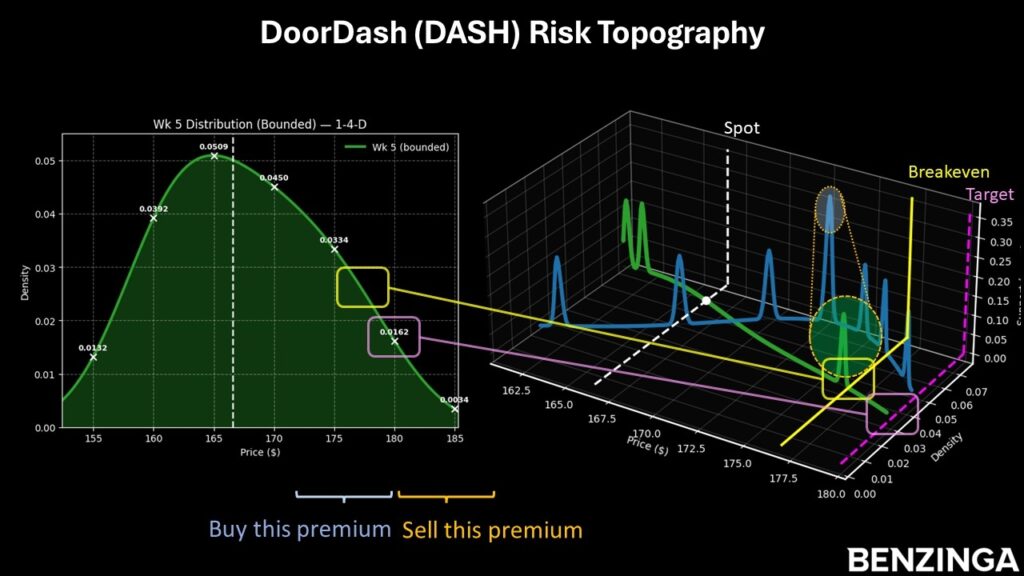
For full transparency, the future is not necessarily compelled by the past, per David Hume's critique of inductive methodologies. However, if we're going to be fair, all market methodologies — fundamental, technical, quantitative — would fall under the same criticism. My counterargument is that, in terms of second-order analyses, the Markov approach utilizes the fewest assumptions.
If you accept the premise above, the forward five-week return of DASH stock would be expected to range between approximately $150 and $190, with probability density admittedly peaking around $165 (below the current spot price). However, overall probability mass appears to slightly favor the bulls. Combined with the steep losses that DASH has already incurred, a reflexive response may also smile on the optimists.
For those who want to take an aggressive wager, the 175/180 bull call spread expiring March 20 appears intriguing. This wager requires DASH stock to rise through the $180 strike at expiration to trigger the maximum payout of over 163%. Breakeven lands at $176.90, helping to improve the trade's probabilistic credibility.
The opinions and views expressed in this content are those of the individual author and do not necessarily reflect the views of Benzinga. Benzinga is not responsible for the accuracy or reliability of any information provided herein. This content is for informational purposes only and should not be misconstrued as investment advice or a recommendation to buy or sell any security. Readers are asked not to rely on the opinions or information herein, and encouraged to do their own due diligence before making investing decisions.
Image: Shutterstock
Mentioned In This Article
Latest News
| Oct-16 | |
| Oct-16 | |
| Oct-16 | |
| Oct-15 | |
| Oct-14 | |
| Oct-14 | |
| Oct-14 | |
| Oct-11 | |
| Oct-09 | |
| Oct-09 | |
| Oct-08 | |
| Oct-08 | |
| Oct-08 | |
| Oct-06 | |
| Oct-05 |
