Revolve (NYSE:RVLV) Delivers Strong Q4 CY2025 Numbers

Online fashion retailer Revolve (NASDAQ:RVLV) announced better-than-expected revenue in Q4 CY2025, with sales up 10.4% year on year to $324.4 million. Its GAAP profit of $0.26 per share was 57.8% above analysts’ consensus estimates.
Is now the time to buy Revolve? Find out by accessing our full research report, it’s free.
Revolve (RVLV) Q4 CY2025 Highlights:
- Revenue: $324.4 million vs analyst estimates of $305.5 million (10.4% year-on-year growth, 6.2% beat)
- EPS (GAAP): $0.26 vs analyst estimates of $0.16 (57.8% beat)
- Adjusted EBITDA: $26.26 million vs analyst estimates of $19.61 million (8.1% margin, 33.9% beat)
- Operating Margin: 6.3%, up from 3.9% in the same quarter last year
- Free Cash Flow was -$12.85 million, down from $7.50 million in the previous quarter
- Active Customers : 2.84 million, up 173,000 year on year
- Market Capitalization: $1.73 billion
Company Overview
Launched in 2003 by software engineers Michael Mente and Mike Karanikolas, Revolve (NASDAQ:RVLV) is a fashion retailer leveraging social media and a community of fashion influencers to drive its merchandising strategy.
Revenue Growth
Examining a company’s long-term performance can provide clues about its quality. Any business can put up a good quarter or two, but many enduring ones grow for years. Regrettably, Revolve’s sales grew at a sluggish 3.6% compounded annual growth rate over the last three years. This was below our standard for the consumer internet sector and is a tough starting point for our analysis.
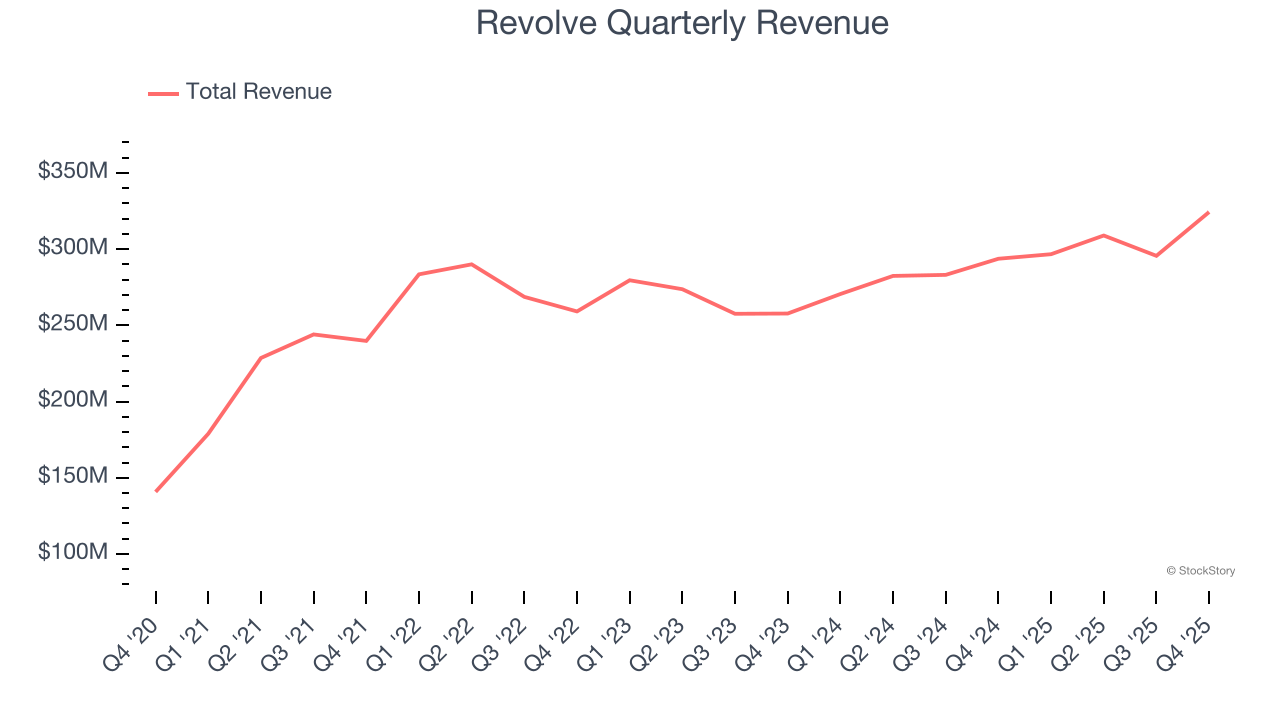
This quarter, Revolve reported year-on-year revenue growth of 10.4%, and its $324.4 million of revenue exceeded Wall Street’s estimates by 6.2%.
Looking ahead, sell-side analysts expect revenue to grow 4.8% over the next 12 months, similar to its three-year rate. Although this projection indicates its newer products and services will catalyze better top-line performance, it is still below average for the sector.
The 1999 book Gorilla Game predicted Microsoft and Apple would dominate tech before it happened. Its thesis? Identify the platform winners early. Today, enterprise software companies embedding generative AI are becoming the new gorillas. a profitable, fast-growing enterprise software stock that is already riding the automation wave and looking to catch the generative AI next.
Active Customers
Buyer Growth
As an online retailer, Revolve generates revenue growth by expanding its number of users and the average order size in dollars.
Over the last two years, Revolve’s active customers , a key performance metric for the company, increased by 5.4% annually to 2.84 million in the latest quarter. This growth rate lags behind the hottest consumer internet applications. If Revolve wants to accelerate growth, it likely needs to engage users more effectively with its existing offerings or innovate with new products.
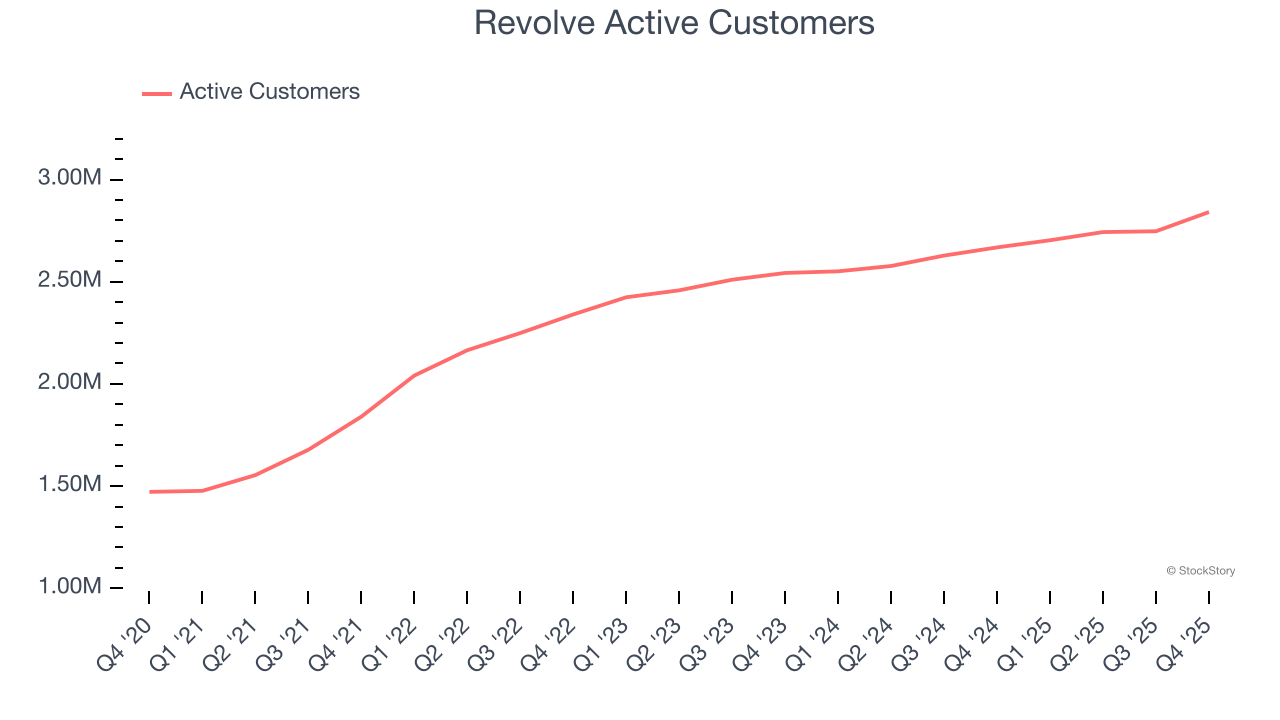
In Q4, Revolve added 173,000 active customers , leading to 6.5% year-on-year growth. The quarterly print was higher than its two-year result, suggesting its new initiatives are accelerating buyer growth.
Revenue Per Buyer
Average revenue per buyer (ARPB) is a critical metric to track because it measures how much customers spend per order.
Revolve’s ARPB growth has been subpar over the last two years, averaging 1.7%. This isn’t great when combined with its weaker active customers performance. If Revolve tries boosting ARPB by taking a more aggressive approach to monetization, it’s unclear whether buyer growth would be sustainable.
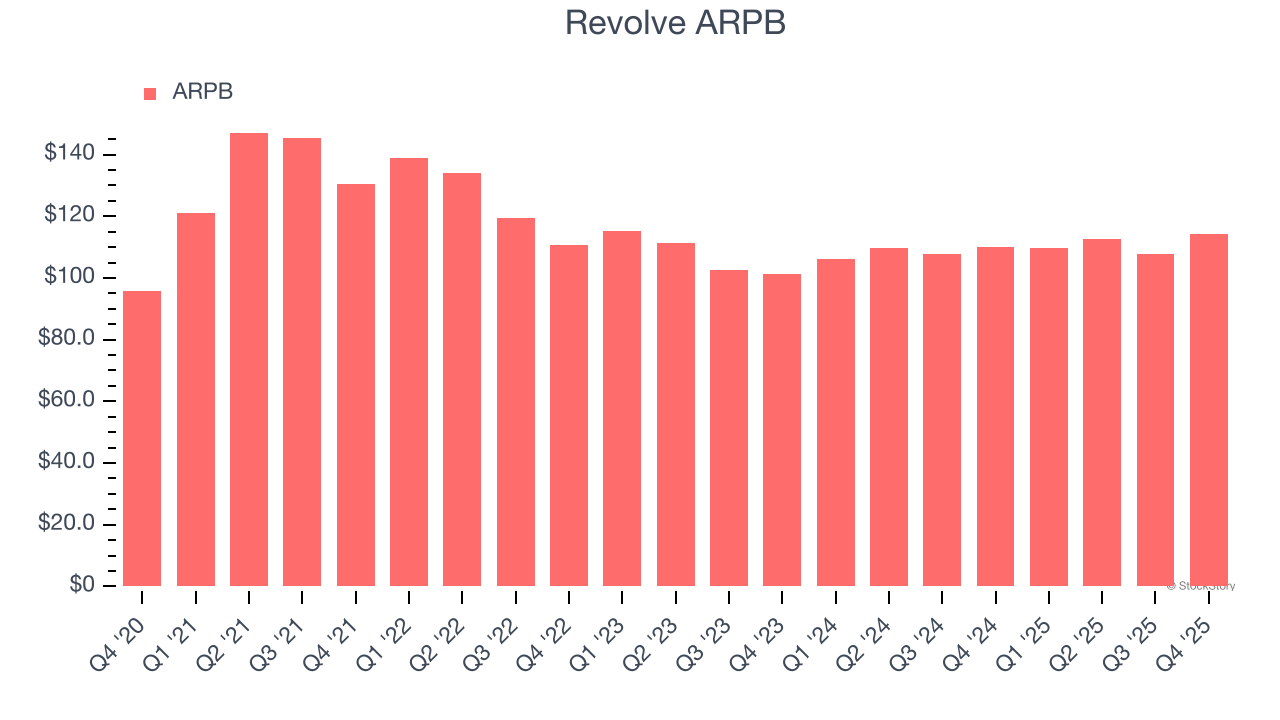
This quarter, Revolve’s ARPB clocked in at $114.17. It grew by 3.7% year on year, slower than its buyer growth.
Key Takeaways from Revolve’s Q4 Results
We were impressed by how significantly Revolve blew past analysts’ EBITDA expectations this quarter. We were also glad its revenue outperformed Wall Street’s estimates. Zooming out, we think this was a good print with some key areas of upside. The stock traded up 1.5% to $26.29 immediately after reporting.
Revolve put up rock-solid earnings, but one quarter doesn’t necessarily make the stock a buy. Let’s see if this is a good investment. What happened in the latest quarter matters, but not as much as longer-term business quality and valuation, when deciding whether to invest in this stock. We cover that in our actionable full research report which you can read here (it’s free).
Mentioned In This Article
Latest News
| Sep-29 | |
| Sep-28 | |
| Sep-21 | |
| Sep-21 | |
| Sep-10 | |
| Sep-08 | |
| Aug-27 | |
| Aug-24 | |
| Aug-05 | |
| Aug-05 | |
| Aug-04 | |
| Aug-04 | |
| Aug-03 | |
| Jul-16 | |
| May-20 |
