QUBT vs. IONQ: Which Quantum Computing Stock Offers Greater Upside?
As the quantum computing industry continues its transition from a research frontier to real-world validation, different underlying technologies are emerging as potential winners. At one end of the spectrum is Quantum Computing Inc.’s (“QCi”) QUBT photonic quantum technology, while at the other end is IonQ’s IONQ trapped-ion technology. Photonic approaches use light particles as qubits, whereas trapped-ion systems rely on atomic ions manipulated by lasers.
IONQ traps ions in a linear ion trap with around 100 tiny electrodes that generate electromagnetic forces to hold ions in 3D space, isolating them from environmental noise. These traps use rapidly oscillating voltages to create stable fields, enabling chains of up to 79 ions for single-qubit gates.
An ultra-high vacuum chamber protects the ions from stray particles that could cause decoherence. Trapped ions offer superior coherence times and reconfigurability without hardware changes, positioning IONQ ahead in scalable quantum systems.
QCi’s photonic technology is a quantum computing approach that uses photons (particles of light) as qubits to encode and process information. Photonic qubits can be represented in several ways, including polarization, path and time-bin. Room-temperature operation reduces costs and complexity, making deployment feasible in commercial, defense and research settings. Photons offer long coherence times, low environmental interaction and compatibility with telecom fibers for scalable, distributed networks.
Price Performance Comparison
In the past year, shares of QCi have surged 49.1% while those of IonQ have skyrocketed 66.4%.

Image Source: Zacks Investment Research
The Case for QUBT
Quantum Computing has achieved several milestones over the past year. First, QCi was awarded a subcontract valued at up to $406,478 to support NASA’s Langley Research Center. Under the project, QCi will apply its Dirac-3 quantum computer to develop quantum-based techniques to remove solar noise from space-based LIDAR data — an obstacle that has historically limited NASA’s ability to conduct reliable daytime atmospheric sensing. QCi was also awarded a contract by the National Institute of Standards and Technology (“NIST”), part of the U.S. Department of Commerce, to design and fabricate TFLN photonic integrated circuits (PICs).
Second, the company achieved several commercial milestones across its quantum AI and cybersecurity offerings. It received a purchase order from a top 5 U.S. bank for its quantum security solutions. This marked QCi’s first U.S. commercial sale of its quantum cybersecurity solutions.
QCi completed construction of its quantum photonic chip foundry in Tempe, AZ, achieving a key milestone in its multi-phase growth strategy. The state-of-the-art facility is now operational, fulfilling customer preorders and positioned to scale production of thin-film lithium niobate (TFLN) photonic chips for the datacom, telecom, advanced sensing and quantum computing markets.
At the end of the third quarter, QCi reported cash and cash equivalents of $352 million, along with $461 million in investments, reflecting ample liquidity to support ongoing operations and expansion plans.
QCi faces elevated near-term risk due to its limited revenue base relative to operating costs, continued dependence on external capital to fund operations and uncertain visibility into large-scale commercial adoption compared with more financially established peers.
The Case for IONQ
IonQ has strengthened its global position through major partnerships, acquisitions and technical breakthroughs in 2025. The company has broadened its strategic engagement with the Korea Institute of Science and Technology Information (“KISTI”), including the scheduled delivery of a 100-qubit Tempo system. It has also expanded its agreement with QuantumBasel, transferring ownership of the existing Forte Enterprise system and securing a future Tempo system deployment.
IONQ signed a memorandum of understanding with the U.S. Department of Energy to advance quantum technologies in space. IonQ announced a strategic collaboration with Emergence Quantum, expanding its presence in APAC and contributing to Australia’s growing quantum industry.
IonQ further accelerated its full-stack quantum platform by acquiring Oxford Ionics, Vector Atomic, Lightsynq and Capella.
IONQ achieved a historic milestone by demonstrating a world-record 99.99% two-qubit gate fidelity, underscoring its path toward 2 million physical qubits and 80,000 logical qubits by 2030. This tangible, peer-reviewable advancement reduces error-correction overhead and strengthens IonQ’s case for an early commercial advantage. The company delivered a 20 times speed-up in quantum-accelerated drug discovery in collaboration with AstraZeneca, Amazon Web Services and NVIDIA.
At the end of the fourth quarter, IonQ reported cash, cash equivalents and investments of $3.3 billion, reflecting ample liquidity to support ongoing operations and expansion plans.
IonQ is still operating at a loss and the commercial viability of large-scale, fault-tolerant quantum systems is yet to be proven. As a result, IONQ faces ongoing execution challenges, uncertain customer adoption and the long development timelines typical of early-stage quantum technologies.
Price Targets: QUBT vs. IONQ
Based on short-term price targets from five analysts, the average price target for QCi is $18.00, representing a potential 107.4% upside from the last closing price.

Image Source: Zacks Investment Research
Based on short-term price targets from 12 analysts, the average price target for IonQ is $73.58, representing a potential 119.1% upside from the last closing price.

Image Source: Zacks Investment Research
Valuation: QUBT vs. IONQ
QCi is trading at a forward 12-month price-to-sales (P/S) ratio of 635.13, below its median of 2114.00 over the past year. IonQ’s forward 12-month P/S ratio of 65.07 is below its median of 91.94. IONQ is trading cheaper than QUBT.
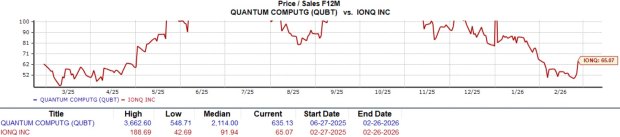
Image Source: Zacks Investment Research
Conclusion
IonQ appears better positioned for long-term leadership, supported by strategic acquisitions, a diversified full-stack roadmap targeting millions of qubits by 2030, and high-profile collaborations with Amazon Web Services, NVIDIA and AstraZeneca. QCi has also made credible technical and commercial progress, including securing government contracts and generating early sales in quantum cybersecurity.
Both companies’ robust balance sheets strengthen their ability to execute through the long commercialization cycle.
Both QCi and IonQ presently carry a Zacks Rank #3 (Hold). Based on 12-month price performance, valuation and price-target metrics, QUBT stock appears less compelling for investors compared with IONQ. You can see the complete list of today’s Zacks #1 Rank (Strong Buy) stocks here.
Want the latest recommendations from Zacks Investment Research? Today, you can download 7 Best Stocks for the Next 30 Days. Click to get this free report
Quantum Computing Inc. (QUBT): Free Stock Analysis Report
IonQ, Inc. (IONQ): Free Stock Analysis Report
This article originally published on Zacks Investment Research (zacks.com).
Mentioned In This Article
Latest News
| Oct-09 | |
| Oct-08 | |
| Oct-08 | |
| Oct-07 | |
| Oct-06 | |
| Oct-06 | |
| Oct-02 | |
| Oct-01 | |
| Sep-30 | |
| Sep-29 | |
| Sep-28 | |
| Sep-28 | |
| Sep-28 | |
| Sep-28 | |
| Sep-28 |
