Coinbase vs. Nasdaq: Which Exchange Stock Is a Better Buy?
Rising market volatility, pro-growth U.S. economic policies under President Donald Trump, broader acceptance of digital assets, ongoing diversification efforts by exchanges beyond core trading operations, and growing retail investor participation are expected to shape the future of exchanges. In this evolving landscape, let’s find out which company is better positioned for long-term growth — Coinbase Global Inc. COIN or Nasdaq NDAQ?
Coinbase, the largest regulated cryptocurrency exchange in the United States, is well-positioned to capitalize on increased market volatility and rising digital asset valuations.
On the other hand, Nasdaq is a leading provider of trading, clearing, marketplace technology, regulatory, securities listing, information and public and private company services. It is set to grow, driven by its focus on Market Technology and Information Services businesses, as well as growth from index and analytics businesses, followed by moderate growth in its exchange data products.
The Case for COIN
Coinbase stands to benefit from President Trump’s supportive stance on cryptocurrencies and efforts to establish clearer digital asset regulations. CEO Brian Armstrong has articulated a long-term vision of transforming Coinbase into an “everything exchange,” offering a comprehensive suite of financial services powered by crypto-native infrastructure. As part of this strategy, Coinbase has introduced stock and ETF trading to users across the United States, significantly expanding its total addressable market beyond digital assets and strengthening its competitive position against diversified fintech brokerages. This move helps bridge traditional financial markets with the digital asset ecosystem, advancing Coinbase’s goal of becoming a unified investment platform.
To support this ambition, Coinbase continues to broaden its product ecosystem. The company has integrated Solana (SOL) onto its Base network, enabled decentralized exchange (DEX) trading to enhance access to Solana-based assets and streamlined cross-asset transfers. It also launched Shiba Inu-linked futures on its U.S.-regulated derivatives platform, expanded alternative cryptocurrency offerings and introduced products such as prediction markets and tokenized equities. These initiatives aim to reduce dependence on spot trading revenues while attracting a broader customer base.
Beyond trading, Base—Coinbase’s low-cost Layer 2 blockchain—plays a central role in driving scalable, real-world on-chain applications and mainstream adoption. Stablecoins are another strategic priority, with Coinbase Payments designed to offer merchants faster, lower-cost alternatives to traditional card networks. Partnerships with Kalshi and major banks, alongside ongoing acquisitions, further diversify revenue streams. While margin pressures and crypto volatility pose risks, Coinbase’s expanding ecosystem and favorable regulatory trends support long-term growth potential.
The Case for NDAQ
Nasdaq operates a highly diversified business model that extends well beyond its traditional stock exchange roots. While its Market Services segment—spanning equities, options, and derivatives trading—benefits from elevated trading volumes and market volatility, a growing share of revenues is derived from its Market Technology division. The company is steadily increasing annual recurring revenue (ARR) by shifting toward subscription-based and long-term contracted offerings. By cross-selling complementary products and integrating acquisitions to expand its solutions portfolio, Nasdaq is enhancing customer retention and improving revenue visibility.
Organic growth has also been supported by the expansion of its non-trading revenue streams, including Trading Services and Marketplace Technology, Data and Listing Services, Index, Workflow & Insights and Anti-Financial Crime solutions. This strategic shift has added greater stability and dynamism to its overall business mix.
Over the years, Nasdaq has strengthened its competitive position through targeted acquisitions, enabling entry into the Canadian equities market, broadening its technology capabilities and enhancing market surveillance solutions. The company continues to leverage advanced technologies and artificial intelligence to modernize market infrastructure and deliver innovative client offerings.
Supported by a solid balance sheet and steady operating cash flows from its diversified operations, Nasdaq remains well-positioned to return capital to shareholders. The company plans to increase its payout ratio to 35%-38% by 2027 and resume share repurchases to offset dilution from the Adenza acquisition. Capital deployment priorities include deleveraging, organic investments, strategic acquisitions, dividend growth and buybacks.
Estimates for COIN and NDAQ
The Zacks Consensus Estimate for COIN’s 2026 and 2027 revenues implies a 0.01% and 9.9% year-over-year increase, respectively. EPS estimates for 2026 imply a 17.6% year-over-year decrease, while the same for 2027 implies a 31.7% year-over-year increase. EPS estimates for 2026 and 2027 have moved down 41% and 33%, respectively, in the past 30 days.
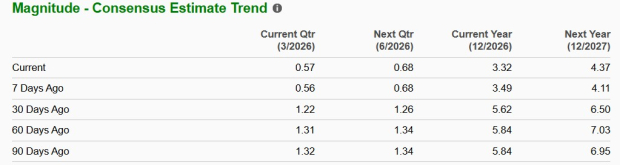
Image Source: Zacks Investment Research
The Zacks Consensus Estimate for NDAQ’s 2026 and 2027 revenues implies a 7.8% and 7.7% year-over-year increase, respectively. EPS estimates for 2026 and 2027 indicate 9.5% and 12.4% year-over-year increase, respectively. The consensus estimate for 2026 EPS has moved down 4 cents, while that for 2027 witnessed no movement in the past 30 days.
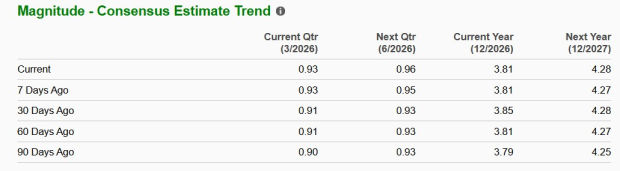
Image Source: Zacks Investment Research
Price Performance of COIN and NDAQ
COIN shares have lost 16.1% in the past year, while NDAQ shares have gained 7% in the same time.
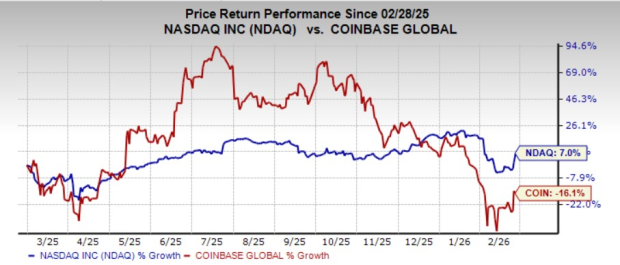
Image Source: Zacks Investment Research
Are COIN and NDAQ Shares Expensive?
Coinbase is trading at a forward 12-month price-to-earnings multiple of 50.4, higher than its median of 46.4 over the past three years. NDAQ’s forward 12-month price-to-earnings multiple sits at 22.82, slightly higher than its median of 22.22 over the past two years.

Image Source: Zacks Investment Research
Parting Thoughts
Coinbase benefits from a well-diversified revenue base that includes trading fees, staking, custodial services and derivatives, all bolstered by growing institutional demand. This crypto leader is leaving no stone unturned to be a one-stop destination for trading of any digital assets or providing financial services related to crypto or digital assets.
Nasdaq is set to grow on impressive organic growth, an increasing on-trading revenue base and strategic buyouts to capitalize on market opportunities. Nasdaq’s focus on Market Technology and Information Services businesses helps explore vast opportunities through its developmental strategies.
Price appreciation, valuation, growth estimate and analyst sentiment give NDAQ an edge over COIN. COIN carries a Zacks Rank #5 (Strong Sell) presently, while NDAQ carries a Zacks Rank #3 (Hold). Thus, NDAQ is better placed than COIN.
You can see the complete list of today’s Zacks #1 Rank (Strong Buy) stocks here.
Want the latest recommendations from Zacks Investment Research? Today, you can download 7 Best Stocks for the Next 30 Days. Click to get this free report
Nasdaq, Inc. (NDAQ): Free Stock Analysis Report
Coinbase Global, Inc. (COIN): Free Stock Analysis Report
This article originally published on Zacks Investment Research (zacks.com).
Mentioned In This Article
Latest News
| 3 hours | |
| 5 hours | |
| 5 hours | |
| 9 hours | |
| 12 hours | |
| 13 hours | |
| 14 hours | |
| 15 hours | |
| 15 hours | |
| Oct-08 | |
| Oct-08 | |
| Oct-08 | |
| Oct-08 | |
| Oct-08 | |
| Oct-08 |
