Don't Be a Wall Street Hero Amid Choppy, Uncertain Trading
Hey there — Senior Market Strategist Matthew Timpane here, filling in for Senior V.P. of Research Todd Salamone this week. It’s been a little while, and the market environment looks much different than the last time I wrote this commentary.
We’ve recently discussed the range-bound behavior in the major indices, and guess what? Nothing changed last week. The S&P 500 Index (SPX – 6,878.88) and Nasdaq Composite (IXIC – 22,668.21) remain stuck in a chop zone. This has been excruciating for investors accustomed to riding growth and momentum leadership. If they haven’t yet rotated into cyclicals or defensive areas, the past few months have been painful.
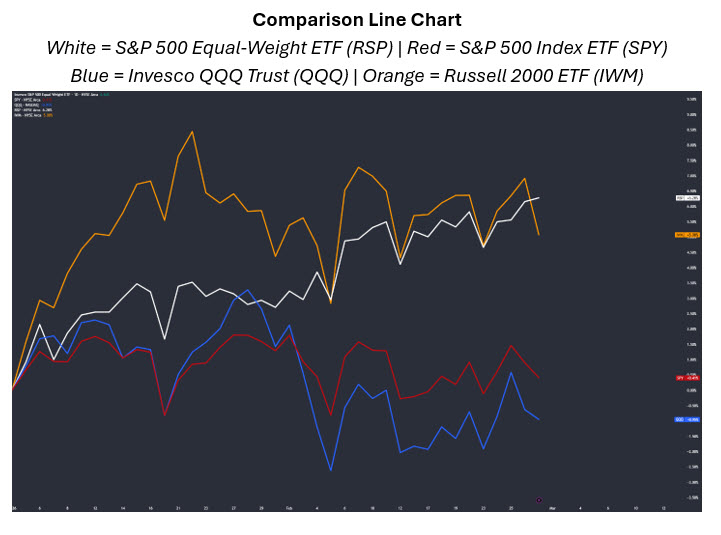
Meanwhile, the Invesco S&P 500 Equal-Weight ETF (RSP – 204.97) and the Russell 2000 Index (RUT – 2,632.36) continue to hold up well and outperform. This divergence helps explain the disconnect we’re now seeing between internals and sentiment.
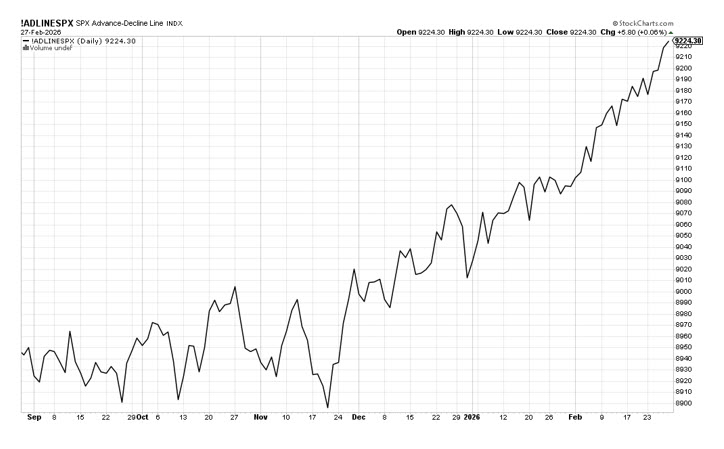
Though market participants remain overwhelmingly bearish, cumulative net new highs continue to expand, and the S&P 500 Advance-Decline Line keeps grinding higher. As frustrating as this may be, it still looks like a healthy rotation, rather than a structural deterioration.
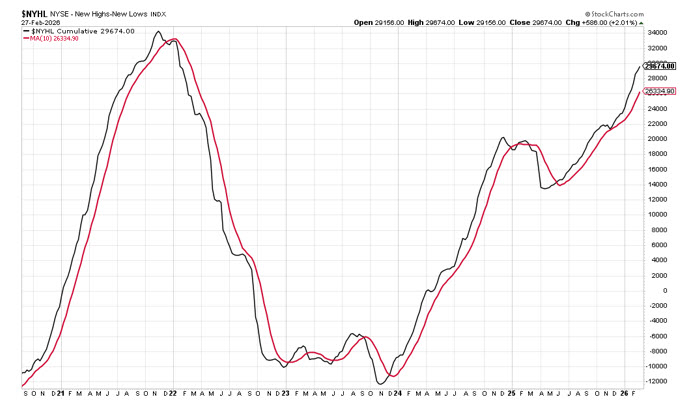
"Are you wondering what happened after the SPX went into similar ranges during the same time frames historically? If you are, we have an answer, using SPX price data during the past 10 years... If history is to repeat, the odds favor more of this “boring” choppy action. Sometime after one month to three months, we may see a sustained break from this range. If a breakout occurs, the direction of it typically favors the bulls, though in one instance it favored bears, driven by the initial tariffs laid out by President Donald Trump in early 2025."
- Monday Morning Outlook, Feb. 23, 2026
The U.S. and Israel carried out a joint preemptive operation against Iran this weekend, adding another layer of uncertainty to a market that is already searching for direction. In my experience, the longer a range holds, the greater the pressure shifts onto the bears, favoring an eventual upside resolution. Last week’s data supported that view, but the escalation in the Middle East gives bears another opportunity.
Historically, wars tend to produce negative short-term reactions in equities, often triggering selloffs in the days or weeks after the initial headlines. According to a J.P. Morgan study from 2022, markets are usually back to about breakeven within three months (average −0.6%) before turning positive, with six-month returns averaging +1.3%, and 12-month returns averaging +5.5%.
What matters most in the near term is the lead-up and early phase of conflict. On average, markets decline about −1.6% initially, with two-week losses averaging −3.7% and one-month declines near −2.9%. These figures are skewed by outliers and should be taken with a grain of salt.
Using simple averages, markets have tended to bottom roughly six to eight weeks after the onset of conflicts. However, when conflicts remain contained or unfold as expected, those lows have often reversed within two to three weeks and are typically associated with V-shaped recoveries. In cases where the conflict was anticipated for weeks or months, markets have tended to bottom almost immediately.
From my perspective, we likely fall into one of the latter scenarios. While the operation was not entirely unexpected, it did surprise markets, as negotiations were still ongoing. According to IG weekend data, broad indices are indicated lower by roughly 75 basis points.
As of this writing, a few key facts are known. The operation is expected to last roughly a week and target critical infrastructure, with the ultimate goal of crippling Iran's operational capacity. Additionally, Iran has confirmed the death of Ayatollah Khamenei. Markets dislike uncertainty, and clarity around these developments removes some of the variables that could dictate Monday’s open and the tone of trading this week.
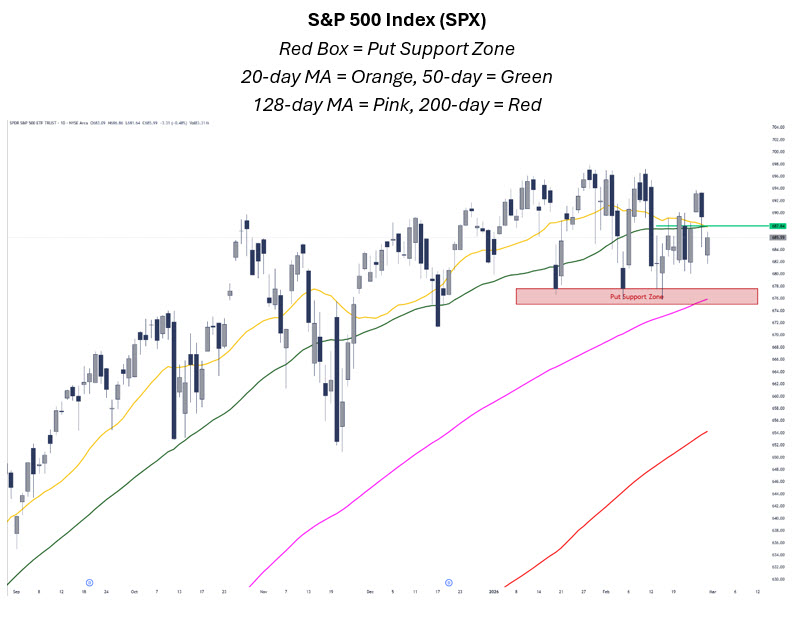
At this point, the primary questions are whether the operation proceeds as planned with minimal casualties, or whether it triggers broader regional escalation. As things stand, I think there is a high probability we test the lower end of the range at the open — roughly the 680 to 675 area on SPDR S&P 500 ETF Trust (SPY – 685.99).
That would be consistent with typical market behavior at the onset of conflict. Below 675 is where conditions become more concerning, as a break of put support could trigger a delta hedge unwind. That is the level to watch closely Monday morning.
If the operation appears contained and the Islamic Revolutionary Guard Corps (IRGC) along with its regional allies and proxies fail to mount a meaningful response, a neutral open would not be entirely surprising. A move back above 688 on SPY could give bulls another opportunity to challenge recent highs, while the round 700 strike remains key resistance on any bullish advance. That said, this is a developing situation, with news driving price action as events unfold.
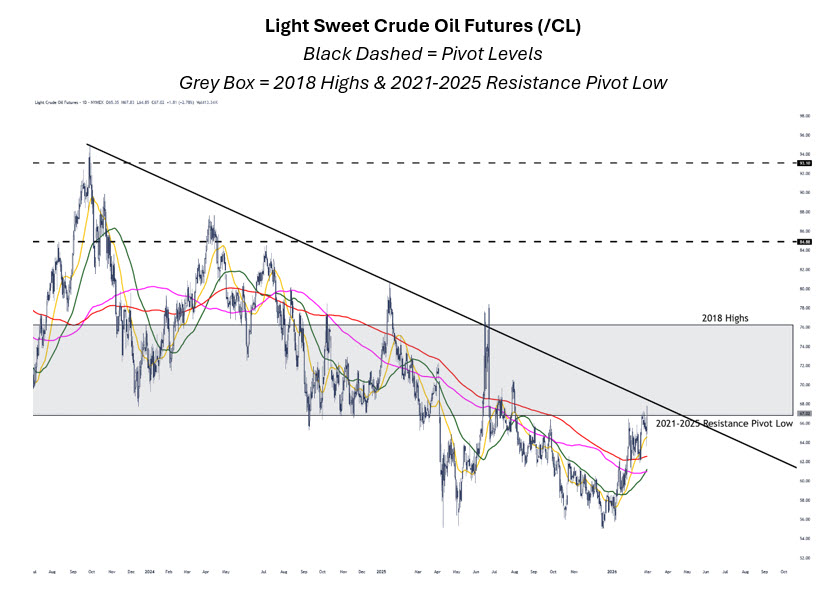
Oil is indicated higher ahead of Sunday night futures trading. Crude rose as much as 11% over the weekend, according to IG data, before easing to roughly 8.5% as of this writing. Expect strength in the energy sector as well as pressure on industries heavily dependent on fuel costs. Upside levels to watch in crude include $77 — the 2018 pivot high — followed by $85, which marked resistance in 2021.
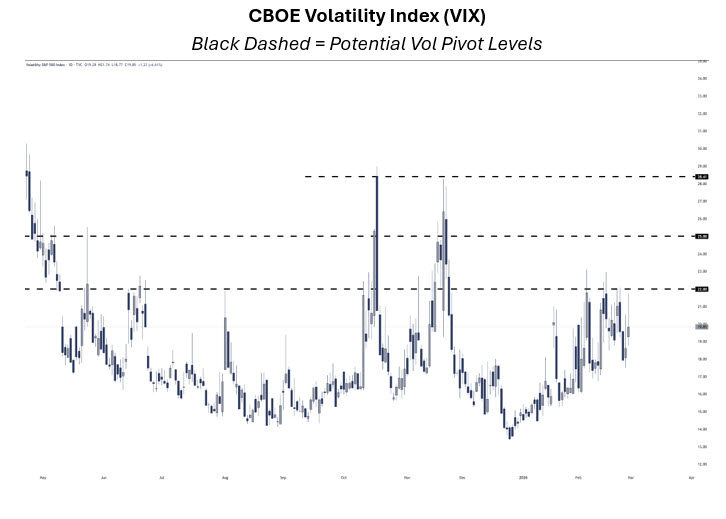
I’ll also be watching volatility early in the week, particularly the 22 level on the CBOE Volatility Index (VIX – 23.26). This level has capped volatility spikes multiple times since May. Only twice during that span has the VIX sustained a move above 22, and in both of those instances it saw volatility push toward 30. A close above 22 may suggest a similar volatility expansion in the near term.
"Additionally, in the short term, the rising buy-to-open put/call volume ratio on SPX components (see chart below) as active fund managers reduce equity exposure is indicative of skepticism as the current range persists."
- Monday Morning Outlook, Feb. 23, 2026
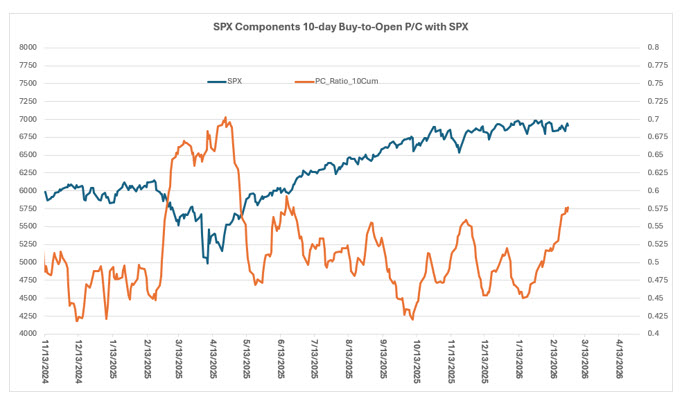
From a sentiment perspective, pessimism continues to build. The 10-day put/call volume ratio ranks at 0.59, or its highest level since June 18, 2025. While not at extreme levels, it remains near the upper end of the recent range.
Friday also saw notable put buying ahead of the conflict, leaving room for potential unwinding should tensions stabilize. Combined with an Advance-Decline Line that is still trending higher, the ingredients are in place for a rally if these geopolitical tensions ease.
I’ll reiterate what I’ve said in recent podcasts: There is no reason to be a hero inside a chop range. Trading conditions like this demand discipline, because the broader market momentum will not bail you out. With added geopolitical uncertainty, discipline becomes even more critical. Opportunities are there, but being selective matters. Until that range resolves, this remains the definition of a stock picker’s market.
Matthew Timpane is a Senior Market Analyst at Schaeffer's Investment Research.
Continue reading:
Mentioned In This Article
Latest News
| 5 hours | |
| Oct-08 | |
| Oct-08 | |
| Oct-08 | |
| Oct-07 | |
| Oct-07 | |
| Oct-07 | |
| Oct-07 | |
| Oct-07 | |
| Oct-07 | |
| Oct-07 | |
| Oct-06 | |
| Oct-06 |
Nassim Taleb and Scott Bessent Clash Over Trump Economy Numbers: Whos Right?
SPY
Benzinga Prediction Markets
|
| Oct-06 | |
| Oct-06 |
