BMY Gains 11.4% in a Month: Should You Buy, Sell or Hold the Stock?
Shares of Bristol Myers Squibb BMY have gained 11.4% in the past month, outperforming the industry’s growth of 5%. The stock has also outperformed the sector and the S&P 500 in the same time frame.
The going has been good for BMY in recent months. Robust fourth-quarter results driven by strength in the company’s growth portfolio and an improving investor sentiment are driving the stock.
BMY Outperforms Industry, Sector & S&P 500 Index

Image Source: Zacks Investment Research
This sustained rally has helped restore confidence among previously cautious investors who now seem confident of the company’s ability to overcome generic erosion of legacy products.
Against this backdrop, let us examine BMY’s fundamentals to assess whether the stock makes for a prudent investment choice.
BMY’s Growth Portfolio Powers Top-Line Growth
BMY’s Growth Portfolio includes key brands, such as Opdivo, Opdivo Qvantig, Orencia, Yervoy, Reblozyl, Camzyos, Breyanzi, Opdualag, Zeposia, Abecma, Sotyktu, Krazati and Cobenfy.
The growth is being driven by the company’s immuno-oncology (IO) portfolio, along with drugs like Camzyos, Breyanzi and Reblozyl. The portfolio accounted for 55% of total revenues in 2025.
Blockbuster IO drug Opdivo is the top revenue generator in this portfolio. Sales continue to be strong, driven by label expansions in newer indications and continued share growth within the first-line non-small cell lung cancer setting.
The approval of Opdivo Qvantig (nivolumab and hyaluronidase-nvhy) for subcutaneous administration has further strengthened BMY’s IO franchise, with initial uptake proving robust across all approved tumor types in the United States.
Sales of its oncology drug, Opdualag, have also been robust, fueling the top line. Growth is strong in the U.S. market, where the drug remains a standard of care in first-line melanoma.
Reblozyl, the thalassemia drug co-developed with Merck MRK, continues to be a major growth driver, with annualized sales now exceeding $2 billion. Revenue growth remains strong, reflecting solid uptake across first- and second-line MDS-associated anemia patients.
Breyanzi sales surpassed a $1 billion annualized run rate, reflecting solid uptake in large B-cell lymphoma and contributions from additional indications. BMY is upbeat about Breyanzi’s prospects in 2026.
The cardiovascular drug Camzyos has also performed well on the back of robust demand.
The FDA approval of xanomeline and trospium chloride (formerly KarXT), marketed as Cobenfy, for the treatment of schizophrenia in adults, represents a significant milestone for BMY.
As the first novel pharmacological approach to schizophrenia in decades, Cobenfy has seen encouraging initial uptake, with sales of $155 million in 2025 driven by expanded access and deepened adoption across community and hospital settings.
The drug is expected to become a meaningful contributor to BMY’s revenue base over time, particularly as the company pursues label expansions into additional indications.
Collectively, these growth drivers are well-positioned to sustain BMY’s top-line momentum in the coming quarters.
BMY’s Legacy Portfolio Grapples With Generic Headwinds
BMY’s legacy portfolio remains under pressure from generic competition, notably affecting Revlimid, Pomalyst, Sprycel and Abraxane, causing a 15% revenue decline in 2025.
The segment — which includes Eliquis, co-developed with Pfizer PFE — generated 45% of total 2025 revenues ($48.2 billion). Although Eliquis demand rose, gains were offset by broader generic erosion and higher U.S. government rebates.
Management expects the legacy portfolio to decline 12-16% in 2026, while Eliquis sales are projected to grow 10-15% on strong global demand.
Under a new U.S. agreement effective Jan. 1, 2026, Eliquis will be supplied at no cost to Medicaid, alongside API donations to support supply-chain resilience. Several other medicines, including Sotyktu, Zeposia and Orencia SC, will also be offered at steep discounts to eligible cash-paying patients.
BMY’s Pipeline Underscores Growth Potential
To further diversify its portfolio, Bristol Myers is making efforts to develop its pipeline. The company expects to report top-line registrational data (mostly in the second half) for six promising candidates — milvexian in both atrial fibrillation and secondary stroke prevention, admilparant in idiopathic pulmonary fibrosis, iberdomide, mezigdomide and arlo-cel in relapsed or refractory multiple myeloma and RYZ101 in second-line gastroenteropancreatic neuroendocrine tumors.
BMY also continues to pursue strategic acquisitions and collaborations to expand its pipeline. The recent acquisition of Orbital Therapeutics adds OTX-201, a preclinical RNA CAR-T therapy designed to reprogram cells in vivo for autoimmune diseases, along with Orbital’s RNA platform.
In 2025, Bristol Myers partnered with BioNTech to co-develop the bispecific antibody pumitamig (BNT327) for solid tumors. Early phase II data in triple-negative breast cancer showed encouraging antitumor activity and manageable safety with chemotherapy. Pumitamig targets PD-L1 and VEGF-A, a dual pathway seen as a promising oncology approach.
BMY’s Valuation & Estimate Revision
Going by the price/earnings ratio, BMY is inexpensive as of now. Shares currently trade at 10.05x forward earnings, higher than its mean of 8.46x but lower than the large-cap pharma industry’s 18.70x.
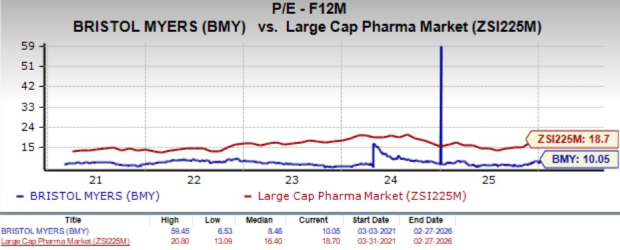
Image Source: Zacks Investment Research
The Zacks Consensus Estimate for 2026 EPS has moved north to $6.24 from $6.08 in the past 30 days, while that for 2027 has gone up to $6.05 from $5.88.

Image Source: Zacks Investment Research
Stay Invested in BMY Stock
BMY delivered a resilient 2025, with growth brands (Opdivo, Opdualag, Reblozyl, Breyanzi and Camzyos) offsetting generic pressure on the legacy portfolio. Looking ahead, potential approvals of new drugs and label expansions for existing drugs should further diversify revenue streams. In addition, upcoming pipeline readouts represent meaningful near-term catalysts that could strengthen the long-term growth outlook of BMY’s growth portfolio.
The company is progressing toward $2 billion in annualized cost savings by 2027, with about $1 billion achieved in 2025, positioning operating expenses to decline and margins to improve from 2026.
However, generic headwinds are expected to weigh on near-term performance, with 2026 revenues guided to $46.0-$47.5 billion, down from $48.2 billion in 2025.
Hence, we recommend a wait-and-watch stance for new investors pending more attractive entry levels, while existing shareholders may consider holding the stock, supported by its ~4% dividend yield.
BMY currently carries a Zacks Rank #3 (Hold). You can see the complete list of today’s Zacks #1 Rank (Strong Buy) stocks here.
Want the latest recommendations from Zacks Investment Research? Today, you can download 7 Best Stocks for the Next 30 Days. Click to get this free report
Bristol Myers Squibb Company (BMY): Free Stock Analysis Report
Pfizer Inc. (PFE): Free Stock Analysis Report
Merck & Co., Inc. (MRK): Free Stock Analysis Report
This article originally published on Zacks Investment Research (zacks.com).
Mentioned In This Article
Latest News
| Oct-09 | |
| Oct-09 | |
| Oct-09 | |
| Oct-09 | |
| Oct-09 | |
| Oct-09 | |
| Oct-09 | |
| Oct-08 | |
| Oct-08 | |
| Oct-08 | |
| Oct-08 | |
| Oct-08 | |
| Oct-08 | |
| Oct-08 | |
| Oct-08 |
FDA approves Pfizer's Tukysa regimen for metastatic breast cancer
PFE
Pharmaceutical Business Review
|
