Focus on Consumers as Household Pessimism Increases
A few weeks ago, I covered the Investors Intelligence (II) sentiment survey and noted that extreme bullishness from published stock market newsletters has historically been followed by market underperformance.
This week, I’m diving into yet another sentiment survey, though this one is very different: the Conference Board Consumer Confidence Index (CCI). Unlike the II, which takes a closer look at published newsletters, the CCI surveys households about current and future economic conditions, focusing on jobs and income expectations.
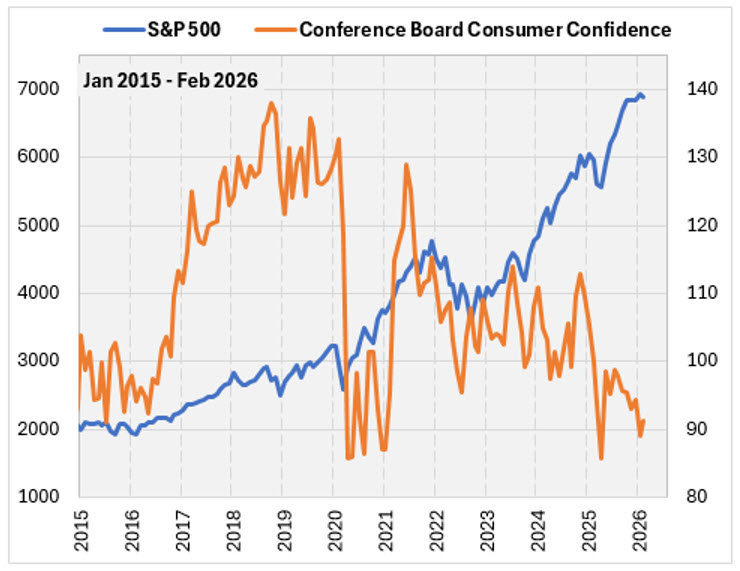
In this article, I examine how the market has performed when households, as reflected in the CCI, are this pessimistic, despite the stock market being near all-time highs for much of the past several months.
Stock Market Near Highs, Households Pessimistic
When the January CCI figure was initially released, it came in at 84.5, the lowest reading since 2014. In the most recent report, however, that reading was revised up to 89.0. As you can see from the chart above, it’s no longer the lowest since 2014, but it’s still low historically.
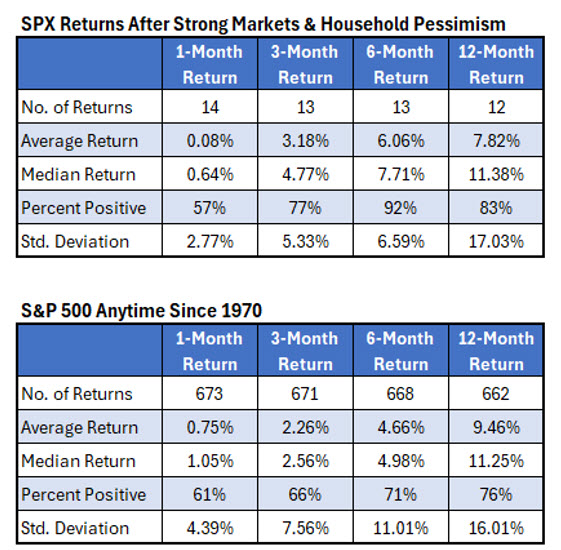
To create an indicator using the monthly CCI data, I found times that the CCI was at least 6% below its average of the last 12 months, while the S&P 500 Index (SPX) was trading near a 52-week high. Specifically for the SPX, its 52-week price range was above 90% (where its low is 0% and high is 100%). The CCI data goes back to 1967. The table below shows the January instance was the 14th time we’ve seen this signal.
The SPX returns look bullish in the medium term (three to six months), with the index averaging a 6.06% return in the next six months, with 92% of the returns positive. The typical six-month return for the index since 1970, the year of the first signal, was 4.66%, with 71% positive.
Over the next year after a signal, the benchmark averaged a return of 7.82% with 83% of returns positive. That average return is slightly less than normal (9.46%), but the percent positive is higher than normal (76%).
Focus on Consumers
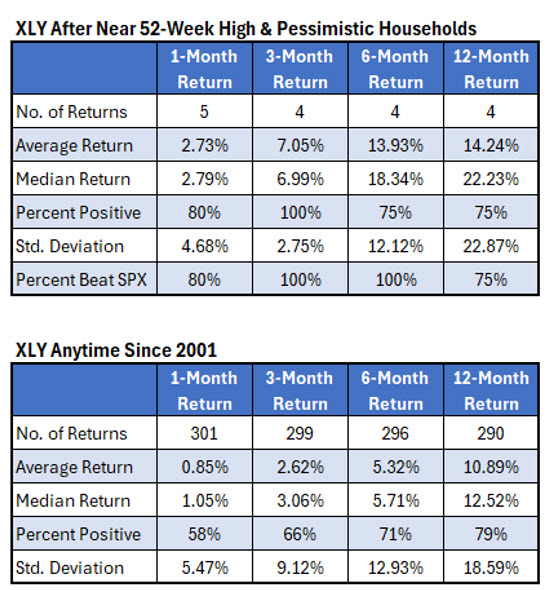
As we’ve seen recently, with the huge spending on data centers due to training AI models, it might not always be consumers driving the stock market. The XLY is an ETF focused on companies sensitive to consumer discretionary spending. Therefore, the CCI might be a better indicator for the XLY, rather than the SPX. For the table below, I found times that the XLY was at 90% or better in its 52-week trading range, while the CCI was 6% or more below its 12-month average. Again, this occurred in January.
The XLY data goes back to 1999. The first signal occurred in 2001, and the recent signal was the fifth time we’ve seen it. Over the next six months, the XLY averaged a return of almost 14% with three of the four positive. The index beat the SPX over the next six months all four times.
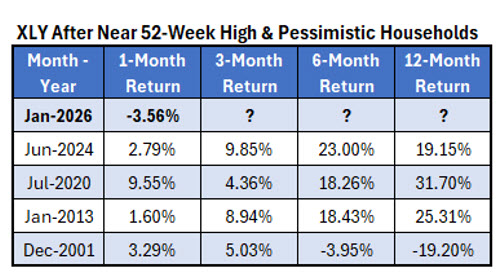
This last table shows each individual XLY signal. The first signal was in late 2001, in which the XLY held up over the next three months but then collapsed, ending lower by almost 20% over the next year. The XLY, however, was stellar following the past three occurrences. In each case, it rallied at least 18% over the next six months and posted one-year gains ranging from 19% to 32%.
Unfortunately, we only have a few data points, so we can’t draw firm conclusions. Still, it looks like the low consumer confidence may be a contrarian signal. So it may be bullish for the XLY, especially given the ETF was recently near the upper end of its 52-week range.
Mentioned In This Article
Latest News
| Oct-22 | |
| Oct-20 | |
| Oct-19 | |
| Oct-13 | |
| Oct-12 | |
| Oct-12 | |
| Oct-06 | |
| Oct-05 | |
| Oct-05 | |
| Sep-29 | |
| Sep-27 | |
| Sep-22 | |
| Sep-22 | |
| Sep-18 | |
| Sep-02 |
