Iran War Sends Oil To $90, Jobs Shock Compounds Fears: This Week On Wall Street
It was the kind of week that reminded investors how quickly the market narrative can shift, as a geopolitical shock, a surprising jobs decline and fresh tariff threats combined to shake confidence across Wall Street.
Energy markets set the tone.
The escalating conflict in Iran disrupted crude supplies and shut down traffic through the Strait of Hormuz — the narrow waterway that normally handles roughly 20% of the world's oil and natural gas shipments.
With parts of the route effectively closed and drone attacks targeting regional energy facilities, several oil-producing countries including Iraq and Kuwait reportedly curtailed production.
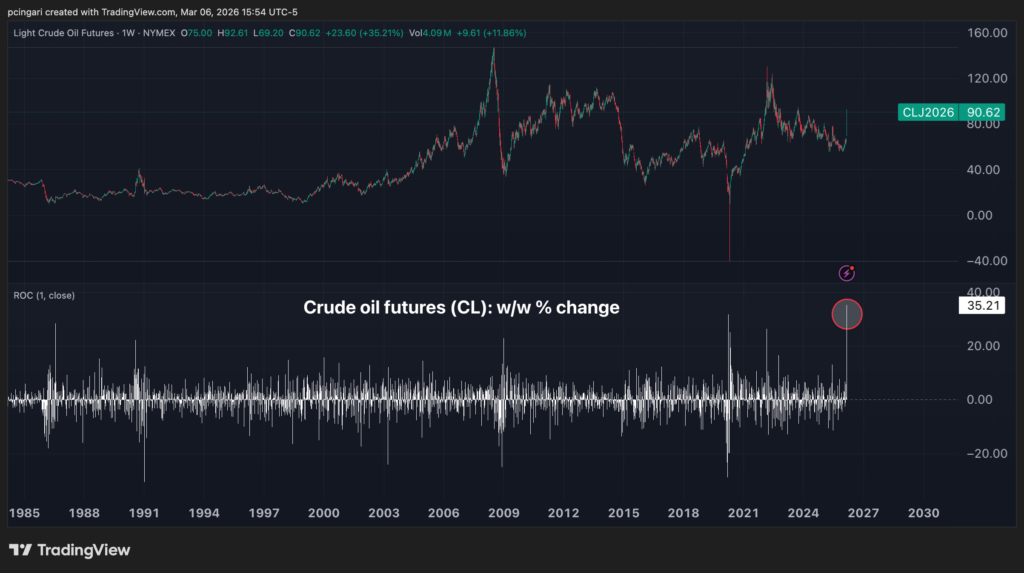
The disruptions helped push crude oil prices sharply higher. Oil surged toward $90 a barrel by midday Friday, up over 30% for the week, one of the biggest weekly jumps in history.
Chart: Crude Tops $90 For First Time Since 2023, Notch Strongest Week Ever
Energy Stocks Avoid Losses, Fuel-Consuming Industries Sink
Higher energy prices quickly rippled through financial markets.
Energy stocks were the only sector in the S&P 500 to finish the week in positive territory, while the remaining sectors ended firmly in the red.
Companies most sensitive to fuel costs suffered the heaviest declines.
Shares of cruise operators Royal Caribbean Group (NYSE:RCL), Carnival Corp. (NYSE:CCL) and Norwegian Cruise Line Holdings Ltd. (NYSE:NCLH) plunged between 15% and 22% during the week.
Airlines were also hit hard. Delta Air Lines Inc. (NYSE:DAL), Southwest Airlines Co. (NYSE:LUV) and United Airlines Holdings Inc. (NASDAQ:UAL) tumbled as investors worried that rising jet fuel costs could squeeze margins just as travel demand begins to soften.
Michigan-based automakers also struggled. Ford Motor Co. (NYSE:F) was among the worst performers in the S&P 500, falling roughly 15% by Friday afternoon. General Motors Co. (NYSE:GM) held up somewhat better but still finished the week about 5% lower.
Job Losses, Tariff Uncertainty Augmented Fears
Economic data added to the negative mood.
On Friday, the Labor Department reported that nonfarm payrolls unexpectedly fell by 92,000 in February, a sharp miss compared with expectations for 59,000 jobs added.
Revisions to prior months also erased an additional 69,000 jobs, suggesting the labor market may be losing momentum faster than previously thought. Meanwhile, the unemployment rate ticked up to 4.4% from 4.3%.
Adding another layer of uncertainty, Treasury Secretary Scott Bessent confirmed the administration plans to implement a sweeping 15% global tariff within days — a move economists warn could add fresh inflationary pressure at a time when energy prices are already surging.
For investors, the message was clear: when geopolitics hits energy markets, it rarely stays confined there.
Image: Shutterstock
Mentioned In This Article
Latest News
| 3 hours | |
| 3 hours | |
| 4 hours | |
| 5 hours | |
| 7 hours | |
| 8 hours | |
| 8 hours | |
| 8 hours | |
| 8 hours | |
| 9 hours | |
| 9 hours | |
| 10 hours | |
| 10 hours |
Royal Caribbean Tops Buy Point On Bullish Outlook. There's One Chart Element To Watch.
RCL +5.46%
Investor's Business Daily
|
| 11 hours | |
| 11 hours |
