2 Domestic Auto Stocks Worth Watching Despite Geopolitical Crisis
Despite these headwinds, some established automakers remain worth watching. Industry leaders such as General Motors GM and Ford F are taking strategic steps to navigate the evolving market landscape while also maintaining investor-friendly capital return policies.
Industry Overview
The Zacks Domestic Auto industry includes companies involved in the design, manufacturing and sale of vehicles worldwide. These range from passenger cars and crossover vehicles to sport utility vehicles, trucks, vans, motorcycles and electric vehicles. The industry is highly cyclical and closely tied to consumer spending, while also supporting a large employment base. At the same time, it is undergoing a major transformation as automakers invest heavily in new technologies. The role of software, electrification and digital connectivity is reshaping how vehicles are developed and sold. Many companies also operate engine and transmission plants and invest in research, development and testing of electric and autonomous vehicles.
Key Themes Shaping the Industry
Vehicle Sales Momentum Losing Steam: The U.S. auto market is showing signs of cooling. Per Cox Automotive, February vehicle sales came in below last year’s level, marking the fifth straight month of year-over-year declines and reflecting the slower momentum seen toward the end of 2025. A key factor behind this slowdown is the pressure on consumers from high new-vehicle prices and lingering concerns about the broader U.S. economic outlook. These challenges are likely to remain major headwinds for the industry in 2026. While March is typically a strong month for auto sales, a sharp spike like the 17.9-million SAAR recorded in March 2025—driven largely by tariff announcements—is unlikely to be repeated this year.
Geopolitical Tensions Add to Consumer Uncertainty: The escalating conflict between the United States and Iran has added pressure to an already fragile consumer confidence. Sentiment in February was weaker compared to a year ago, and persistent global tensions often make households more cautious about major purchases such as vehicles or homes. The situation has also disrupted global energy markets. With oil shipments through the strategically important Strait of Hormuz facing disruptions, crude prices have climbed above $100 per barrel for the first time in four years. Higher fuel and energy costs risk pushing inflation higher, which could further dampen auto demand in the months ahead.
EV Demand Slows After Incentive Rollback: Electric vehicle demand in the United States has slowed sharply after key incentives expired at the end of the third quarter of 2025. The removal of a federal tax credit of up to $7,500 for qualifying EVs and plug-in hybrids has made these vehicles less affordable, weakening an important demand driver. Automakers are increasingly acknowledging that EV demand—particularly in the United States—has not met earlier expectations. The country is also starting to lag other major markets in EV adoption as government support has weakened following policy changes under Donald Trump. The slowdown is already visible in sales data. Ford sold just 2,122 EVs in February, a sharp 71% year-over-year decline.
Higher Tax Refund Could Offer Some Respite: Some improvement in auto demand may emerge in the coming months as tax refunds start reaching households. Refunds are expected to be higher this year due to the One Big Beautiful Bill Act enacted in 2025, potentially giving consumers extra cash for discretionary spending, such as vehicles. The law also introduced a tax deduction on interest paid on qualified auto loans, allowing taxpayers to deduct up to $10,000 annually. While this is unlikely to dramatically change demand trends, it could provide a modest near-term boost to vehicle purchases. These savings may also help partly offset price pressures linked to import tariffs introduced under Trump.
Zacks Industry Rank Indicates Tepid Prospects
The Zacks Automotive – Domestic industry is part of the broader Zacks Auto-Tires-Trucks sector. The industry currently carries a Zacks Industry Rank #150, which places it in the bottom 38% of more than 240 Zacks industries.
The group’s Zacks Industry Rank, which is basically the average of the Zacks Rank of all the member stocks, indicates lukewarm near-term prospects. Our research shows that the top 50% of the Zacks-ranked industries outperform the bottom 50% by a factor of more than 2 to 1.
The industry’s positioning in the bottom 50% of the Zacks-ranked industries is a result of a negative earnings outlook for the constituent companies in aggregate. Looking at the aggregate earnings estimate revisions, it appears that analysts are getting pessimistic about this group’s earnings growth potential. Over the past year, the industry's earnings estimate for 2026 has declined 51%.
Despite that, we will present a couple of stocks that you might consider adding to your watchlist. Before that, let us discuss the industry’s recent stock market performance and valuation picture.
Industry Tops Sector & S&P 500
The Domestic Auto industry has significantly outperformed the auto sector and the Zacks S&P 500 composite over the past year. The industry has returned 81% compared with the sector and S&P 500’s growth of 48% and 23%, respectively.
One-Year Price Performance
.jpg)
Industry's Current Valuation
Since automotive companies are debt-laden, it makes sense to value them based on the EV/EBITDA (Enterprise Value/Earnings before Interest Tax Depreciation and Amortization) ratio. On the basis of the trailing 12-month enterprise value to EBITDA (EV/EBITDA), the industry is currently trading at 55.31X compared with the S&P 500’s 17.6X and the sector’s 30.61X. Over the past five years, the industry has traded as high as 69.8X, as low as 10.28X and at a median of 29.34X, as the chart below shows.
EV/EBITDA Ratio (Past Five Years)
.jpg)
.jpg)
2 Stocks to Consider
Ford: It is one of the leading automakers in the United States and ranks as the third-largest seller by vehicle sales volumes. The company is adjusting its strategy to reflect changing market realities, placing greater emphasis on profitable hybrids and traditional vehicles while scaling back the pace of its EV expansion. Going forward, Ford will focus its EV efforts on smaller and more affordable models built on its upcoming Universal EV Platform, designed to lower production costs.
A key strength for Ford is its commercial and fleet division, Ford Pro. The segment has become an important profit driver, supported by strong demand for work trucks as well as integrated software and service offerings. Paid software subscriptions within Ford Pro rose 30% in 2025 and profits from software and related services are projected to increase about 6.5% this year.
Beyond vehicles, Ford is expanding into energy solutions through its Ford Energy initiative. The company plans to invest roughly $1.5 billion in 2026 to build a presence in the energy storage market. Ford also ended 2025 with about $50 billion in liquidity, including $29 billion in cash, providing financial flexibility to fund growth initiatives. Income investors may also find the stock attractive, with the dividend yield currently above 4%.
F stock currently carries a Zacks Rank #2 (Buy). The Zacks Consensus Estimate for Ford’s 2026 and 2027 EPS implies year-over-year growth of 40% and 20%, respectively. You can see the complete list of today’s Zacks #1 Rank (Strong Buy) stocks here.
Price & Consensus: F
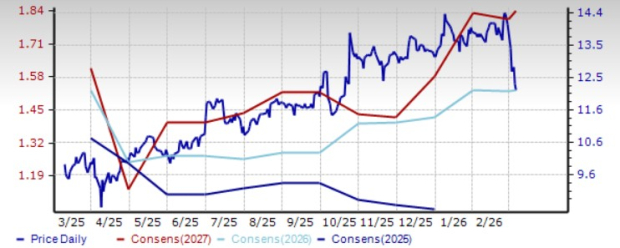
Image Source: Zacks Investment Research
General Motors: It strengthened its position in the U.S. auto market in 2025, emerging as the country’s top-selling automaker. Notably, 2025 marked GM’s fourth consecutive year of market share gains, highlighting steady momentum in its core vehicle lineup. The automaker has also adjusted its strategy in response to slower-than-expected EV demand. GM sold its stake in the Ultium Cells Lansing battery plant and shifted some production capacity from EVs back to ICE models. At the same time, warranty expenses are trending lower and EV-related losses are expected to decline, which should support overall profitability.
Beyond vehicles, software and services are becoming an increasingly important profit contributor. Subscription-based offerings such as OnStar and the driver-assistance system Super Cruise recorded strong subscriber growth in 2025. Deferred revenues from software and services are projected to reach about $7.5 billion in 2026, nearly 40% higher than last year.
GM is also returning significant cash to shareholders through buybacks and dividends. Since late 2023, the company has returned about $23 billion to shareholders and recently approved a new $6 billion share repurchase program while raising its dividend by 20%.
GM stock currently carries a Zacks Rank #3 (Hold). The Zacks Consensus Estimate for General Motors’ 2026 and 2027 EPS implies year-over-year growth of 16% and 7%, respectively.
Price & Consensus: GM
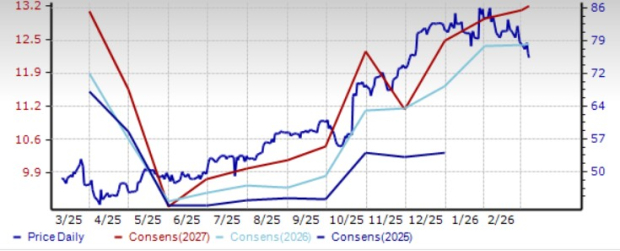
Image Source: Zacks Investment Research
Want the latest recommendations from Zacks Investment Research? Today, you can download 7 Best Stocks for the Next 30 Days. Click to get this free report
General Motors Company (GM): Free Stock Analysis Report
Ford Motor Company (F): Free Stock Analysis Report
This article originally published on Zacks Investment Research (zacks.com).
Mentioned In This Article
Latest News
| Oct-08 | |
| Oct-08 | |
| Oct-08 | |
| Oct-08 | |
| Oct-07 | |
| Oct-07 | |
| Oct-07 | |
| Oct-07 | |
| Oct-07 | |
| Oct-06 | |
| Oct-06 | |
| Oct-06 | |
| Oct-05 | |
| Oct-05 | |
| Oct-05 |
