Large-format Grocery & General Merchandise Retailer Stocks Q4 Recap: Benchmarking Walmart (NASDAQ:WMT)

As the Q4 earnings season wraps, let’s dig into this quarter’s best and worst performers in the large-format grocery & general merchandise retailer industry, including Walmart (NASDAQ:WMT) and its peers.
Big-box retailers operate large stores that sell groceries and general merchandise at highly competitive prices. Because of their scale and resulting purchasing power, these big-box retailers–with annual sales in the tens to hundreds of billions of dollars–are able to get attractive volume discounts and sell at often the lowest prices. While e-commerce is a threat, these retailers have been able to weather the storm by either providing a unique in-store shopping experience or by reinvesting their hefty profits into omnichannel investments.
The 4 large-format grocery & general merchandise retailer stocks we track reported a mixed Q4. As a group, revenues were in line with analysts’ consensus estimates while next quarter’s revenue guidance was 1.2% below.
In light of this news, share prices of the companies have held steady. On average, they are relatively unchanged since the latest earnings results.
Walmart (NASDAQ:WMT)
Known for its large-format Supercenters, Walmart (NYSE:WMT) is a retail pioneer that serves a budget-conscious consumer who is looking for a wide range of products under one roof.
Walmart reported revenues of $190.7 billion, up 5.6% year on year. This print was in line with analysts’ expectations, but overall, it was a slower quarter for the company with full-year EPS guidance missing analysts’ expectations significantly and EPS guidance for next quarter missing analysts’ expectations significantly.
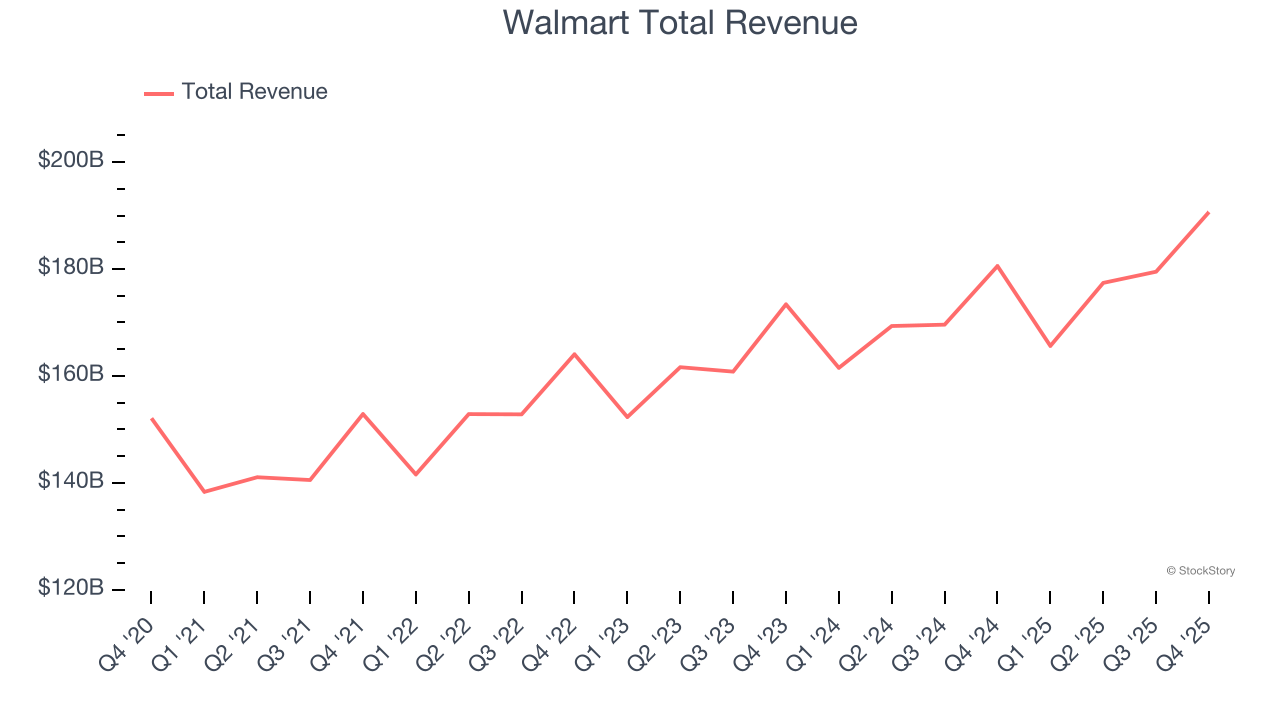
Unsurprisingly, the stock is down 2.4% since reporting and currently trades at $123.59.
Read our full report on Walmart here, it’s free.
Best Q4: Target (NYSE:TGT)
With a higher focus on style and aesthetics compared to other large general merchandise retailers, Target (NYSE:TGT) serves the suburban consumer who is looking for a wide range of products under one roof.
Target reported revenues of $30.45 billion, down 1.5% year on year, in line with analysts’ expectations. The business had a strong quarter with full-year EPS guidance exceeding analysts’ expectations and a beat of analysts’ EPS estimates.
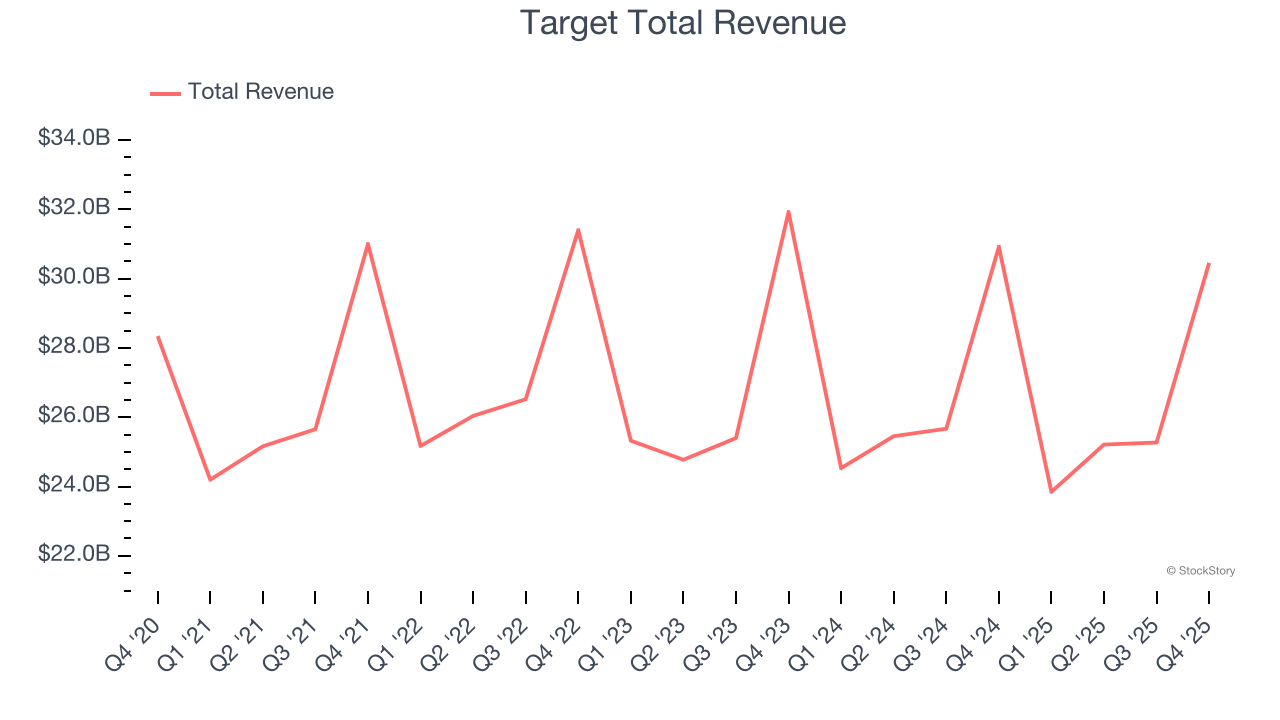
The market seems happy with the results as the stock is up 6.6% since reporting. It currently trades at $120.61.
Is now the time to buy Target? Access our full analysis of the earnings results here, it’s free.
Weakest Q4: BJ's (NYSE:BJ)
Appealing to the budget-conscious individual shopping for a household, BJ’s Wholesale Club (NYSE:BJ) is a membership-only retail chain that sells groceries, appliances, electronics, and household items, often in bulk quantities.
BJ's reported revenues of $5.58 billion, up 5.6% year on year, in line with analysts’ expectations. It was a slower quarter as it posted a significant miss of analysts’ EBITDA estimates and full-year EPS guidance missing analysts’ expectations.
As expected, the stock is down 3.4% since the results and currently trades at $96.59.
Read our full analysis of BJ’s results here.
Costco (NASDAQ:COST)
Designed to be a one-stop shop for the suburban consumer, Costco (NASDAQ:COST) is a membership-only retail chain that sells groceries, apparel, toys, and household items, often in bulk quantities.
Costco reported revenues of $69.6 billion, up 9.2% year on year. This number surpassed analysts’ expectations by 0.8%. Aside from that, it was a mixed quarter as it also logged an impressive beat of analysts’ gross margin estimates but a slight miss of analysts’ EBITDA estimates.
Costco achieved the biggest analyst estimates beat and fastest revenue growth among its peers. The stock is up 1.3% since reporting and currently trades at $995.93.
Read our full, actionable report on Costco here, it’s free.
Want to invest in winners with rock-solid fundamentals? Check out our Top 5 Quality Compounder Stocks and add them to your watchlist. These companies are poised for growth regardless of the political or macroeconomic climate.
StockStory’s analyst team — all seasoned professional investors — uses quantitative analysis and automation to deliver market-beating insights faster and with higher quality.
Mentioned In This Article
Latest News
| 10 hours | |
| 10 hours | |
| 11 hours | |
| 17 hours | |
| Oct-15 | |
| Oct-15 | |
| Oct-15 | |
| Oct-15 | |
| Oct-15 | |
| Oct-15 | |
| Oct-15 | |
| Oct-15 |
Target, Walmart, Other Discounters Make Bullish Moves Amid Plunging Yields, AI Exodus
WMT
Investor's Business Daily
|
| Oct-15 | |
| Oct-15 | |
| Oct-15 |
