Microsoft Positioned to Win AI Race With Dual-Model Strategy
The circular nature of funding for artificial intelligence (AI) infrastructure has weighed on technology stocks. However, Microsoft's (NASDAQ: MSFT) recent announcement that it would continue to integrate Anthropic into its products, despite objections from the Trump administration, shows why its investments are paying off for users and shareholders.
Here’s the background. On March 5, the U.S. Department of Defense informed AI company Anthropic that it would label the company a supply-chain risk and would discontinue the use of its products within six months. President Trump went one step further and called for all federal agencies to discontinue their use of Anthropic.
Microsoft was the first company to announce it would continue to make Anthropic products, including Claude, available to its federal government customers, excluding the U.S. Department of Defense.
This isn’t just a symbolic gesture of defiance. In November 2025, Microsoft committed to invest up to $5 billion in Anthropic, which in turn committed to purchase $30 billion of Azure compute capacity and to contract additional capacity up to one gigawatt.
It’s been a profitable partnership. Microsoft spends approximately $500 million per year to use Anthropic AI in its suite of products. Furthermore, Microsoft allows its Azure sales team to count sales of Anthropic AI models as part of their sales quotas.
The benefit to shareholders goes beyond the company’s relationship with Anthropic. There’s also a bullish story for Microsoft related to its ongoing partnership with OpenAI.
GPT-5.4 Launch Expands Microsoft’s AI Ecosystem
On the same day Microsoft announced it was standing by Anthropic, OpenAI also launched ChatGPT-5.4. OpenAI is framing GPT-5.4 as its “most capable and efficient frontier model for professional work.” It’s available as a standard model, a reasoning model (GPT-5.4 Thinking), and a high-performance variant labeled GPT-5.4 Pro.
Here’s where the story becomes more interesting. By providing the computational horsepower for both Anthropic’s Claude and OpenAI’s ChatGPT, Microsoft has positioned Azure as the critical close ecosystem for much of the AI environment.
Allowing its customers to have access to both models creates a “best model for the job” scenario. Microsoft can route tasks to whichever model performs the best. That means Microsoft wins no matter which model customers prefer.
Azure’s Explosive Growth Is Being Fueled by AI Workloads
That model-agnostic position only holds its value if the underlying infrastructure keeps scaling. But that’s exactly what Azure is doing. In Microsoft’s most recent earnings report, Azure surpassed $75 billion in annual revenue in fiscal 2025, growing 34% for the full year and 39% year-over-year (YOY) for the quarter.
That growth is getting a significant boost from AI-related workloads embedded across the product stack as Copilot adoption spreads across Office, GitHub, and enterprise software suites. That’s the flywheel effect that investors should focus on. With roughly 25% global cloud market share and 85% of Fortune 500 companies now using Azure, Microsoft has become the default cloud infrastructure layer for enterprise AI adoption.
Copilot and Azure Are Creating a Powerful Enterprise Flywheel
The relationship between Microsoft's AI products and its cloud business can't be understated. Every Copilot seat sold drives more Azure consumption. Every Azure contract creates a natural on-ramp for Copilot adoption. The two businesses are accelerating each other in ways that are increasingly visible in Microsoft's financial results.
Microsoft chief executive officer (CEO) Satya Nadella has noted that more than 90% of the Fortune 500 now use Microsoft 365 Copilot, and the product is increasingly being treated less like a chatbot add-on and more like a core enterprise platform.
That said, Copilot adoption is still in its early stages, which is arguably more bullish than bearish. Most organizations are running pilots and phased rollouts rather than full enterprise-wide deployments.
MSFT Stock Shows Signs of a Potential Bullish Reversal
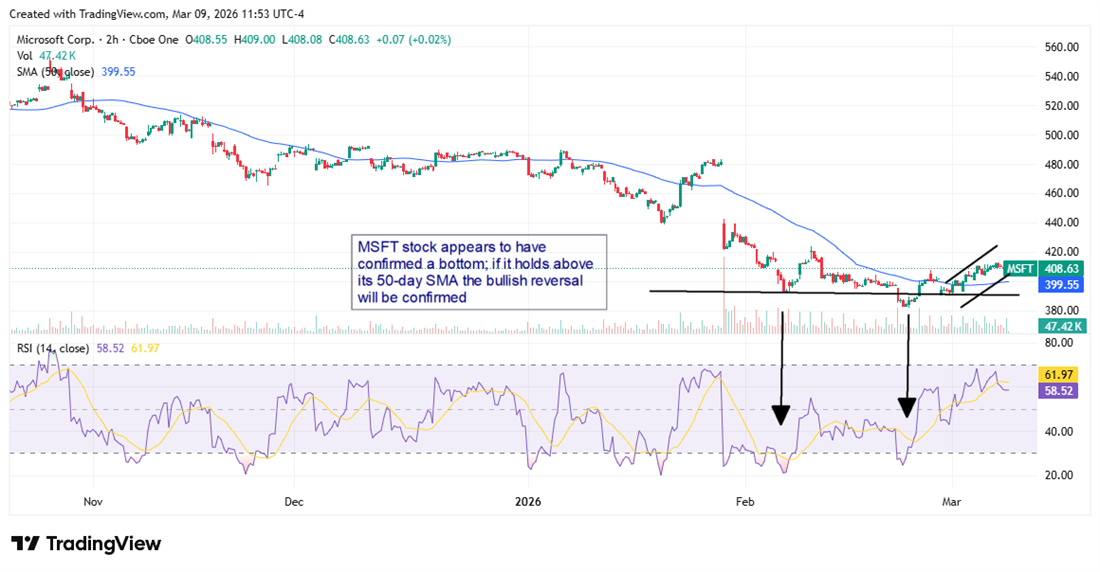
Of course, all this good news won’t matter much to shareholders if the outlook for Microsoft’s stock price doesn’t improve. MSFT stock is down over 15% in 2026, mostly due to a steep gap down after its earnings report, triggered by AI bubble fears that were amplified by the selloff in software stocks.
But that may also change. The chart shows signs of a bottoming. The question for investors is what the upside for the stock looks like. For now, that looks limited. However, the stock has managed to climb above the 50-day simple moving average (SMA). If it can hold that level and build on a recent pattern of higher highs and higher lows, there could be confirmation of a bullish reversal.
Analysts remain bullish on MSFT stock. The Microsoft analyst forecasts on MarketBeat give the stock a consensus price target of $591.95, which would be a nearly 45% gain. It’s worth noting that several recent price targets are much higher than the consensus price. Those targets are supported by institutional buying, which was up strongly in the last quarter.
Where Should You Invest $1,000 Right Now?
Before you make your next trade, you'll want to hear this.
MarketBeat keeps track of Wall Street's top-rated and best performing research analysts and the stocks they recommend to their clients on a daily basis.
Our team has identified the five stocks that top analysts are quietly whispering to their clients to buy now before the broader market catches on... and none of the big name stocks were on the list.
They believe these five stocks are the five best companies for investors to buy now...
The article "Microsoft Positioned to Win AI Race With Dual-Model Strategy" first appeared on MarketBeat.
Mentioned In This Article
Latest News
| 24 min | |
| 2 hours | |
| 2 hours | |
| 2 hours | |
| 2 hours | |
| 3 hours | |
| 3 hours | |
| Oct-08 | |
| Oct-08 | |
| Oct-08 | |
| Oct-08 | |
| Oct-08 | |
| Oct-08 | |
| Oct-08 | |
| Oct-08 |
