Key Catalysts That Will Likely Drive Prospects for NPCE Stock in 2026
NeuroPace, Inc. NPCE enters 2026 after posting $100 million in 2025 revenue, up 25% year over year. The business is also moving toward a cleaner mix, with the core RNS System taking center stage as non-core revenue rolls off.
The company is targeting continued growth in its core adult focal RNS franchise, with a long-term expectation of at least 20% growth and 2026 guidance consistent with that direction. At the same time, the stock is expected to perform broadly in line with the market, making 2026 less about calling a top and more about building a decision framework around execution, valuation, and catalysts.
NPCE Investment Snapshot From 2025 to 2026
The 2025 setup combined strong top-line growth with a gradual shift toward the core RNS business. DIXI Medical product distribution still represented about 16% of 2025 revenue, but that contribution ends after inventory sell-through and repurchase arrangements that concluded by Dec. 31, 2025.
Operationally, management points to expanding growth channels beyond Level 4 comprehensive epilepsy centers and to engagement indicators that improved through 2025. For investors, this matters because procedure-based adoption tends to accelerate when referral pathways broaden and clinician capacity expands.
NeuroPace Valuation Multiples vs Peers and History
On valuation, NPCE trades at about 4.57x forward 12-month sales per share. That sits modestly above the Zacks sub-industry at 4.11x and well above the Zacks Medical sector at 2.28x, while below the S&P 500 at 5.06x. The multiple has ranged from 0.63x to 11.74x over the past five years, with a five-year median of 3.4x.
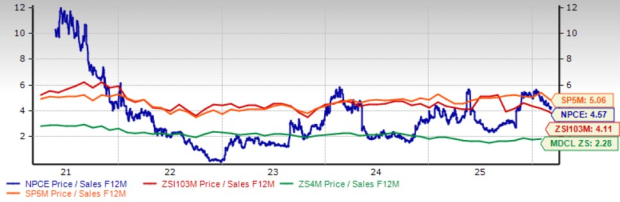
Image Source: Zacks Investment Research
To justify staying above its historical median, the market likely needs to see core RNS growth hold near the guided cadence, margin expansion track guidance, and evidence that community expansion translates into sustained procedure volume. By contrast, the multiple can compress if seasonal softness drags longer than expected, if spending ramps ahead of tangible funnel conversion, or if investors lose confidence in the timing of software and indication milestones that support capacity expansion.
Peer context can help frame expectations. Companies such as LivaNova LIVN and Medtronic MDT participate in broader neuromodulation markets, where adoption and valuation often hinge on reimbursement support, clinical workflow integration, and durable procedure growth rather than one-quarter beats.
NPCE Margin Setup After the DIXI Wind-Down
A practical reason 2026 is a reset year is that the business becomes “pure-play” core RNS after the DIXI distribution agreement expired on Sept. 30, 2025, with remaining inventory sold through Dec. 31, 2025. After that wind-down, NeuroPace no longer records DIXI revenue.
That cleaner mix can matter for how investors interpret profitability. Fourth-quarter 2025 gross margin expanded to 77.4%, with RNS gross margin at 80.5%, supported by mix shift, manufacturing efficiencies, and pricing conversion. For 2026, adjusted gross margin guidance is 81.5%–82.5%. Even if revenue is weighted to the second half, the margin profile becomes more directly linked to core RNS pricing discipline and manufacturing execution rather than the blend of product streams.
NeuroPace Reimbursement Upside That Could Lift Economics
Medicare updates effective Jan. 1, 2026 are a notable catalyst because they raise both hospital and physician economics for replacement-related procedures. CMS reassigned RNS replacement procedures to a higher-paying neurostimulator category, lifting average hospital reimbursement to $31,526 from $21,444. CMS also increased physician payments for RNS implantation and replacement procedures by about 43% and 45%, respectively.
In investor terms, that uplift can support neurosurgeon adoption, procedure growth, and continued access for Medicare beneficiaries receiving treatment in outpatient settings. It also reinforces management’s unit-economics narrative, where reimbursement and pricing levers help protect average selling prices and sustain margins as volume scales.
NPCE Near-Term Risk: Front-Loaded Spend and Seasonality
The near-term risk case is largely about cadence. Management guides to adjusted EBITDA losses in 2026, with adjusted EBITDA expected to be a loss of about $9 million to $11 million. Operating expenses are guided to $90 million to $92 million, with slightly more than half of annual spend planned in the first half.
Revenue seasonality is also expected to moderate growth in the first half of 2026 before re-accelerating in the second half. First-quarter 2026 revenue is guided to $21 million to $22 million. This combination can pressure sentiment even if full-year revenue targets remain intact, especially if investors demand visible evidence that expanded channels are converting to procedures fast enough to absorb the early-year investment.
NeuroPace Decision Framework Using Zacks Signals
Zacks’ stance implies expectations for performance broadly in line with the market, which fits a framework approach: investors can focus on whether fundamentals improve fast enough to support the current premium to the five-year median sales multiple.
NeuroPace currently carries a Zacks Rank #3 (Hold). You can see the complete list of today’s Zacks #1 Rank (Strong Buy) stocks here.
Want the latest recommendations from Zacks Investment Research? Today, you can download 7 Best Stocks for the Next 30 Days. Click to get this free report
Medtronic PLC (MDT): Free Stock Analysis Report
LivaNova PLC (LIVN): Free Stock Analysis Report
NeuroPace, Inc. (NPCE): Free Stock Analysis Report
This article originally published on Zacks Investment Research (zacks.com).
Mentioned In This Article
Latest News
| Oct-23 | |
| Oct-23 | |
| Oct-22 | |
| Oct-22 | |
| Oct-21 | |
| Oct-21 | |
| Oct-20 | |
| Oct-20 | |
| Oct-19 | |
| Oct-16 | |
| Oct-15 | |
| Oct-15 | |
| Oct-15 | |
| Oct-15 | |
| Oct-15 |
