Is The 10% Correction Level an Arbitrary Point for Stocks?
Over the past few weeks, three of four major stock indexes - the Dow Jones Industrial Average (DJI), Nasdaq Composite (IXIC), and Russell 2000 Index (RUT) have entered correction territory, meaning a decline of 10% from the recent all-time high. The S&P 500 Index (SPX) came close, falling about 9%, but never quite got to that threshold.
While 10% is arbitrary, it tends to attract a lot of attention from pundits. This week, I’ll look at the historical data to see what typically happens when these indexes first hit correction territory. Does this widely watched level fuel more selling due to negative headlines, create a buying opportunity, or is it just an arbitrary point at which nothing out of the ordinary happens?
10% Corrections on Major Indexes
For the data below, I’m looking at the returns after the index fist pulls back 10% from it’s all-time high on a closing basis.
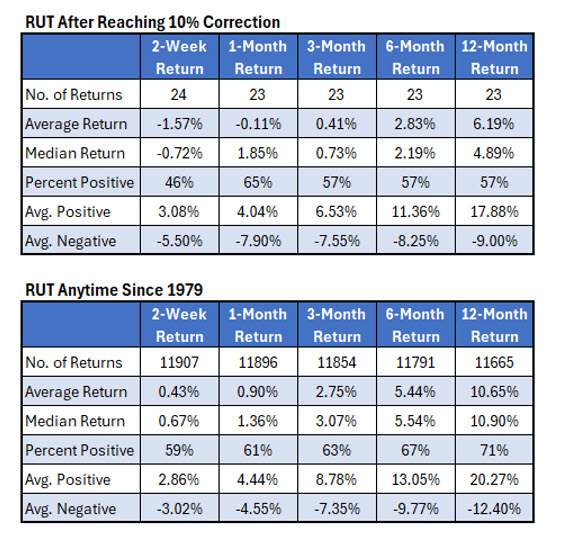
First, I’m looking at the small-cap Russell 2000 Index. The RUT was the first of the indexes to close at a 10% loss from its all-time high. It occurred on March 20. Going back to 1979, this is the 24th correction for the index.
The index has tended to struggle after closing in correction territory, especially in the short term. In the two weeks after these signals, the index lost 1.57% on average with over half of the returns negative. This recent signal has bucked this trend with the RUT gaining over 4% in the two weeks after March 20. In the short term, the negative average return was due to bigger losses than normal (the average negative is bigger than usual). In the longer term, the underperformance is due more to a smaller percentage of positive returns. The index averages a one-year return of 6.19% after a signal with 57% of returns positive vs. an typical average of 10.65% with 71% of returns positive.
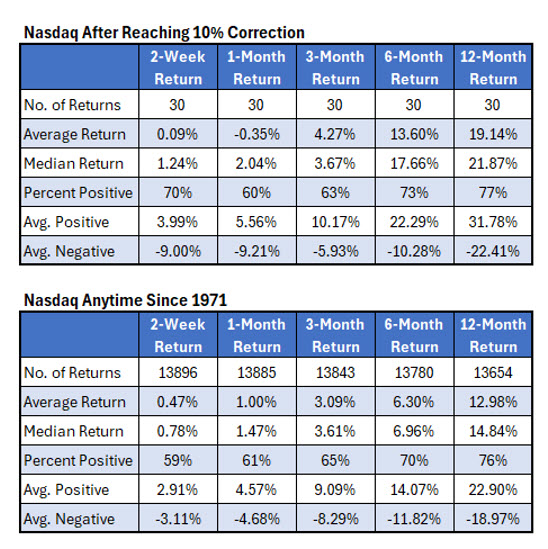
Next, I’m showing returns for the tech-heavy Nasdaq Composite, which I have data going back to 1971. This index reached correction territory on March 26. Like the RUT, this index shows poor returns in the short term due to bigger losses than usual. In the first month after a signal, the index averaged a slight loss of 0.35% vs. a typical 1% gain, even though the percentage of positive returns is about normal. The losses, however, averaged a decline of 9.21% vs. a typical average negative return of 4.68%. Once you get past the first month, things get a lot better. In the six months after a correction, the Nasdaq averages an impressive return of 13.6% with 73% of the returns positive vs. a typical six-month return of 6.3% and 70% win rate.
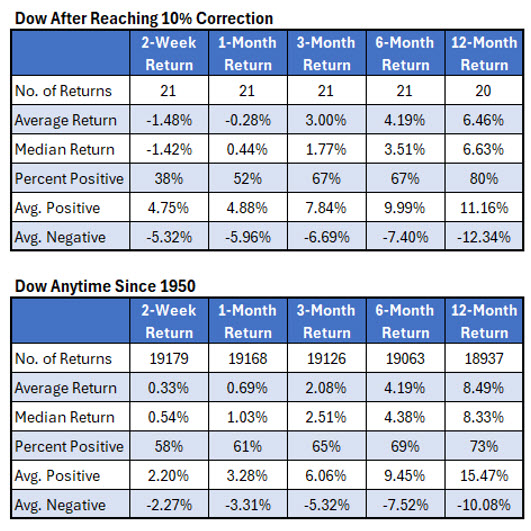
The last of the three indexes to reach correction territory was the large-cap Dow Jones Industrial Index. Going back to 1950, we’ve now seen 22 corrections for the Dow. Once again, this level seems to accelerate losses in the short term. The index tends to loss about 1.5% over the first two weeks after a correction with just 38% of the returns positive. The longer term returns are mixed with slight outperformance at three months, slight underperformance at one year and six month returns which are typical to anytime returns.
With the recent rally, the SPX is about 4.5% above correction territory. But for completeness, let’s look at how the SPX has performed after a correction. The SPX has had 24 corrections since 1950. Again, big losses in the short term have led to underperformance in the month after a signal. Returns get closer to normal after that but there’s still significant underperformance after a year with an average 12-month return of 5.71% after a correction vs. a typical return of 9.33%.
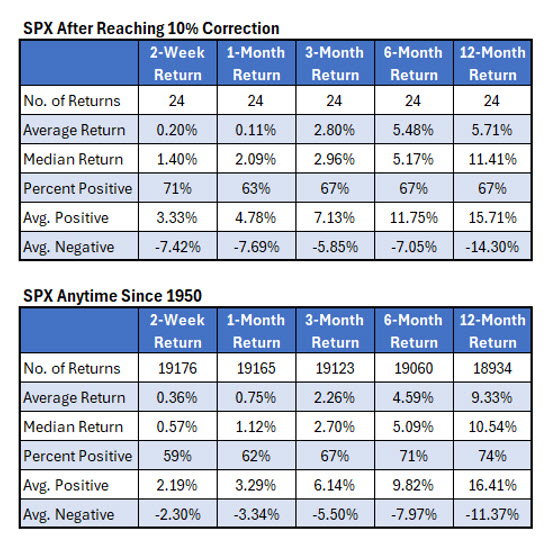
In conclusion, the 10% correction level seems like more than an arbitrary point on a stock chart. Although it didn’t happen this time for the three indexes that recently hit correction territory, losses tend to accelerate in the short term after the 10% threshold is reached. Scary headlines declaring stocks in correction territory might fuel panic selling from investors. This is something to keep an eye on if the SPX falls to about 6,280, which is 10% below the all-time closing high from late January.
Mentioned In This Article
Latest News
| 4 min | |
| 4 min | |
| 15 min | |
| 2 hours | |
| 2 hours | |
| 3 hours | |
| 3 hours | |
| 4 hours | |
| 6 hours | |
| Oct-22 | |
| Oct-22 | |
| Oct-22 | |
| Oct-22 | |
| Oct-22 | |
| Oct-22 |
