What the Call Buying Frenzy Means for the S&P 500
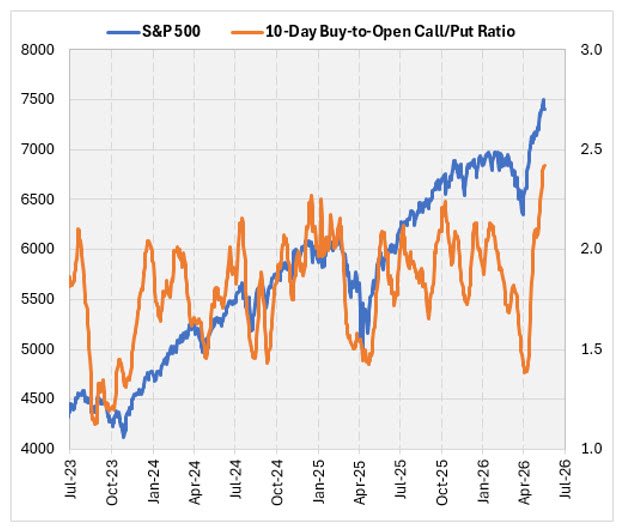
It’s been a tumultuous few months for stocks, and option buyers have been chasing the momentum. That’s what I gather from the 10-day buy-to-open (BTO) call/put ratio for current S&P 500 Index (SPX) stocks. This indicator only tracks option purchases, excluding option selling activity and closing trades. This volume, which we get from three exchanges, is more likely speculative, giving a clearer picture of sentiment. As you can see in the chart, sentiment swung dramatically in a very short period of time.
After March -- the worst month for the S&P 500 Index (SPX) in a year -- the 10-day BTO call/put ratio fell to 52-week low. This means option buyers were buying puts at the highest rate compared to calls over the preceding year. Since then, the market has surged. April was the best month for the SPX in over five years, and it’s up another 2% so far in May.
At the same time, the 10-day BTO call/put ratio went from a 52-week low to a high in just over a month’s time. We have BTO data since 2015, and that’s by far the fastest it’s gone from one extreme to the other.
This week I’m looking at the other two times this indicator went from extreme bearish sentiment to bullish in a very short amount of time. Then I’ll focus on which stocks option buyers have been targeting to drive this ratio higher.
Extreme to Extreme
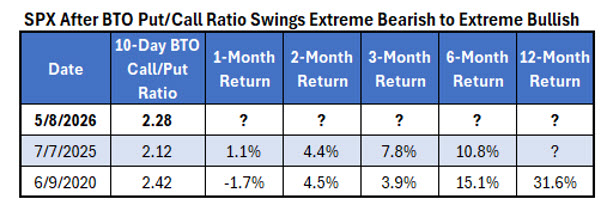
The rapid move from extreme low to extreme high for this indicator is very rare. There have only been two other times since 2015 that the 10-day BTO put/call ratio went from a 52-week low to near a 52-week high in less than three months. This recent time and the 2020 occurrence in the table below are the only two times it went from extreme to extreme. The last time, in July of last year, it didn’t quite get to a 52-week high, but it was close. On a hopeful note, the SPX performed very well going forward after those two instances. The index was up double-digits within six months both times. Hopefully, in six months, it’ll be three for three.
Sector Breakdown
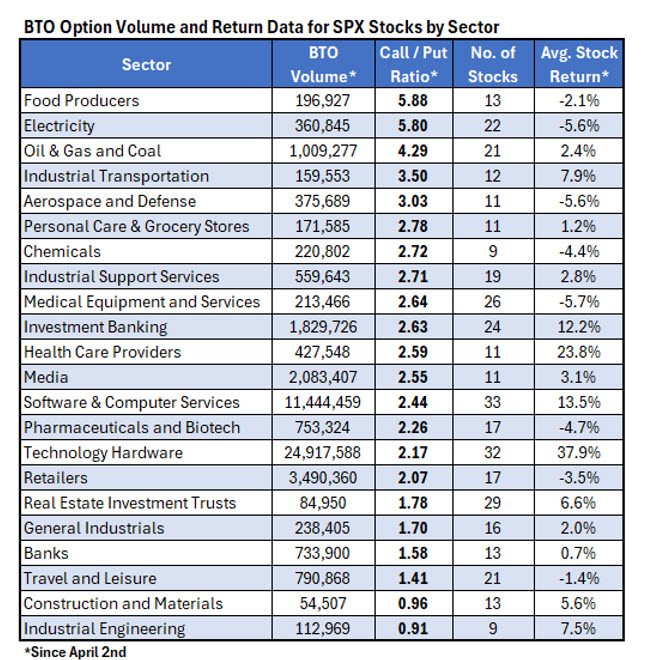
The 10-Day BTO call/put ratio bottomed on the last trading day before Easter, April 2. Since then, the SPX has gained about 12%, while option buyers have purchased 2.1 calls for every put. With that context, let’s look at what sectors option buyers have been betting on and betting against.
We track about 40 different sectors, but I’m narrowing down the list to those which have at least eight SPX companies and had at least 50,000 BTO volume since early April. That gives us the 22 sectors listed below sorted by their BTO call/put ratio.
The technology hardware sector made up about 35% of total BTO volume over the period. The sector includes Apple (AAPL), Nvidia (NVDA), Intel (INTC), Advanced Micro Devices (AMD), and Micron Technology (MU), which all were in the top ten stocks for BTO volume during the period. This sector performed the best with an average stock return of 38% during the period (INTC returned 115%). The call/put ratio since early April was 2.17, just slightly above the ratio for all stocks.
Another observation is, if I’m making a contrarian case, I notice the top two sectors in the list, food producers and electricity, are two of the seven worst performing sectors in the table going by the average stock return. Despite the poor performance since early April, there have been almost six call purchased for each put.
At the bottom of the table, construction materials and industrial engineering were two of the top eight sectors by average stock return, yet those are the only two sectors in which more puts were purchased than calls. A contrarian could suspect bullish implications going forward for these sectors.
Individual Stocks
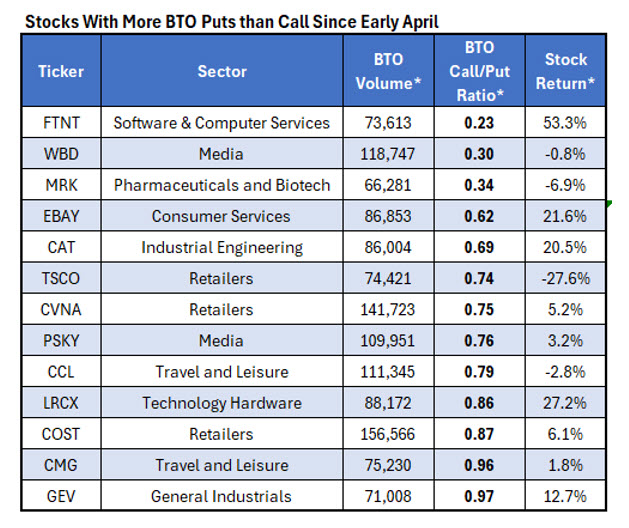
Considering the top 100 SPX stocks by BTO volume, the table below lists the 13 stocks which had more puts bought to open than calls. A contrarian strategy would look at the best performers in this table (i.e. FTNT, LRCX, EBAY, and CAT) and consider a long position.
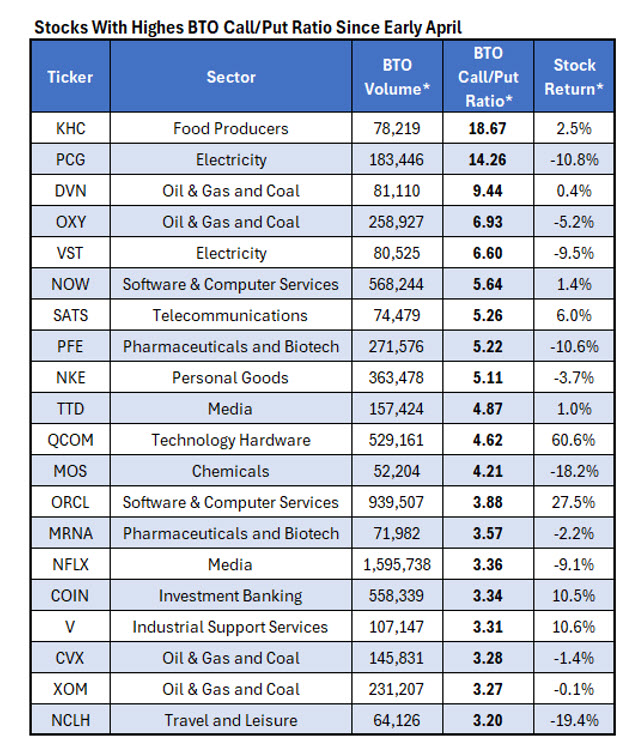
Finally, here are the stocks with the highest BTO call/put ratios since early April. Option buyers seem to be bullish on these names. A contrarian would find the biggest underperformers (NLCH, MOS, PCG, PFE, VST, and NFLX) and avoid them or consider making a bet on further declines.
Mentioned In This Article
Latest News
| 6 min | |
| 56 min | |
| 1 hour | |
| 1 hour | |
| 2 hours | |
| 2 hours | |
| 2 hours | |
| 2 hours | |
| 5 hours | |
| 5 hours | |
| 6 hours | |
| 7 hours | |
| 8 hours | |
| Oct-22 | |
| Oct-22 |
