Monitor These Crosswinds Amid Equity Market Volatility
Last week was not short on headlines. There was the obligatory “Deal and No Deal” with respect to Iran-U.S. negotiations, plus the occasional dust-up or threat from President Donald Trump that market participants have become accustomed to in recent weeks. Last week also offered up Apple’s (AAPL -- 291.13) Worldwide Developers Conference, fresh reads on inflation, and the Space Exploration Technologies' (SPCX -- 160.95) first day of trading after its $135/share initial public offering (IPO).
By week’s end, the 10-year treasury yield (TNX) was lower than the previous week’s close. While the bond market held its own on the inflation data, investors sold stocks, but rushed back in late Thursday on a headline that a deal was made between Iran and the U.S. The headline was not accurate, but was followed by the usual “a deal could be reached within days.”
Deal, no deal and inflation data aside, the TNX remains below the 4.6% area at which it peaked in May. (I have pointed out in previous commentaries that the TNX peaked around 4.6% in May 2024 and May 2025).
“Profit-taking may have added to the selloff… last week’s peak came near 7,615 — a level I flagged as potentially significant because it sits 20% above the March low. Investors anchored to that low may have viewed the level as an opportunity to lock in gains… don’t lose sight of the potential importance of SPX 7,350 which marked the low on May 19…. If the 10-year yield continues to stabilize below 4.6%, buyers may surface here. If the 7,350 level is breached, the next potential area of support is between 7,000 (the late-January high) and the rising 50-day moving average, which enters the week at 7,155.”
- Monday Morning Outlook, June 8, 2026
The S&P 500 Index (SPX -- 7,431.46) ended around its level of the prior week, although a drawdown during the week was significantly more than its peak upside. In fact, on Wednesday, the SPX closed below the 7,350 area that I highlighted as a potential first level of support.
However, the index closed back above that level on Thursday and Friday. Wednesday’s low of 7,257 held just above the rising 50-day moving average, then at 7,230. I continue to view the 50-day moving average as the next potential support level if the mid-May short-term low is broken to the downside.
With the 50-day moving average at 7,250 entering the shortened standard expiration week, I continue to see the area between 7,250 and 7,350 as a first line of defense as trading begins this week.
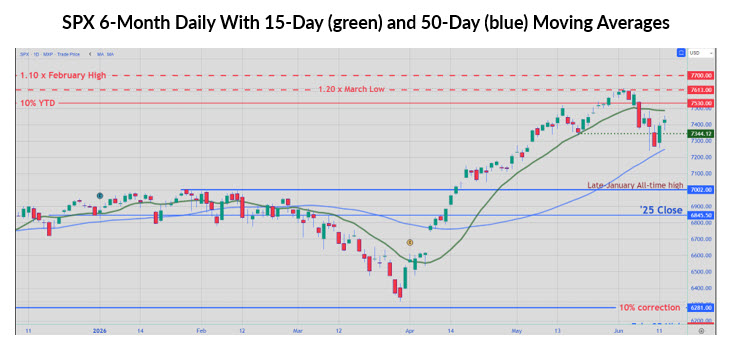
There are multiple levels of potential resistance overhead on the SPX. The first area is in the vicinity of 7,500, as this marks the mid-May short-term closing high before its most recent closing high earlier this month. Just below this level is the flattening 15-day moving average, which acted as support after a three-day decline in mid-May. Last week’s high was only 11 points below this moving average.
I see the area between 7,530 and 7,610 as potentially significant too if a profit-taking mentality sets in again among market participants. The 7,530 level is exactly 10% above last year’s close and the 7,610 area is 20% above the March trough. After a near 5% decline from the early June high to last week’s low, anyone looking for a second chance to reduce exposure and anchored to these round percentage levels could create headwinds for the market.
There are sentiment-based crosswinds we are monitoring as the equity market tries to find direction.
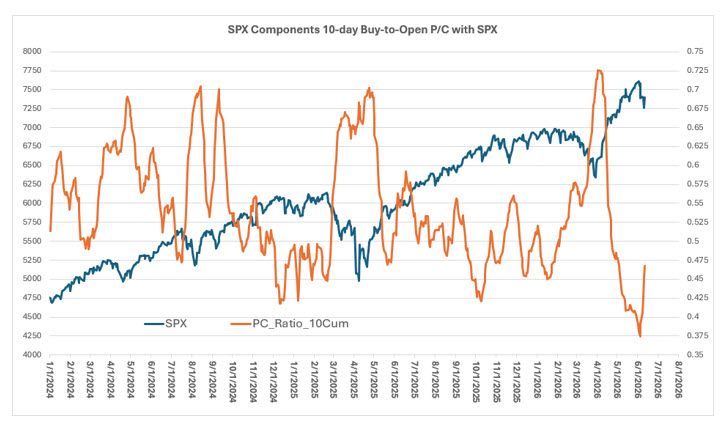
The SPX component buy (to open) put/call volume ratio rising, after record call buying in the two weeks through the first week of June. The implication is that support from the actions of equity option buyers is not as plentiful as it was when stocks reached their recent peak.
Therefore, a short-term risk is the continued unwind of excessive optimism among short-term traders that was evident at the recent peak. I initially flagged the excessive optimism a couple week ago as a sentiment-based indicator that might be worth hedging long positions.
When the ratio of put buying to call buying turns higher from an extreme low, the SPX has historically entered weaker phases. Per the chart below, weaker environments typically mean mild to more severe corrections or, at best, volatile trading ranges.
“Traders are aggressively building short-selling positions in US stocks, while bullish wagers on the tech sector remain stretched, putting the market at risk, according to Citigroup Inc. strategists.”
But extremes in optimism are not among other sentiment indicators we track are not nearly as profound as what we are seeing in the equity options market. For example, the percentage of bears in the weekly American Association of Individual Investors (AAII) is at a two-month high at 47%.
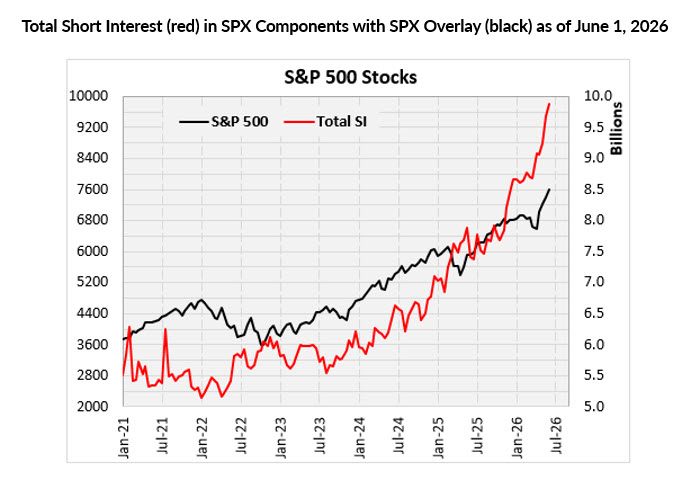
And the shorts continue to be active, which has kept us bullish in the context of the SPX’s favorable intermediate-term and longer-term price action. The excerpt from Bloomberg does not fully capture what we have seen for the past couple of years, which is a massive build in short positions as the market marches higher.
Short covering can be supportive on pullbacks when those wagering against equities take profits on short positions. Or, short covering can fuel rallies, particularly if there are margin calls.
This “future buying power” is at a multi-year high after total SPX component short interest increased 2% in the last two-week reporting period. This increase pushed the year-to-date lift to 14% and another multi-year high. In context of the SPX’s recent all-time high and a multi-year high in known “future buying power,” the bull case reminds intact.
But that has not made the SPX immune to corrective moves the past few years. As such, if you are one that thinks you may panic sell on weakness, I still think a portfolio hedge is worthwhile as equity option buyers could be in the early innings of unwinding extreme optimism. The Cboe Market Volatility Index (VIX – 17.68) – a measure of portfolio insurance prices – is not at the multi-month low when I first recommended a portfolio hedge two weeks ago. But as of Friday’s close, it is 17% below the previous Friday’s close.
Todd Salamone is Schaeffer's Senior V.P. of Research
Continue reading:
- Indicator of the Week: A Closer Look at an Unusual S&P 500 Pullback
- The Week Ahead: Fed Interest Rate Decision Highlights Busy Week
- The Contrarian Edge: What to Do With Satellite Stocks After the SpaceX IPO
Mentioned In This Article
Latest News
| 8 hours | |
| 12 hours | |
| 12 hours | |
| 15 hours | |
| 16 hours | |
| 17 hours | |
| 17 hours | |
| 18 hours | |
| Oct-16 | |
| Oct-16 | |
| Oct-16 | |
| Oct-16 | |
| Oct-16 | |
| Oct-16 | |
| Oct-16 |
