How Wall Street Has Positioned Itself Ahead of July Seasonality
Once again, I am back ahead of one of the most seasonally bullish periods of the year to fill in for Todd Salamone.
June is a true “grinder’s” month from a trading perspective. It is not inherently bad for buy-and-hold investors, but it is often flattish to slightly positive, with a lot of sideways action, whipsaws, and price movement that ultimately goes relatively nowhere. Over the last 20 years, June has been positive 55% of the time, with an average gain of just 0.10%.
As I said last year, and probably the year before that, July is one of the most bullish months of the year. In fact, based on last year’s update, July became the most bullish month on average. For readers who may not remember, or who may be new here, July has been positive 80% of the time over the last 20 years, with an average gain of 2.67%. Over the last 10 years, it has been positive 100% of the time, with an average gain of 3.51%.
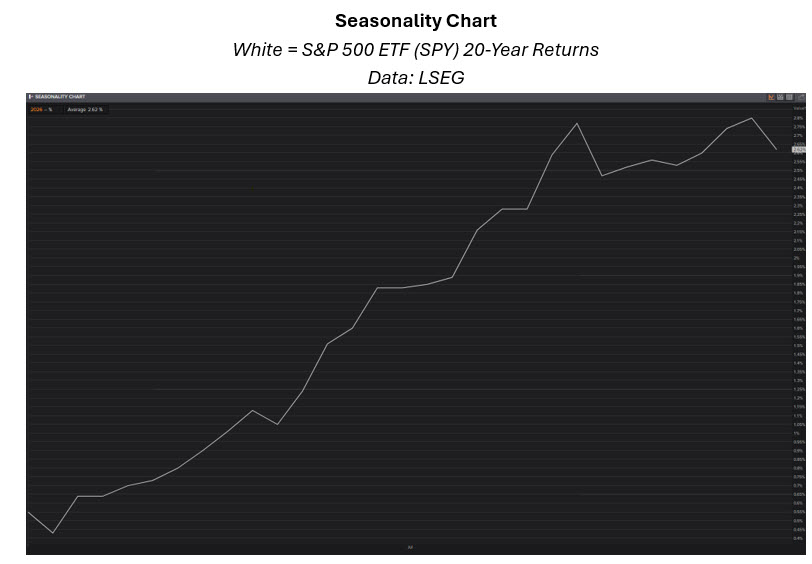
Of course, this year could be different. We know that can happen. And if price action fades seasonality, that is often a great trade to take, as you can catch the herd offsides. So, let’s look at some levels.
The S&P 500 Index (SPX – 7,354.02) is down 3.01% for the month, but what I find interesting is that this weakness is largely being driven by the Magnificent 7 stocks, which are down 12.71% month-to-date, as measured by the Roundhill Magnificent Seven ETF (MAGS – 61.60). Traders and investors do not appear to be in love with the large hyperscalers right now, as they continue to spend aggressively on AI capex. In some cases, these companies are even willing to issue debt and equity in size to continue the AI buildout.
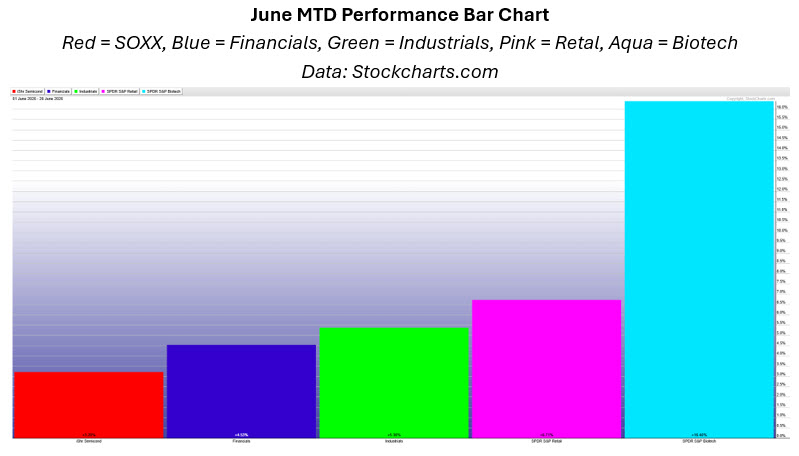
We can see the rotation by simply looking at other sectors and industries that are positive on a month-to-date basis. Industrials are up 5.36%, as measured by the Industrial Select Sector SPDR Fund (XLI – 181.20). Financials are up 4.53%, as measured by the Financial Select Sector SPDR Fund (XLF – 53.57). Retail is up 6.71%, as measured by the SPDR S&P Retail ETF (XRT – 88.72). Semiconductors are up 3.20%, as measured by the iShares Semiconductor ETF (SOXX – 589.94). And biotech is up 16.40%, as measured by the SPDR S&P Biotech ETF (XBI – 155.38).
These are not the areas of the market you would typically expect to see leading in a bearish tape. Software is down 15.21%, as measured by the iShares Expanded Tech-Software Sector ETF (IGV – 88.20), but this is largely due to the potential for AI disruption in legacy names. So, we are seeing a bit of a changing of the guard, as we all know. Right now, traders and investors would rather put their money in the picks and shovels of the AI trade than the hyperscalers themselves.
So, what does this mean when looking at the chart?
The SPDR S&P 500 ETF Trust (SPY – 728.99) is holding where it needs to, so far. I would describe the setup as vulnerable, but not outright bearish at the moment. Bulls are holding the line near the early-June low, which coincides with the May 6 gap higher. This is the second test of that area, so from a chartist’s perspective, it has the potential to form a double bottom.
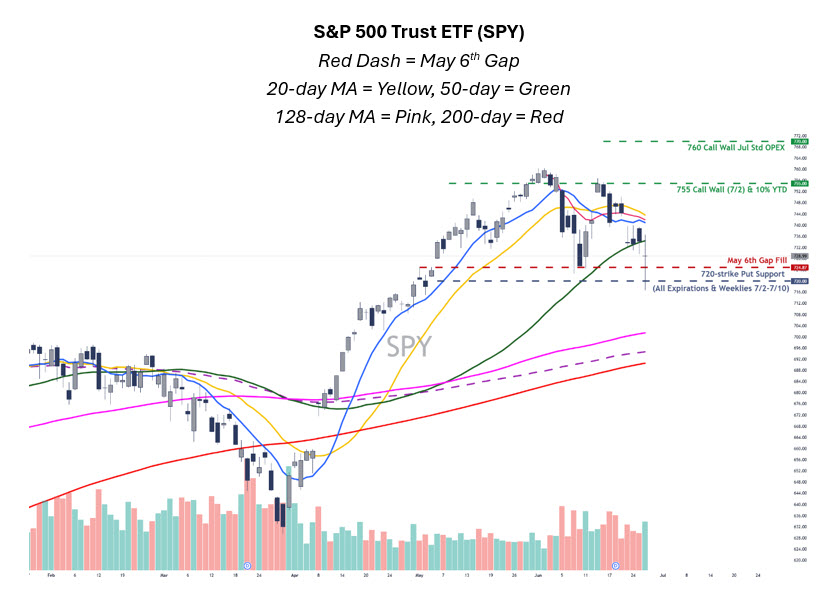
This past Friday, we saw put support shift lower to the 720-strike from the 730-strike. While that is worth noting, it also gives price action a bit more room to breathe around this structural support zone. We are below the 50-day moving average for the first time since April, which is not ideal, but the moving average is still trending higher. These types of moves can often turn into fakeouts as long as the broader trend remains intact.
What bulls do not want to see, in my opinion, is a decisive break below the 720-strike. If that level gives way, it opens the door for the broader market to decline toward the large 700-strike level, which would also represent a retest of the April pivot and six-month moving average.
Moreover, I think June has held up relatively well despite pressure from the Magnificent 7, especially as both the dollar and yields moved higher this month. The dollar broke out of a year-long range and has since tapped and pulled back from the May 2025 high. That level also marks a pivot that ended the dollar’s downtrend in late 2024 as we headed into the election.
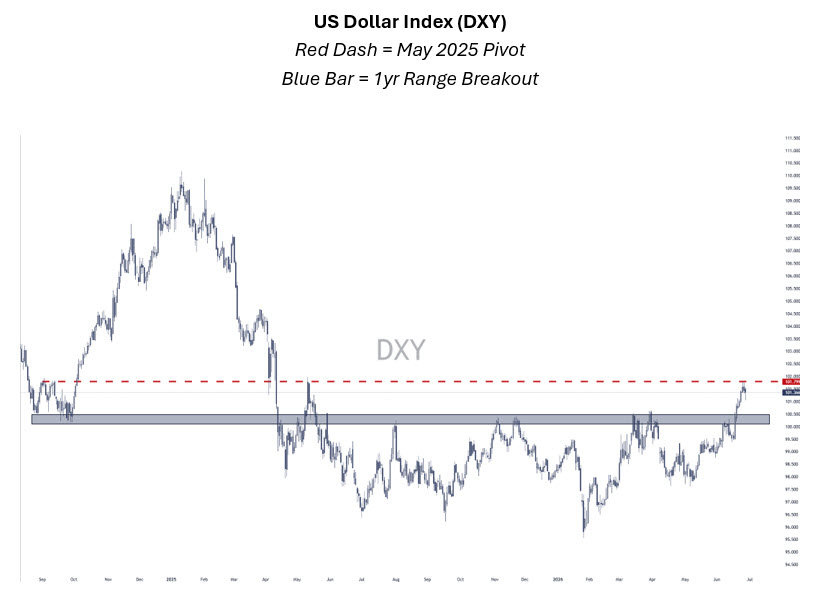
While that dollar rally was largely driven by expectations that the current administration would prefer a stronger dollar, it did not derail markets at the time. But that rally occurred alongside expectations for a pro-business and deregulatory agenda. I think that story is a bit different heading into the midterms, where polling has become more relevant to the market narrative.
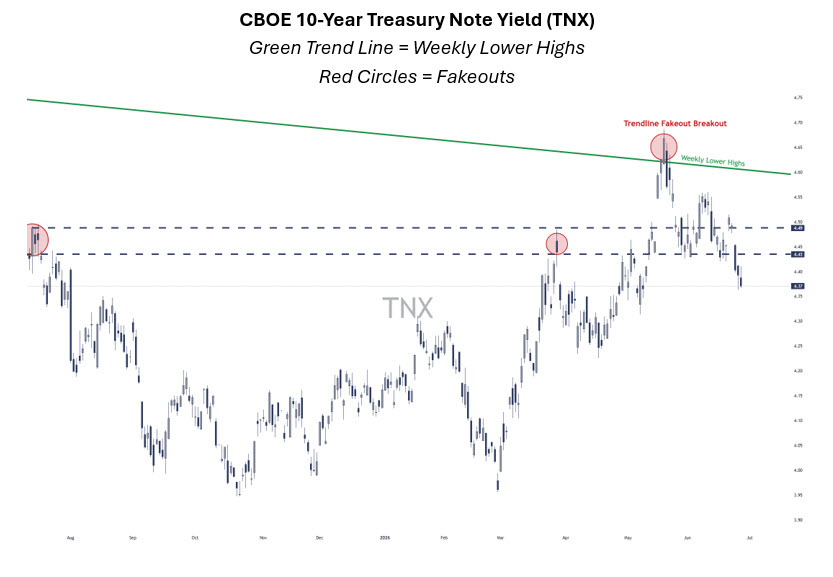
While I will not get into the longer-term implications of the midterm cycle this week, I do think we want to see the dollar remain contained if July’s bullish seasonality is going to play out. Likewise, we want to see rates fall. So far, the 10-year yield has rejected its major weekly downtrend after a failed breakout and has put in another lower high. I would keep my eyes on both the dollar and yields, as they may provide clues as to what equities do next. However, I would be remiss if I did not acknowledge that stocks can rally in the face of both a rising dollar and rising rates, as long as the economy remains strong.
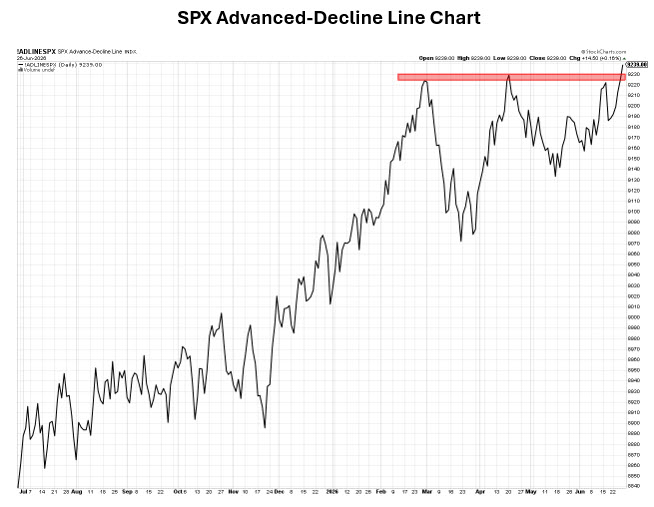
From a breadth standpoint, this market is actually broadening despite the major indexes chopping around to a slightly negative monthly return so far. As you can see from the S&P 500 advance-decline line chart, breadth has broken out to fresh all-time highs. You do not usually see this at major market tops. Typically, breadth diverges or flatlines before major tops, though there are always exceptions, especially when unexpected catalysts emerge, as we saw with the latest Middle East conflict involving the U.S. and Iran in late February and early March of this year.
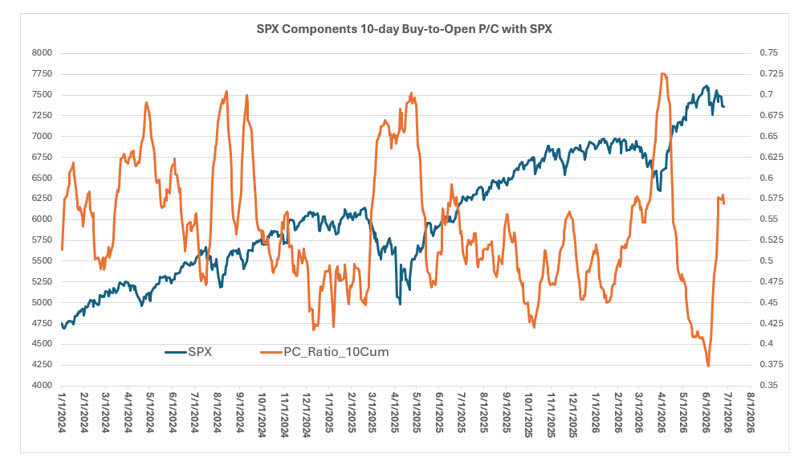
In other words, the SPX has (to this point) weathered a coincidental headwind from a notable sentiment shift among equity options buyers from “the path of least resistance is higher” a few weeks ago to a more neutral outlook.
- Monday Morning Outlook, June 22, 2026
As we highlighted last week, from an options market sentiment standpoint, the market has weathered the snapback from extreme optimism relatively well. In fact, the 10-day ratio has now turned lower again since last week’s discussion, as we started to see bulls step back in this past week.
One thing I logged in my trading notes was the market-on-close, or MOC, buying we saw in the Magnificent 7 stocks during the final two trading days of last week. Friday stood out specifically, as the broader indexes were sharply negative while Magnificent 7 stocks were being bought.
This could be happening for a couple of reasons. We are approaching the end of the month, so it could be forced rebalancing from mutual funds and ETFs. It could also be tied to market-maker exposure. But it could also be institutions finding relative value in these names after their pullback and accumulating shares ahead of another potential bullish July rally.
If that is the case, combined with options buyers starting to buy calls increasingly relative to puts again, we could be watching bottoming action unfold, even if it remains a bit ugly beneath the surface.
While nothing is ever certain, and areas of this market are certainly overbought, the broader market has yet to roll over in a meaningful way. Midterm election cycles tend to get more difficult as we move closer to the election, but for now, the market has taken a much-needed pause to cool off. That places the burden of proof on the bears and opens the door for bulls to try to rally once again in July.
Until next time, trade ’em well.
Matthew Timpane is a Senior Market Analyst at Schaeffer's
Continue reading:
- Indicator of the Week: Does Higher Volatility Increase the Chance of an SPX Pullback?
- The Week Ahead: Holiday-Shortened Week Brings Nike Earnings
- The Contrarian Edge: Making the Case for Apple Stock
Mentioned In This Article
Latest News
| Oct-09 | |
| Oct-09 | |
| Oct-09 | |
| Oct-09 | |
| Oct-09 | |
| Oct-08 | |
| Oct-08 | |
| Oct-08 | |
| Oct-08 | |
| Oct-08 | |
| Oct-07 | |
| Oct-07 | |
| Oct-07 | |
| Oct-07 | |
| Oct-07 |
