How Asian Stocks Tend to Perform After U.S. IPOs
Subscribers to Chart of the Week received this commentary on Sunday, July 12.
South Korea’s SK Hynix has been on global investor’s radar for some time as demand for AI memory and data infrastructure rapidly expands to parabolic levels. The tech giant is the second-most valuable company in South Korea, only behind Samsung. Buzz surrounding SK Hynix is is finally reaching critical mass in the U.S., with the chipmaker making its highly-publicized public trading debut on Friday.
Trading on the Nasdaq Composite (IXIC) under the ticker SKHY on Friday and eventually switching to SKHY, the American invasion has only just begun. Plans are in motion to take the trillion-dollar company even further, with its first production facility due to be completed in 2028 in Indiana, while its U.S. R&D headquarters are located in northern California.
SKHYV debuted at a 14% premium to its IPO price of $149, kicking off Friday with a $170 price point. This raised a record $26.5 billion for a foreign debut in the States, topping Alibaba’s (BABA) $21.8 billion in 2014, but can we expect this record-breaking performance to continue?
Looking toward SKHY’s Asian peers, JD.Com (JD) also debuted in 2014, while Baidu (BIDU) got a much earlier beginning in 2005. Schaeffer’s Senior Quantitative Analyst Rocky White gathered data looking at the post-debut performance of all three stocks, going back one, three, six, and 12-months.
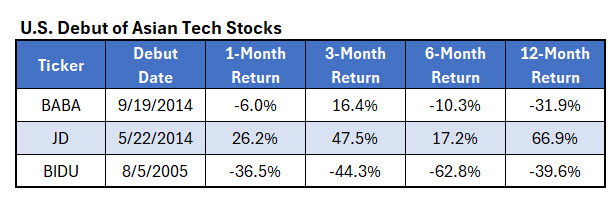
Per the table above, there is a clear winner to the bunch. China-based e-tailer JD.Com surged 26.2% in the first four weeks, surged to a 47.5% return by month three, and despite a cooling off period around the six-month mark, was sporting an impressive 67% return 12 months out. Readings from BABA and BIDU don’t hold a candle to JD, both sporting more than 30% deficits at the one-year mark.
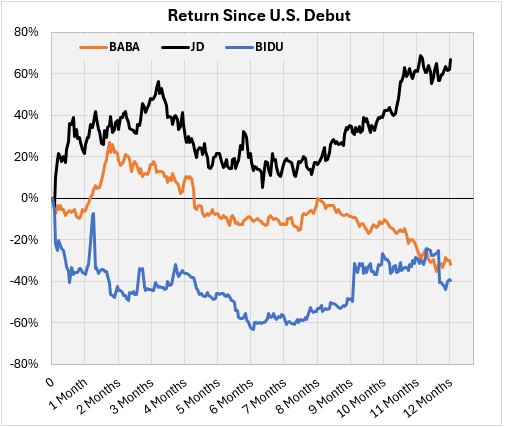
Only time will tell how SKHY will weather the volatile market. But if the recent rise -- and subsequent fall -- of Space Exploration Technologies (SPCX) following its own highly anticipated debut on June 12, it tells us one thing, its that the road is far from linear. Regardless, there are plenty lines of supports backing the tech leader, including its up to $458 million in funding from the U.S. CHIPS grant and continued South Korean expansions through packing facilities and semiconductor cluster in the region, so place your bets memory chip bets accordingly.
Mentioned In This Article
Latest News
| 51 min | |
| 53 min | |
| 2 hours | |
| 3 hours | |
| 3 hours | |
| Oct-26 | |
| Oct-26 | |
| Oct-26 | |
| Oct-26 | |
| Oct-26 | |
| Oct-26 | |
| Oct-26 | |
| Oct-26 | |
| Oct-26 | |
| Oct-26 |
