3 Best AI Stocks to Buy on This Pullback (SNDK, LITE, JBL)
Rising risk-off sentiment is once again weighing on AI and semiconductor stocks, with some of the market's strongest performers selling off. Concerns over rapidly rising interest rates and uncertain central bank policy, compounded by geopolitical tensions and persistently strong energy prices have prompted investors to rotate into more defensive sectors.
We've seen this play out numerous times throughout the AI bull market. Periodic corrections shake out weaker hands, but the underlying growth trends continue to strengthen. And for investors willing to look beyond short-term volatility, these pullbacks have consistently presented attractive buying opportunities.
The key, in my view, is focusing on companies supplying the mission-critical infrastructure behind the AI buildout, particularly businesses benefiting from supply constraints, strong pricing power and accelerating earnings growth.
Three stocks that stand out today are Sandisk Corporation (SNDK), Lumentum (LITE) and Jabil (JBL). Each represents a different but essential piece of the AI infrastructure boom, spanning memory and storage, optical networking, and advanced electronics manufacturing.
More importantly, all three are benefiting from powerful fundamental tailwinds that appear likely to persist well beyond the current market correction.
Sandisk (SNDK): AI's Insatiable Demand for Memory and Storage
Sandisk has emerged as one of the biggest beneficiaries of the AI-driven memory boom. Following its separation from Western Digital, the company has become a more direct way to invest in the rapidly expanding demand for NAND flash memory and data storage.
AI systems generate and process enormous volumes of data, and that information needs to be stored, retrieved and moved efficiently. As AI workloads expand, particularly inference applications, demand for high-performance storage continues to grow.
At the same time, memory manufacturers have struggled to keep up with demand, creating one of the most significant supply-demand imbalances the industry has experienced in years. The result has been extraordinary pricing power.
Sandisk's latest quarterly results illustrate just how powerful this trend has become. Fiscal fourth-quarter revenue surged 372% year over year to nearly $9 billion, including a 51% sequential increase. Approximately two-thirds of that sequential growth came from higher pricing, with the remainder driven by increased shipment volumes.
Profitability has exploded alongside revenue. Gross margins reached 84.6%, compared with just 26.2% a year earlier, while non-GAAP earnings climbed to $39.25 per share. The company's data center business has been particularly impressive, with annual revenue surging 437% to more than $5.1 billion.
And according to consensus estimates, the momentum is expected to continue.
For fiscal 2027, analysts forecast revenue growth of 143% to $49.25 billion, followed by another 18.7% increase to $58.46 billion in fiscal 2028. Earnings estimates are even more impressive, with EPS expected to surge 201% this year to $213.31, before climbing another 18.5% to $252.80 next year.
These are extraordinary numbers, and even more remarkable considering the scale of the business.
Yet despite the enormous earnings growth, Sandisk currently trades at just 7x forward earnings and carries a Zacks Rank #2 (Buy).
Of course, that seemingly cheap valuation needs to be considered in the context of the highly cyclical memory industry. When supply is constrained and pricing is exceptionally strong, earnings can surge, making stocks appear unusually inexpensive near the peak of a cycle.
That is the primary risk here. Today's extraordinarily high margins should not be assumed to persist indefinitely, and additional supply or a slowdown in demand could eventually reverse some of the pricing gains.
However, the AI infrastructure boom has introduced a significant new source of structural demand, potentially making this cycle more durable than those of the past. If memory pricing remains elevated longer than investors anticipate, Sandisk's valuation could prove genuinely attractive.
Following its extraordinary rally over the last year, SNDK shares have spent the past six months consolidating in a wide and volatile trading range. Given the size of that range, the most attractive tactical opportunities may come either on a pullback toward support near $1,200 or on a decisive breakout above resistance around $1,800.
The former would offer a more favorable entry near support, while the latter would signal renewed bullish momentum and potentially the start of another leg higher.
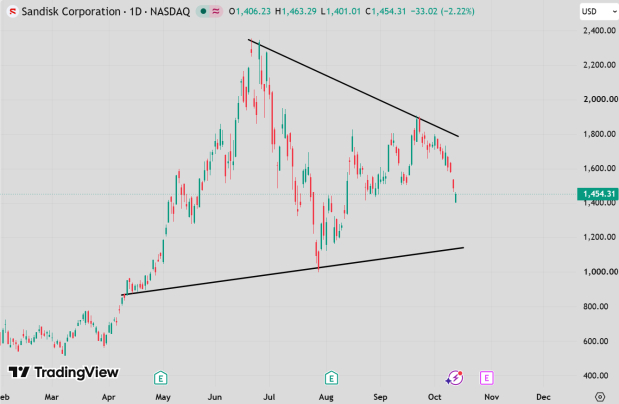
Image Source: TradingView
Lumentum (LITE): The Optical Networking Bottleneck
One of the most significant challenges facing the AI infrastructure buildout is no longer simply obtaining enough computing power. Increasingly, it is figuring out how to connect all that computing power efficiently.
This is creating an enormous opportunity for Lumentum, a leading developer of advanced optical and photonic technologies.
The company manufactures high-performance lasers, optical components and networking systems that allow enormous quantities of data to move through modern data centers.
As AI clusters become larger and more sophisticated, moving information between GPUs, servers and data centers has become an increasingly difficult engineering challenge. And while adding more computing power is essential, that hardware is only as useful as the networks connecting it.
Traditional electrical connections are increasingly challenged by the bandwidth, distance and power requirements of next-generation AI systems. Optical technologies offer substantially greater bandwidth and improved power efficiency, making them a critical part of the industry's ongoing expansion.
Demand has become so intense that Lumentum recently indicated that some of its AI-related optical components are effectively sold out through early 2029.
That is an extraordinary level of demand visibility, particularly for a hardware supplier, and suggests the industry's capacity constraints are unlikely to disappear overnight.
The financial implications are becoming increasingly apparent.
Lumentum's fiscal fourth-quarter revenue more than doubled year over year to approximately $1.01 billion, while non-GAAP earnings surged to $3.23 per share from $0.88 in the year-ago quarter. Operating margins have also expanded dramatically, reaching 36.6% from just 15% a year earlier.
And based on current analyst forecasts, the company is only getting started.
According to Zacks consensus estimates, fiscal 2027 revenue is projected to more than double, rising 107% to $6.25 billion. Analysts then expect another 60.5% increase in fiscal 2028, bringing annual sales above $10 billion.
Earnings growth should be even more explosive. EPS is expected to surge 146.8% to $21.40 this fiscal year, followed by another 64% increase to $35.08 next year.
These forecasts represent one of the more aggressive growth trajectories anywhere in the AI infrastructure industry.
That growth comes at a price, however. Lumentum currently trades at approximately 46.4x forward earnings, a considerable premium even among rapidly growing technology companies.
While the valuation is elevated, it is not necessarily unreasonable given the company's extraordinary earnings outlook and unusually strong demand visibility.
Beyond its existing products, Lumentum is positioned to benefit from emerging technologies including optical circuit switching, 1.6-terabit networking modules and co-packaged optics. These technologies should become increasingly important as hyperscalers build larger AI clusters while attempting to contain networking costs and power consumption.
The main risk is that expectations have become exceptionally high. Any disappointment in orders, capacity expansion or margins could trigger substantial volatility, particularly following the stock's enormous rally.
Nevertheless, with its products occupying an increasingly critical position in AI infrastructure and demand expected to substantially exceed available supply, Lumentum remains one of the most compelling growth stories in the sector.
After breaking out from a significant consolidation earlier this month, LITE shares have pulled back to retest the breakout level.
This is a critical area to watch. Ideally, the stock should find support here and resume its uptrend, confirming the breakout. A failure to hold this level, however, could open the door to further downside and potentially serve as an early warning sign for the broader AI infrastructure trade.
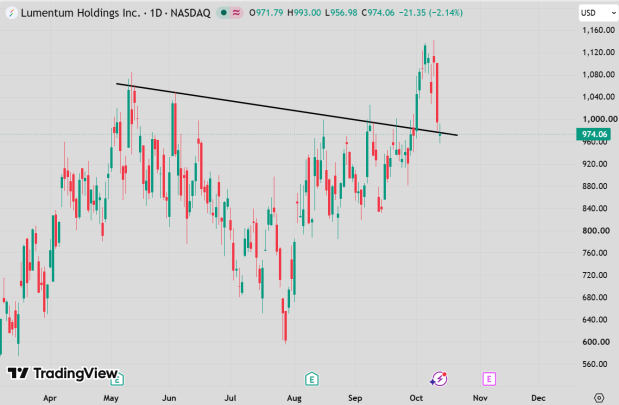
Image Source: TradingView
Jabil (JBL): My Favorite AI Stock on This Pullback
Of the three stocks discussed today, Jabil may offer the most compelling combination of growth, valuation and technical positioning.
Unlike Sandisk and Lumentum, which operate in highly specialized areas of memory and optical networking, Jabil provides advanced manufacturing, engineering and supply chain services to some of the world's largest technology companies.
Its capabilities span data center hardware, server infrastructure, networking equipment, power systems and other sophisticated electronics.
Building AI infrastructure at scale involves far more than purchasing GPUs. Companies need complex server assemblies, networking systems, power distribution equipment, cooling infrastructure and an enormous network of components and suppliers.
Jabil helps customers manage this complexity, allowing them to ramp production and deploy infrastructure more efficiently.
And as hyperscalers continue committing hundreds of billions of dollars to AI infrastructure, Jabil is capturing a rapidly growing share of that spending.
In fiscal 2026, revenue increased 21% to $36 billion, while core operating margins expanded by 40 basis points. The company also generated more than $1.5 billion in adjusted free cash flow.
More importantly, management expects the growth to accelerate considerably in fiscal 2027.
The company recently guided for approximately $44.5 billion in revenue this year, representing 24% growth, while core earnings are expected to rise 34% to $17.55 per share.
AI-related revenue alone is expected to surge 54% to approximately $22.1 billion, approaching half of total sales.
That is a remarkable transformation for a company that has historically operated in the relatively mature electronics manufacturing industry.
And the consensus outlook suggests the momentum should continue well beyond the current year.
Analysts expect fiscal 2027 revenue of $44.62 billion, followed by another 15.3% increase to $51.45 billion in fiscal 2028. Earnings are expected to grow 34.5% to $17.61 per share this year, then another 25% to $22.02 next year.
What's particularly attractive is that investors aren't being asked to pay an excessive premium for that growth.
Jabil currently trades at just 17.7x forward earnings and carries a Zacks Rank #1 (Strong Buy), highlighting the strength of its earnings outlook and estimate revision trends.
For a company expected to grow earnings more than 34% this year and another 25% next year, that valuation looks especially reasonable.
Jabil also offers some diversification beyond AI infrastructure, with exposure to healthcare, automotive, industrial and other end markets. While AI has become an increasingly important growth driver, the company is not entirely dependent on a single industry.
There are risks, of course. Electronics manufacturing is a relatively low-margin business, and even modest disruptions to customer spending or manufacturing efficiency can have an outsized impact on profitability.
However, the combination of accelerating revenue growth, improving margins and substantial free cash flow generation puts Jabil in a particularly attractive position.
Along with the broader AI trade, JBL shares began correcting over the summer. Since then, the stock has carved out a compelling bullish wedge pattern, with support near $285 and resistance around $320.
A decisive breakout in either direction would provide an important signal, with a move above resistance suggesting the uptrend is ready to resume, while a breakdown below support could open the door to further downside.
Of the three stocks highlighted today, I think Jabil has the cleanest technical setup. Combined with its Zacks Rank #1, impressive growth forecasts and comparatively modest valuation, it stands out as my favorite opportunity on the current pullback.
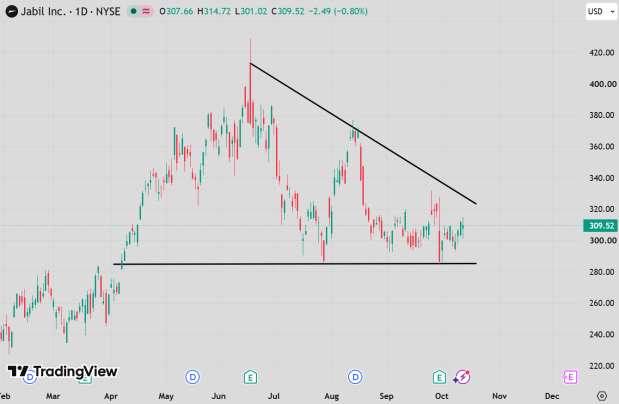
Image Source: TradingView
AI Infrastructure Still Offers Compelling Opportunities
The recent selling pressure across AI-related stocks is understandably frustrating, particularly after the enormous gains many of these companies have delivered.
But investors should distinguish between deteriorating business fundamentals and a correction driven by changing sentiment, crowded positioning or valuation concerns.
For now, the fundamental picture across the most critical areas of AI infrastructure remains exceptionally strong.
Importantly, these companies are not merely trading on distant expectations of AI adoption. Their revenue, earnings and forward guidance already reflect significant real-world demand.
That doesn't mean the stocks cannot fall further. Valuations remain elevated in parts of the sector, and a meaningful slowdown in hyperscaler capital expenditures would present a serious risk to the broader investment thesis.
But until there is convincing evidence of a sustained deterioration in AI infrastructure spending or earnings expectations, I continue to view these corrections as opportunities rather than a reason to abandon the theme.
For investors looking to take advantage of the current weakness, Sandisk, Lumentum and Jabil represent three compelling ways to gain exposure to some of the most important and supply-constrained segments of the AI infrastructure boom.
Want the latest recommendations from Zacks Investment Research? Today, you can download 7 Best Stocks for the Next 30 Days. Click to get this free report
Sandisk Corporation (SNDK): Free Stock Analysis Report
Jabil, Inc. (JBL): Free Stock Analysis Report
Lumentum Holdings Inc. (LITE): Free Stock Analysis Report
This article originally published on Zacks Investment Research (zacks.com).
Mentioned In This Article
Latest News
| 2 hours | |
| 2 hours | |
| 3 hours | |
| 3 hours | |
| 3 hours | |
| 3 hours | |
| 5 hours | |
| 6 hours | |
| 7 hours | |
| 7 hours |
Stock Market Today: Dow Rises On Bank Earnings; Micron, Sandisk, SK Hynix Sell Off (Live Coverage)
SNDK
Investor's Business Daily
|
| 8 hours | |
| 9 hours | |
| 10 hours | |
| 10 hours | |
| 10 hours |
