Stocks Trying to Push Past AI, Inflation Headwinds
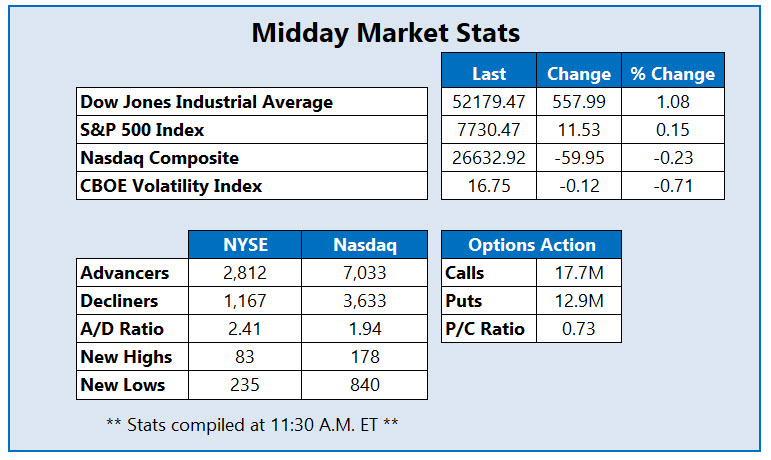
Stocks are a mixed bag today, as the latest inflation data divides markets. The producer price index (PPI) gained 1.3% for September and spiked 6.3% year-over-year, the largest increases since 2022. As investors brace for a hawkish Federal Reserve to combat inflation, the Nasdaq Composite (IXIC) is modestly lower amid mounting AI debt concerns, but has pared steeper, triple-digit losses from the morning.
The Dow Jones Industrial Average (DJI) is up 557 points, eyeing its best single-session pop since Aug. 4 as Nike (NKE) and Home Depot (HD) help investors rotate away from tech. The S&P 500 Index (SPX) and Russell 2000 (RUT) have moved into the black as well.
Continue reading for more on today's market, including:
- CoreWeave stock among the AI casualties today.
- Retail stock upgraded as innovation impresses.
- Plus, Cameco bears dig in; Walmart upgraded; and another neocloud sells off.
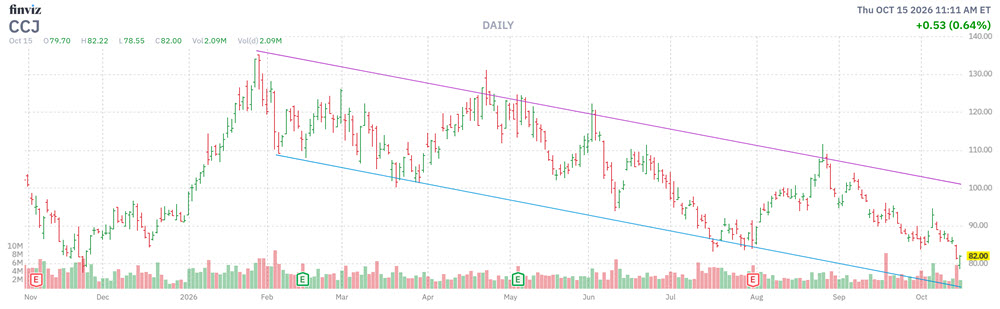
Cameco Corp (NYSE:CCJ) stock is seeing an uptick in options activity today. At last look, 72,000 contracts have changed hands, volume that's triple the average intraday amount. The October 80 put leads the way by a wide margin, while the November 90 put is also popular. The uranium stock is up 1.6% to trade at $82.73, but earlier traded at 2026 lows of $78.55. Year to date, CCJ is down 11%, leading a steady decline since a Jan. 29 all-time high of $135.24.
Walmart Inc (NASDAQ:WMT) stock is near the top of the Dow today, last seen up 2.8% to trade at $119.59. Deutsche Bank upgraded the blue-chip retailer to "buy" from "hold," and hiked its price target to $136 from $113. The analyst in coverage cited the inflationary environment as a tailwind for the company. Walmart stock is trading at its highest levels since June and is now up 7% on the year, thanks to eight wins in the last nine trading days.
IREN Ltd (NASDAQ:IREN) is among the worst-performing stocks on the Nasdaq today, down 8.6% to trade at $27.92. The neocloud provider is feeling the AI debt panic, earlier trading at a 52-week low of $26.60. The shares are in the midst of a seven-day skid, and are now 26% lower on the year.
Mentioned In This Article
Latest News
| 56 min | |
| 1 hour | |
| 3 hours | |
| 3 hours | |
| 3 hours | |
| 4 hours | |
| 5 hours | |
| 5 hours | |
| 6 hours | |
| 10 hours | |
| Oct-14 | |
| Oct-14 | |
| Oct-13 | |
| Oct-13 | |
| Oct-12 |
