IBM Rebounds From Its Q2 Stumble As Software Reaccelerates, But An Unchanged Revenue Guide Tempers The Beat
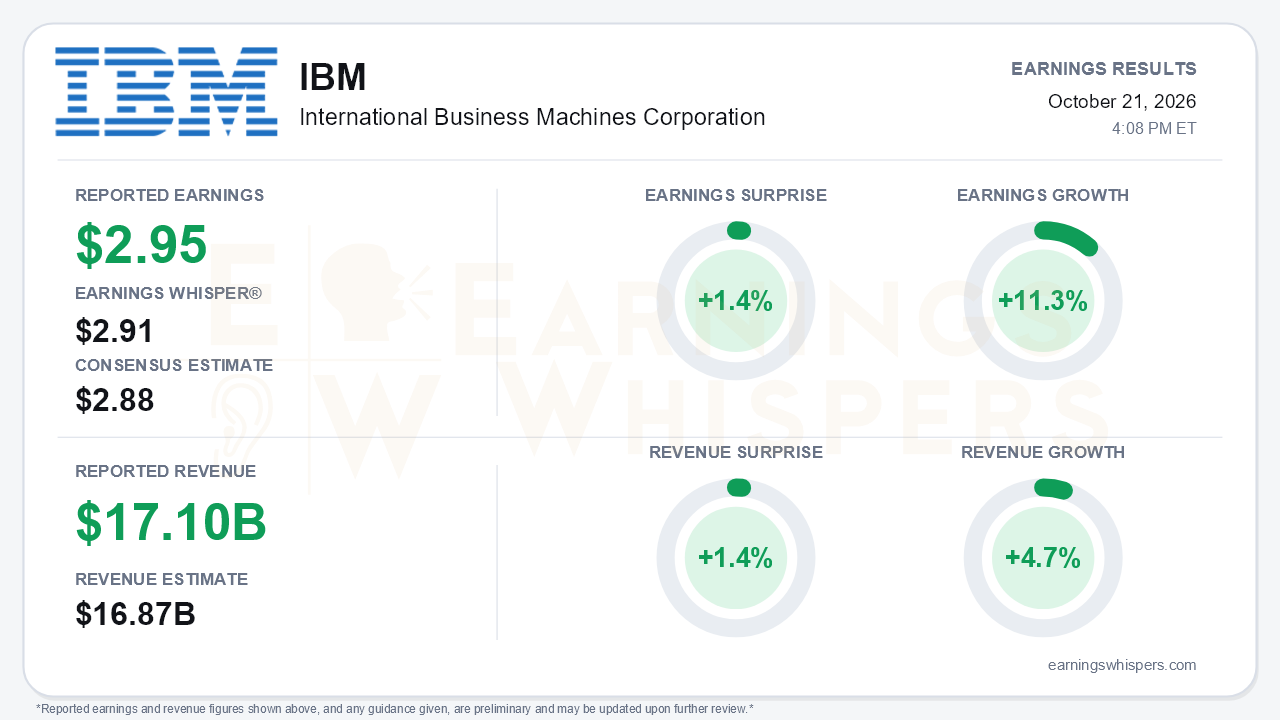
IBM delivered the recovery quarter investors needed after a disappointing second quarter. Operating earnings of $2.95 per share topped the $2.88 consensus and the $2.91 Earnings Whisper number by 1.4%, while revenue of $17.103 billion beat the $16.87 billion consensus by the same margin. Earnings grew 11.3% year over year and revenue rose 4.7%, or 6% at constant currency. That is a sharp acceleration from roughly 1% constant-currency growth in Q2. The central tension is that management raised nearly every operating target except the one that anchors the top line: full-year constant-currency revenue growth stays at 4% to 5%, still below the 5%-plus IBM guided at the start of the year.
The quality of the beat holds up better on an operating basis than the GAAP figures suggest. GAAP EPS from continuing operations jumped 26% to $2.31, but much of that came from an effective tax rate of 11.9%, compared with 28.2% a year ago, when a tax-reform charge depressed results. Operating pre-tax income rose a more representative 9%, and operating pre-tax margin widened 70 basis points to 19.3%, double the 30-basis-point expansion in Q2. A lower operating tax rate (14.7% versus 17.0%) helped lift EPS growth above pre-tax growth. Operating gross margin slipped 20 basis points, so the margin story is about expense discipline and mix rather than pricing. SG&A fell in dollars even as R&D rose about 14%. Cash generation was the cleanest part of the quarter: free cash flow of $3.0 billion rose $0.7 billion, and nine-month free cash flow of $7.8 billion moved ahead of last year after a flat first half.
Software drove the turnaround. Segment revenue grew 9% at constant currency, up from 5% in Q2, and segment margin expanded to 35.0% from 32.9%. Transaction Processing swung to +10% from -9% in Q2, which supports management's argument that the Q2 shortfall reflected deal slippage rather than lost demand. About two-thirds of the roughly $250 million in slipped large enterprise license agreements closed during the quarter. Management attributed about 75% of the software acceleration to net new business rather than catch-up. Underneath, the recurring indicators improved:
- Red Hat grew 11%, with bookings back to the high teens.
- OpenShift ARR reached $2.4 billion, growing more than 30%.
- Data grew 20%.
- Software ARR rose to $24.9 billion.
Infrastructure flipped to +5% from -7% in Q2. Distributed Infrastructure grew 32%, though that eased from a record 37%. IBM Z revenue fell 20%, even as management said the z17 program is running more than $1 billion ahead of its predecessor over six quarters, which points to a tough comparison rather than a demand problem.
The weak spots are real but contained. Consulting grew only 2% at constant currency, and its segment margin fell to 12.2% from 12.9% as IBM reinvested, despite new partnerships with OpenAI and Google Cloud. Automation declined 3% against a tougher comparison. Management explicitly warned that Transaction Processing's double-digit growth will moderate in Q4. It also held its 100-basis-point operating margin expansion target rather than raising it. On the balance sheet, IBM has spent $11.4 billion on acquisitions this year, cash has fallen $3.4 billion since year-end, and total debt has climbed to $63.8 billion. That raises the stakes on integration, including the cross-selling opportunity management highlighted for Confluent's StreamHouse capability.
The forward catalysts lean constructive:
- Software guidance rose to 7% to 8% from 6% to 8%.
- Full-year Transaction Processing was lifted to flat.
- Free cash flow growth now exceeds $1 billion, up from about $1 billion.
- The Lightwell remediation offering is generally available, with a pipeline approaching $700 million.
- Quantum milestones include DARPA Stage C selection, closing of the $1 billion Anderon award, and a December 10 Quantum Day.
- Management is already framing 2027 as a year of growth synergies.
Bears still have legitimate ammunition. Software guidance remains well below the 10%-plus outlined in Q1, and the reaffirmed revenue range implies Q3's strength mostly restores the plan rather than expands it.
Investors had already moved ahead of the print. Earnings Whispers sentiment rose from a near-neutral 0.03 to 0.21, a meaningful improvement that remains only moderately positive. Shares have climbed 19.4% since the open after the Q2 report and are more than 21% above the 52-week low of $199.19 set the day after that release. Even so, the stock entered earnings about 3.7% below its 200-day moving average and roughly 4% below its September 15 inter-earnings high of $251.82. The market has rewarded the recovery thesis without fully repricing IBM back to its prior highs. The internal trend readings are mixed, with AVWAP positive but momentum negative.
The bottom line is that IBM answered the main question from Q2: the software slippage was largely deferral, and the operating model again produced margin expansion and record-level cash generation. The beat was modest in size but solid in composition. With the stock already up sharply and the revenue guide unchanged, further upside likely depends on whether software can sustain high-single-digit growth once Transaction Processing cools in Q4.
Read our earnings preview for International Business Machines Corporation: https://www.earningswhispers.com/article/IBM/20464
This earnings review was originally published on Earnings Whispers.
This article is for informational purposes only and is not investment advice. Earnings Whispers and its staff may hold positions in the securities mentioned. It was generated automatically, with the help of AI, from Earnings Whispers and company data, and checked by Earnings Whispers before publication.
Mentioned In This Article
Latest News
| 1 hour | |
| 1 hour | |
| 2 hours | |
| 4 hours | |
| 4 hours | |
| 4 hours | |
| 4 hours | |
| 4 hours | |
| 4 hours | |
| 4 hours | |
| 7 hours | |
| 11 hours | |
| 11 hours | |
| 12 hours | |
| 16 hours |
