Meta FCF Flips Negative: Why Investors Should Overlook It
Why Did Meta Move Up Its Earnings Date?
Just before the normal market trading hours concluded on Wednesday, investors finally got an answer on why Meta Platforms (META) moved up its earnings date. Meta plans to issue nonvoting shares to fund AI investments without diluting CEO Mark Zuckerberg’s control. Meta also narrowed its FY26 CAPEX outlook to $130-$145B.
Meta Misses EPS Expectations Due to One-Time Charges
Meta Platforms reported mixed earnings after Wednesday’s market close. Revenue of $64.60B beat Wall Street expectations of $63.33B (26% YoY growth). EPS of $3.83 fell well short of Wall Street expectations of $5.89 (+265% YoY growth). However, the EPS miss was driven by one-time, non-operating expenses, including a $2.4 billion legal settlement, restructuring costs, and aggressive AI infrastructure and CAPEX. Investors should take the headline EPS number with a grain of salt, as nothing has materially changed in Meta’s core business. For instance, Ad revenue, Meta’s most important number, jumped 28%. Additionally, Ad impressions and price per Ad each jumped double digits year over year as AI continues to optimize the Meta family of products, while the company’s headcount plunged 15%.
Meta Free Cash Flow Flips Negative
The post-EPS headline Wall Street is focused on is that, in Q3, Meta posted its first negative free cash flow quarter since it went public in 2012.
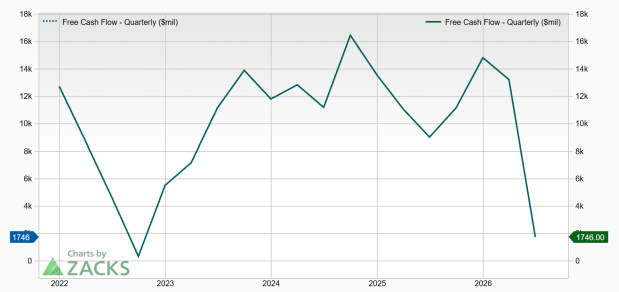
Image Source: Zacks Investment Research
While this stat should normally raise concerns, investors must apply some nuance in their analysis.
Why Investors Should Overlook Meta’s Negative Free Cash Flow
On Wall Street, CEOs generally fall into two categories: caretakers and visionaries. For instance, the CEO of a company like Pepsi (PEP) is going to operate completely differently than the CEO of a cutting-edge tech company like Meta. In Pepsi’s case, the CEO’s main goal is to ensure nothing “breaks,” the company generates cash flow, and it stays stable. Conversely, Meta CEO Mark Zuckerberg is hyper-focused on spotting the next big tech trends and turning them into growth opportunities. For instance, many Wall Street pundits scoffed when Zuckerberg purchased Instagram for $1 billion in April 2012. Today, Instagram is worth an estimated $70 billion.
Meta Muse Will Spur Future Growth
“Muse,” Meta’s agentic AI platform, is the answer to the spending question. On the conference call, Mark Zuckerberg said that he expects Muse to beat the Meta family apps average revenue per user over time. In just one month, Muse achieved 10 million setups. The app has also consistently topped the Apple App Store rankings. Most impressively, shopping is the #1 use case, and the average purchase size is over $200. While Muse is still in its early days, continued CAPEX spending is justified by the impressive early traction it’s achieved.
Bottom Line
While negative free cash flow often signals trouble, Meta’s temporary dip is a deliberate reinvestment into its high-growth future. With a thriving core ad business and early traction from agentic AI platforms like Muse, Mark Zuckerberg’s aggressive CAPEX strategy is setting the stage for Meta’s next multi-billion-dollar expansion.
Want the latest recommendations from Zacks Investment Research? Today, you can download 7 Best Stocks for the Next 30 Days. Click to get this free report
PepsiCo, Inc. (PEP): Free Stock Analysis Report
Meta Platforms, Inc. (META): Free Stock Analysis Report
This article originally published on Zacks Investment Research (zacks.com).
Mentioned In This Article
Latest News
| 10 min | |
| 38 min | |
| 41 min | |
| 41 min | |
| 45 min | |
| 54 min | |
| 59 min | |
| 59 min | |
| 1 hour | |
| 1 hour | |
| 1 hour | |
| 1 hour | |
| 1 hour | |
| 2 hours | |
| 2 hours |
