HCA Beats And Steers To Upper Half Of 2026 Guidance, But A Flat 2027 Preview And Buyback-Driven EPS Temper The Rebound
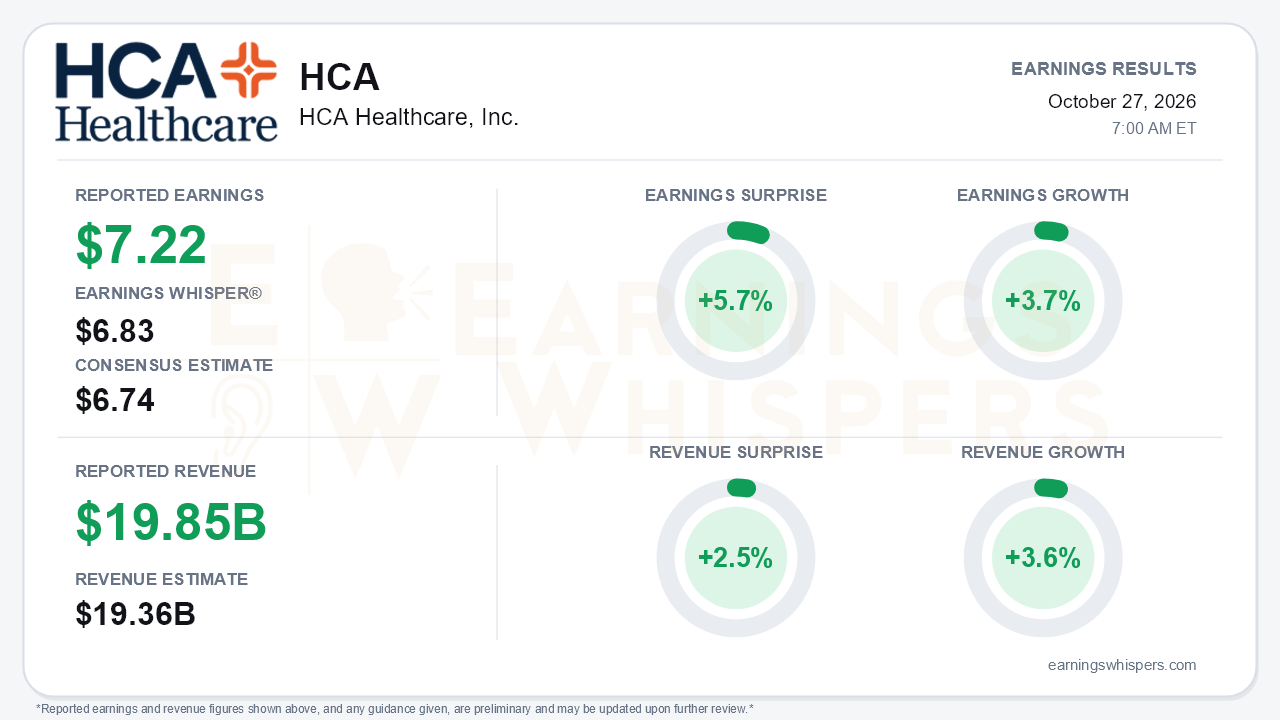
HCA Healthcare delivered a clean third-quarter beat. Adjusted earnings of $7.22 per share topped the $6.74 consensus by 5.7% and cleared the $6.83 Earnings Whisper number. Revenue of $19.849 billion beat the $19.36 billion consensus by 2.5%. Management also said full-year 2026 results should land in the upper half of the ranges it reset in July. Beneath that, however, adjusted EPS grew just 3.7% year over year, a sharp slowdown from roughly 11% in each of the first two quarters. Revenue grew 3.6%. The preliminary 2027 outlook calls for roughly flat earnings. That is the central tension: 2026 is turning out better than feared, but the path beyond it has flattened.
The quality of the beat deserves scrutiny. Net income attributable to HCA fell 3.9% to $1.579 billion. Adjusted net income slipped to $1.569 billion from $1.644 billion. Per-share growth came entirely from an 8% drop in diluted shares, to 217.2 million from 236.2 million. Adjusted EBITDA rose only 1.2% to $3.918 billion, and margin compressed to 19.7% from 20.2%. The main drag was the payer-mix shift, as patients who lost exchange coverage showed up uninsured. HCA estimates that cost about $400 million in pretax income during the quarter. Other operating expenses also climbed to 23.0% of revenue from 21.8%, and professional fees rose about 12% (versus roughly 8.5% in the second quarter), led by anesthesia and radiology. The offset was genuine labor discipline: salaries and benefits improved to 43.2% of revenue from 43.6%. Management described core EBITDA growth of about 10% once the exchange drag is set aside.
The operating trends on the call were better than the earnings line suggests. Same-facility equivalent admissions grew 3.0%, accelerating from 2.7% in the second quarter and 1.3% in the first. That marked the 22nd straight quarter of growth. Emergency room visits rose 5.1%, up from 3.6% and 0.3% in the prior two quarters. Commercial volumes excluding exchanges grew 2.7%, compared with 0.6% in the first quarter. Insured revenue per adjusted admission also accelerated on mix, rate and collection yield. Cost per equivalent admission excluding supplemental payments was flat year over year despite the seasonal merit increase.
The exchange damage keeps getting worse, though. Exchange equivalent admissions fell about 19%, worse than the 15–16% management had expected. The uninsured share of equivalent admissions rose to roughly 10.5% from 8.5%. Management now expects the full-year exchange headwind to land at or slightly above the top of a $1.0–1.2 billion range, up from $600–900 million earlier in the year. Elective surgery remains soft: inpatient surgeries fell 1.4%, outpatient surgeries 3.7% and ambulatory surgery center cases 5.4%. Management tied the weakness to coverage loss and affordability.
Much of the 2026 relief is non-recurring. Management raised its expected net benefit from Medicaid supplemental payments to $600–800 million. That figure was $300–500 million in July and a $50–250 million decline in the first quarter. The increase was helped by a grandfathered Virginia approval worth about $50 million in the quarter. But HCA expects $550–650 million less supplemental benefit in 2027 as out-of-period grandfathered payments, mostly from Florida, roll off. Medicaid work requirements are expected to add a modest drag. Those pressures only partly offset by 2–3% volume growth and resiliency savings, which drives the flat 2027 preview. Management expects its long-term growth targets to resume after 2027. Potential supports include an 8% sequential improvement in exchange volumes, a proposed 2027 outpatient payment rule that management views favorably on 340B, and a multi-year resiliency program.
The balance sheet shows how aggressively HCA is supporting per-share results. It repurchased $2.97 billion of stock in the quarter, ahead of the $2.1 billion repurchased in the second quarter. Operating cash flow of $4.461 billion was strong, helped by lower receivables. Over nine months, however, operating cash flow was $8.81 billion versus $10.28 billion a year earlier. Short-term debt rose to $8.1 billion, total debt stands at $50.5 billion, and cash is just $908 million.
The market had already moved ahead of the report. Shares rose 21.9% from the post-July open to $465.26. That leaves the stock 4.6% above its 200-day moving average and just 2.8% below its October 15 inter-earnings high of $478.86, so HCA entered the print near the top of its range. Investor sentiment remained negative but improved substantially, rising from -0.64 to -0.19. Price and AVWAP trend readings are positive, while momentum is negative.
The bottom line is that HCA showed accelerating volumes, better pricing and real cost control, enough to absorb a worsening exchange shock and lift 2026 toward the top of guidance. Investors who rerated the stock 22% since July now face a flat 2027, a beat flattered by buybacks, and supplemental-payment tailwinds that will not repeat. Bears still have legitimate ammunition.
Read our earnings preview for HCA Healthcare, Inc.: https://www.earningswhispers.com/article/HCA/20698
This earnings review was originally published on Earnings Whispers.
This article is for informational purposes only and is not investment advice. Earnings Whispers and its staff may hold positions in the securities mentioned. It is AI-assisted, based on proprietary Earnings Whispers data and company reports, and edited by Earnings Whispers staff.
Mentioned In This Article
Latest News
| 32 min | |
| 1 hour | |
| 3 hours |
HCA Healthcare Stock Nears Buy Point Despite Uninsured Cost Jump
HCA -5.21%
Investor's Business Daily
|
| 4 hours | |
| 5 hours | |
| 5 hours | |
| Oct-21 | |
| Sep-30 | |
| Sep-29 | |
| Sep-22 | |
| Sep-16 | |
| Sep-15 | |
| Sep-09 | |
| Aug-21 | |
| Aug-20 |
