JetBlue's Revenue Engine Accelerates, But Fuel, A Lower Margin Guide And Liquidity Questions Dominate A Narrow Miss
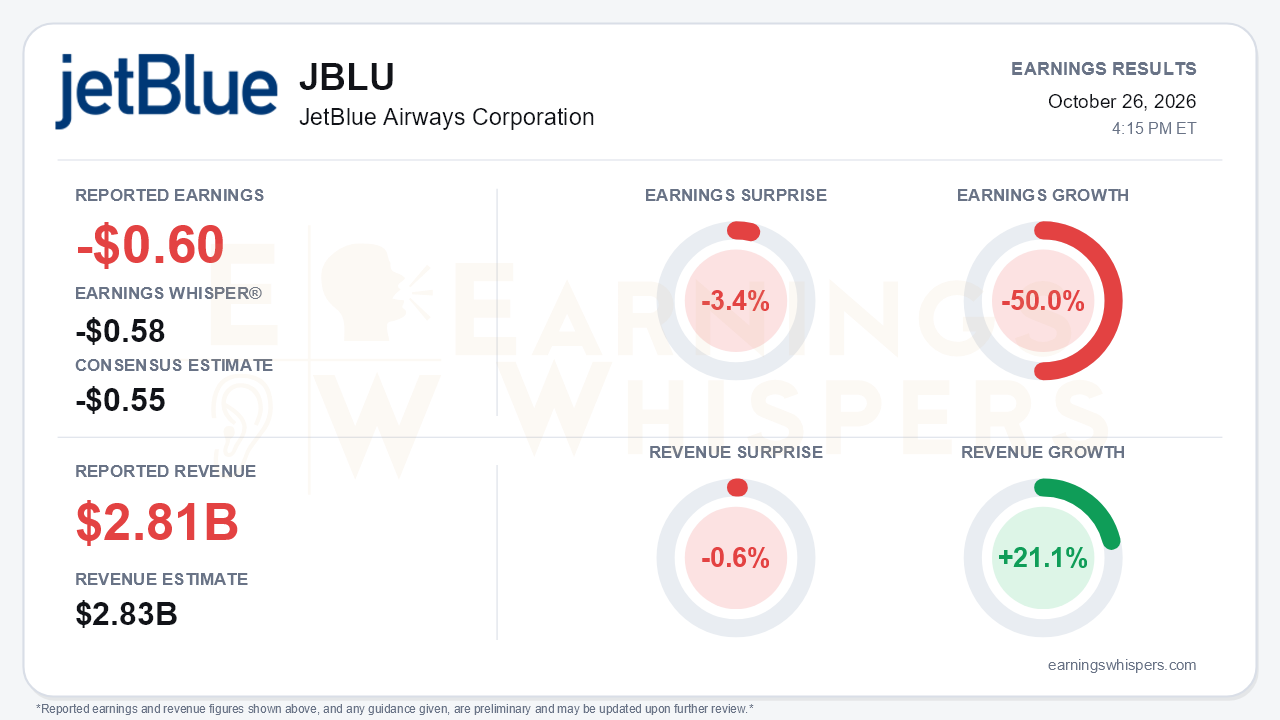
JetBlue Airways reported an adjusted third-quarter loss of $0.60 per share, missing the -$0.55 consensus and the -$0.58 Earnings Whisper number by 3.4%. Earnings fell 50.0% from a year ago, when the adjusted loss was $0.40. Revenue rose 21.1% to $2.812 billion but slipped 0.6% short of the $2.83 billion consensus. On a GAAP basis, the net loss widened to $257 million, or $0.68 per share, from $143 million, or $0.39. That is the central tension. JetBlue's commercial turnaround is producing some of the strongest unit-revenue gains in its recent history, yet the losses are getting larger, the full-year margin outlook moved down again, and the conversation has shifted toward the balance sheet.
The quality of the quarter deserves a closer look, because the operating picture was less weak than the headline EPS suggests. RASM jumped 18.4% on just 2.3% more capacity. Yield rose 21.2%, average fare climbed 19.2% to $245, and premium and Main cabins both posted double-digit RASM growth. Adjusted operating margin edged up to -3.9% from -4.1%, and adjusted pre-tax margin was essentially flat at -8.5%. The deterioration came largely below the operating line. Interest income fell 45%, and the income tax benefit shrank to $13 million from $53 million, reflecting a valuation allowance. Fuel was the dominant cost force at $3.91 per gallon, up 57%, which lifted the fuel bill 61%. JetBlue still recaptured roughly 87% of that increase. Costs were not clean, however. CASM ex-fuel rose 7.0%, including about four points of weather and air-traffic-control disruption. Load factor also fell 1.5 points as price-sensitive demand dropped away.
The call reinforced the sense that the revenue engine is accelerating. Fuel recapture has climbed from a 30-40% guide in the first quarter to about 50% in the second and 87% now, and management expects full recapture in early 2027. Fort Lauderdale RASM rose 15% on capacity growth of more than 65%, an improvement over the second quarter's 11% gain on roughly 40% growth. Loyalty revenue grew 20%, and Premier card acquisitions rose eightfold. The upgraded revenue management system is now fully in place. Management also put a number on Paisly for the first time, citing roughly $100 million of operating income this year and saying it expects that figure to nearly double by 2028. Fourth-quarter RASM is guided up 18% to 22%, which would mark a fifth straight quarter of acceleration. CASM ex-fuel is expected to fall to between -1% and +1%, and the adjusted operating margin is expected to expand one to two points despite fuel forecast at $4.64, up 85%.
Bears still have legitimate ammunition. The full-year adjusted operating margin guide was cut to -4.5% to -6.5%, down from -2% to -5% in July and from breakeven or better at the start of the year. Full-year CASM ex-fuel was raised to 3.5% to 4.5%. Positive free cash flow is now framed as a 2028 event, whereas the second-quarter call had described it as a 2027 goal. The liquidity figure also deserves scrutiny. The $2.2 billion now includes the $600 million undrawn revolver, while the second-quarter $2.2 billion excluded it. Cash and equivalents have fallen to $1.26 billion from $1.95 billion at year-end. Stockholders' equity dropped to $1.34 billion, against $8.4 billion of debt. Analyst questions focused on cash burn, creditor-group rumors and the bond market. The roughly $7 billion of unencumbered assets, including $2.8 billion of aircraft and engines after reappraisal, provides real financing flexibility. Still, management's emphasis on a "bridge" to at least $1 of EPS in 2028 shows where the debate now sits. BlueFirst launches December 8, but retrofit completion has slipped into later 2028 because of supply-chain constraints.
The market has already priced in a great deal of that anxiety. Shares sit at $2.37, down 57.9% from the $5.63 opening after the July report and about 52% below the $4.96 200-day moving average. Earnings Whispers investor sentiment stayed negative and weakened slightly, moving from -0.34 to -0.38. That is a modest shift, not a capitulation. The Earnings Whispers trend signals are mostly negative, with price, sequential growth and AVWAP all deteriorating, although momentum reads positive.
The bottom line is that JetBlue delivered a split quarter. Pricing power, Fort Lauderdale and loyalty are clearly working, and fourth-quarter guidance implies margin expansion even against brutal fuel costs. But a narrow EPS miss, a third consecutive reduction in the full-year margin outlook and a free-cash-flow target pushed to 2028 keep the focus on whether the balance sheet can carry the company until the revenue gains outrun fuel. Until cash burn visibly slows, the stock's collapse suggests investors will weigh liquidity risk more heavily than RASM momentum.
Read our earnings preview for JetBlue Airways Corporation: https://www.earningswhispers.com/article/JBLU/20709
This earnings review was originally published on Earnings Whispers.
This article is for informational purposes only and is not investment advice. Earnings Whispers and its staff may hold positions in the securities mentioned. It is AI-assisted, based on proprietary Earnings Whispers data and company reports, and edited by Earnings Whispers staff.
Mentioned In This Article
Latest News
| 1 hour | |
| 1 hour | |
| 1 hour | |
| 2 hours | |
| 3 hours | |
| 5 hours | |
| 7 hours | |
| 7 hours | |
| Oct-26 | |
| Oct-26 | |
| Oct-26 | |
| Oct-26 | |
| Oct-26 |
JetBlue Shares in Tailspin as High Fuel Prices Threaten Turnaround
JBLU -9.71%
The Wall Street Journal
|
| Oct-26 | |
| Oct-23 |
