Charter's First Cox-Era Report Puts Broadband Losses And A Trimmed EBITDA Outlook On Trial
Charter Communications heads into its third-quarter report with a stock that has been marked down as if the worst is still ahead, and with a business that has never been bigger. The Cox acquisition was expected to close in mid-to-late August, which makes this the first release since Charter became a roughly $67 billion revenue, $28 billion EBITDA operator. Yet the question investors care about most is decidedly old-fashioned: can Charter stop bleeding internet customers fast enough to make its reduced 2026 outlook look safe?
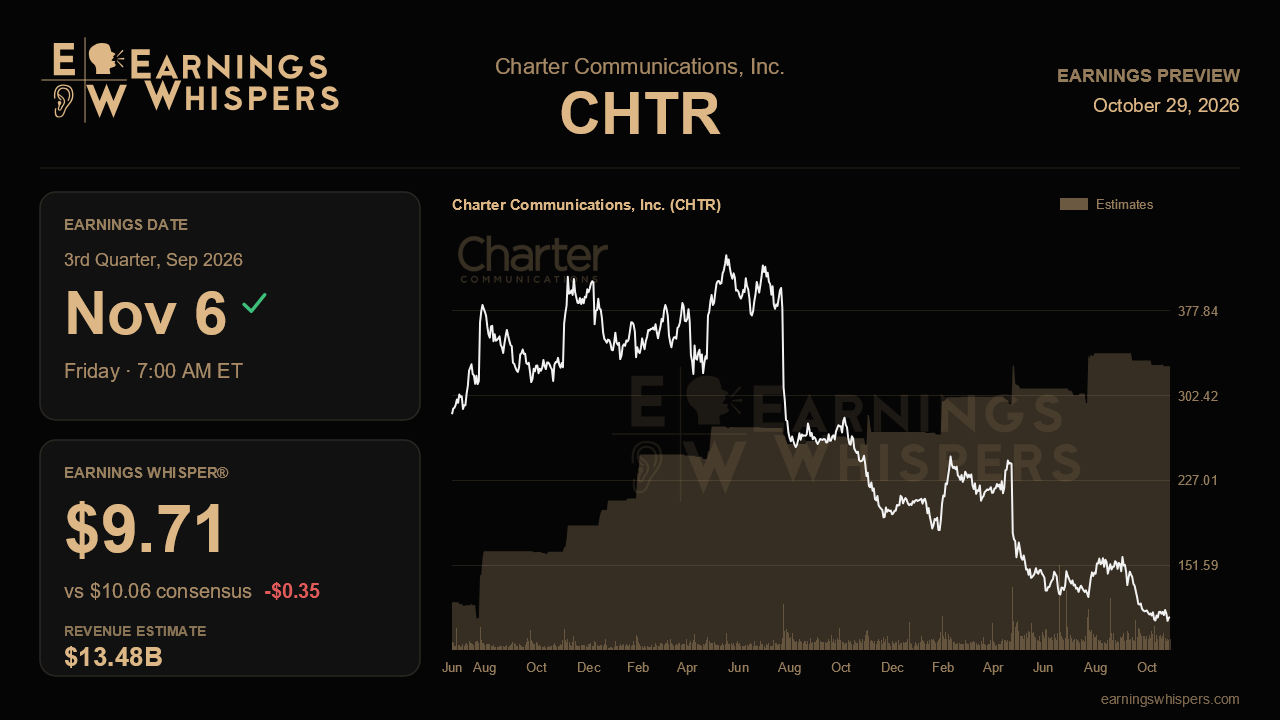
Wall Street is looking for earnings of $10.06 per share on revenue of $13.48 billion. That implies EPS growth of about 21% from the $8.34 earned a year ago, even as revenue slips about 1.4%. The combination tells the story of the past several quarters: a shrinking top line with per-share earnings supported by financial engineering, including heavy buybacks and debt repurchased at a discount. The Earnings Whisper sits at $9.71, roughly 3.5% below consensus, a meaningful gap suggesting the more skeptical crowd expects a softer print, perhaps reflecting buybacks paused through the third quarter, elevated Cox transition costs and possible noise from the timing of the close. A partial quarter of Cox could muddy year-over-year comparisons, so the standalone figures may be the cleaner read.
The backdrop is a guidance cut. Last quarter, management abandoned its call for slight EBITDA growth excluding transition costs and instead guided to a decline of around 1%, after standalone EBITDA fell 3.2% in the second quarter. Internet net losses widened to 172,000, well worse than the roughly 110,000 to 120,000 per quarter Charter had posted over the prior year, and management blamed persistent weakness in gross additions rather than churn alone. Revenue declines deepened to 1.7%. Management said it was aiming to beat the reduced outlook, pointing to second-half help from political advertising, cost pass-throughs and pricing changes tied to speed upgrades. This report is the first real test of that claim. Validation would look like internet losses narrowing back toward the prior run rate, residential revenue trends improving and standalone EBITDA declines easing from the second quarter's pace. Another quarter of losses near or above 172,000, or broadband ARPU still weighed down by the aggressive retention offers from earlier in the year, would challenge the notion that the guide was a one-time reset.
The bright spots deserve attention too. Mobile added 406,000 lines last quarter, video losses shrank to just 21,000 as streaming-app bundles gained traction, and rural expansion kept producing steady net additions. Continued strength there would show the convergence strategy is working, but it has not yet offset broadband, the company's profit engine. On Cox, management lifted its synergy framing, calling the $800 million run-rate target conservative and likely heading toward $1 billion. Early commentary on integration, transition costs that ran to $65 million last quarter, progress toward the newly lowered 3.5x leverage target and the timing of a fourth-quarter buyback restart will all shape how the market values the combined company. Fresh COO Nick Jeffrey, who started September 1, may also factor into the operating narrative.
The market has not been patient. Shares are down 5.7% since the last report while the S&P 500 gained 4.6%, and at $105.39 the stock trades near the bottom of its post-earnings range of $101.11 to $160.70 and far below its 200-day moving average near $166. Sentiment, while still bearish, has improved markedly from the prior quarter, suggesting some investors believe the bad news is largely priced in.
Ultimately, synergy talk and debt maneuvers will matter less than one number. If internet net losses stabilize and EBITDA tracks at or better than the 1% decline, Charter's argument that it is a deleveraging, free-cash-flow story with a fixable subscriber problem stays intact. If broadband losses keep worsening, the guidance cut will look like the first step rather than the last.
This earnings preview was originally published on Earnings Whispers.
This article is for informational purposes only and is not investment advice. Earnings Whispers and its staff may hold positions in the securities mentioned. It is AI-assisted, based on proprietary Earnings Whispers data and company reports, and edited by Earnings Whispers staff.
Mentioned In This Article
Latest News
| 5 hours | |
| Oct-27 | |
| Oct-26 | |
| Oct-16 | |
| Oct-15 | |
| Oct-15 | |
| Oct-14 | |
| Oct-14 | |
| Oct-13 | |
| Oct-13 | |
| Oct-13 | |
| Oct-13 | |
| Oct-13 | |
| Oct-13 | |
| Oct-12 |
