Merck Beats And Raises On A Flattered Quarter As Pipeline Wins Collide With A Muted 2027 Outlook
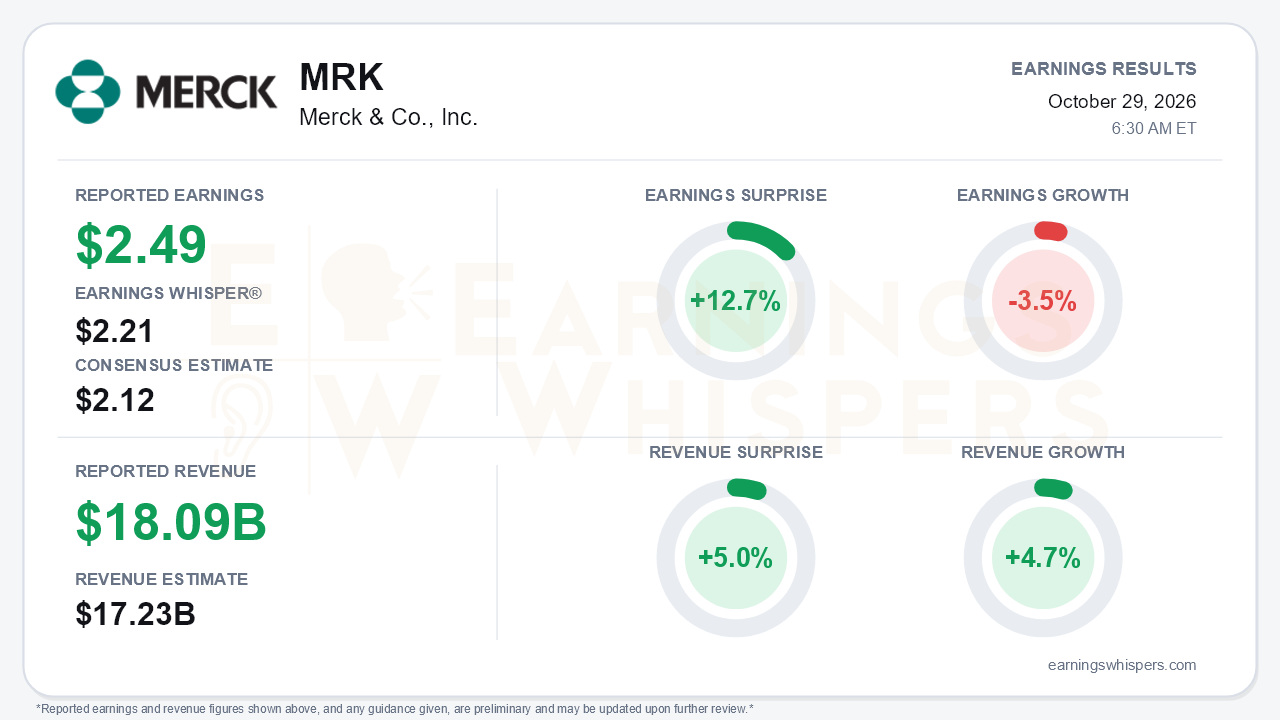
Merck delivered a clear beat and another guidance raise, but the quarter is more about where the company is headed than what it earned. Non-GAAP EPS of $2.49 topped the $2.12 consensus by 12.7% and cleared the $2.21 Earnings Whisper number, even after absorbing a $0.12-per-share charge for the SciBrunch KRAS G12D license. Revenue of $18.085 billion beat the $17.23 billion consensus by 5.0% and grew 4.7% year over year. Earnings still fell 3.5% from a year ago, and that is the central tension: the top line keeps growing while heavier R&D, launch spending and financing costs absorb the gains. Management argues that is the price of building a post-Keytruda franchise. The release and call made a credible case for that argument but offered little near-term relief.
The quality of the beat deserves scrutiny. Management quantified roughly $550 million of favorable U.S. purchase timing in the quarter. About $300 million, including $200 million of Keytruda and $50 million of Winrevair, is expected to reverse in the fourth quarter. Another roughly $250 million, tied to a Gardasil CDC stockpile purchase, unwinds in 2027. The non-GAAP tax rate was also unusually low at 10.9%, helped by discrete items. Below the line the trends were weaker:
- Non-GAAP gross margin slipped to 81.4% from 81.9% on higher production costs.
- SG&A rose 10%.
- Non-GAAP R&D climbed 13%.
- Non-GAAP other expense swelled to $420 million from $106 million as interest costs tied to deal financing mounted.
The headline beat is real, but a meaningful share of it came from timing and tax rather than operations.
Underneath, the product mix is shifting quickly. The Keytruda family grew 6% to $8.6 billion, up from 4% growth in the second quarter. Much of that came from conversion to subcutaneous Keytruda Qlex, which reached $830 million, up from $463 million in Q2 and $128 million in Q1. Intravenous Keytruda alone fell 5%. Elsewhere in the portfolio:
- **Winrevair** nearly doubled to $694 million.
- **Welireg** rose 56%.
- **Prevymis** gained 30%.
- **Gardasil** swung to 14% growth, helped by public-sector purchasing.
- **Bridion** collapsed 67%, and management now concedes multiple generic entrants, a reversal from its more benign Q2 view.
- **Januvia/Janumet** fell 39%.
- **Capvaxive** growth slowed to 7% from 40%.
- **Ohtuvayre** slipped sequentially to $184 million from $204 million.
- **Winrevair** U.S. new patient starts dipped to about 1,600 from more than 1,800.
The growth engines are working, but several newer launches look less linear than the headline growth rates suggest.
The pipeline is where the call preserved, and arguably strengthened, the long-term story. At ESMO, TroFuse-005 showed sac-TMT cut the risk of death by 32% in previously treated endometrial cancer. The FDA has accepted the filing with a June 15, 2027 PDUFA date, and Merck says it hopes for earlier approval. INTerpath-001 showed intismeran plus Keytruda reduced recurrence or death by 42% in resected melanoma. Tulisokibart is advancing to Phase 3 in hidradenitis suppurativa. Chief executive Robert Davis said the more than $70 billion mid-2030s commercial opportunity is expected to be raised. The setbacks were real but contained: the withdrawn I-DXd small-cell lung cancer filing and a Dutch injunction halting Qlex supply in six European markets.
Guidance reflects the same push-pull. Merck narrowed full-year sales to $66.8–$67.3 billion and lifted non-GAAP EPS to $2.77–$2.82 from $2.66–$2.76, despite folding in the SciBrunch charge. The EPS lift leaned heavily on a lower tax-rate assumption of 32–33%, down from 35–36%. Operating expense guidance moved up to $42.4–$42.9 billion. Management framed 2027 as another investment year. It expects only modest revenue growth, more than $2 billion of loss-of-exclusivity headwinds, moderating Keytruda growth, German pricing pressure, vaccine hesitancy, and mid-to-high single-digit opex growth. Bears have legitimate ammunition there.
Investors entered the report less enthusiastic than last quarter. Earnings Whispers sentiment remained positive but weakened, slipping from 0.19 to 0.12. The stock closed at $140.93 before the release, up 9.7% since the open after the prior report. That leaves shares 11.6% above the 200-day moving average but 10.2% below the August 25 52-week high of $156.92, so the stock has given back a good portion of its late-summer surge. The internal trend readings are mixed, with momentum positive while AVWAP remains negative.
The bottom line is that Merck produced a beat-and-raise quarter with a stronger clinical narrative than investors had a quarter ago. The earnings quality is softened, however, by purchase timing, a low tax rate and rising costs, and EPS is still declining year over year. The pipeline is increasingly de-risked. The bridge to that pipeline, though, now explicitly includes a modest-growth 2027, and that is likely to keep the market weighing long-term promise against near-term earnings pressure.
Read our earnings preview for Merck & Co., Inc.: https://www.earningswhispers.com/article/MRK/21106
This earnings review was originally published on Earnings Whispers.
This article is for informational purposes only and is not investment advice. Earnings Whispers and its staff may hold positions in the securities mentioned. It is AI-assisted, based on proprietary Earnings Whispers data and company reports, and edited by Earnings Whispers staff.
Mentioned In This Article
Latest News
| 1 hour | |
| 1 hour | |
| 3 hours | |
| 3 hours | |
| 3 hours | |
| 6 hours | |
| 7 hours | |
| 7 hours | |
| 7 hours | |
| 7 hours | |
| 7 hours | |
| Oct-28 | |
| Oct-28 | |
| Oct-27 | |
| Oct-27 |
