Rivian Beats As R2 Drives Revenue Acceleration And A Third Guidance Raise, But Margins And Cash Burn Moved Backward
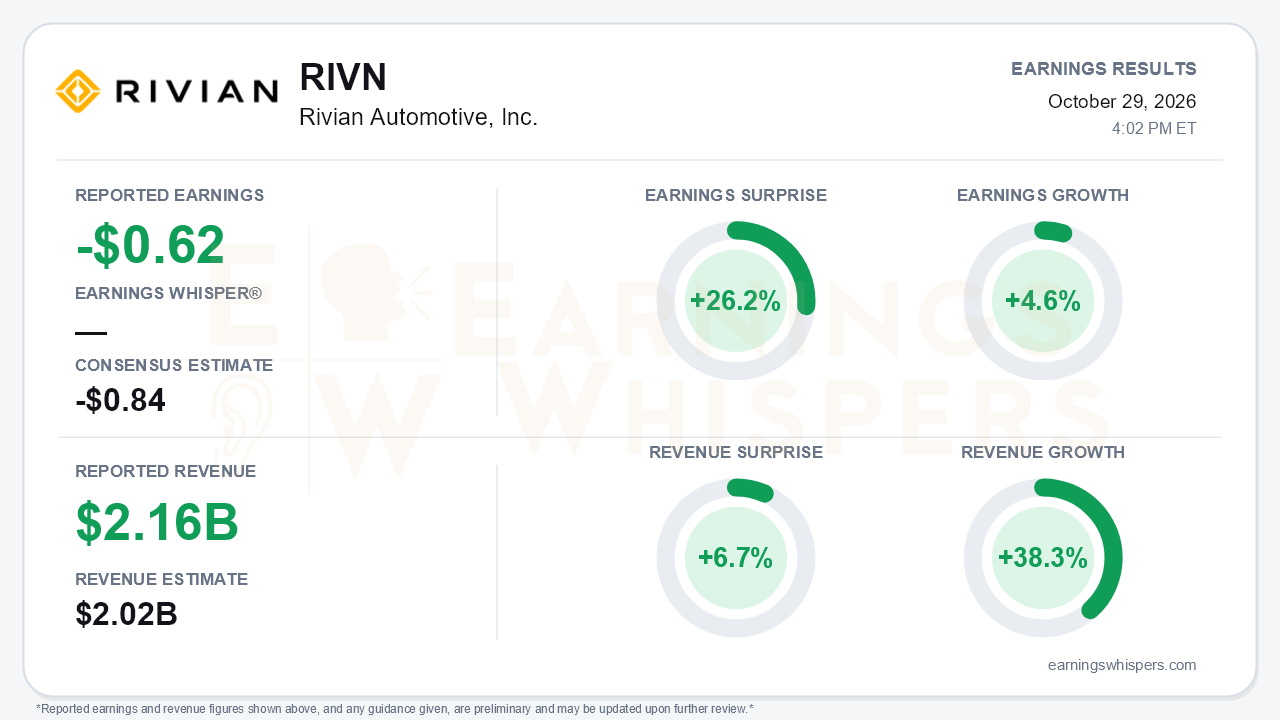
Rivian Automotive delivered the volume inflection the R2 story depended on, but the cost of getting there showed up everywhere below the revenue line. The company reported a third-quarter loss of $0.62 per share, beating the -$0.84 consensus by 26.2%. Revenue of $2.155 billion topped the $2.02 billion estimate by 6.7%. Revenue growth accelerated sharply to 38.3% year over year, up from roughly 27% in the second quarter and about 11% in the first. Earnings grew only 4.6% year over year, and that gap is the central tension. Rivian is now growing like a scaling automaker but is not yet earning like one. The per-share comparison is also flattered by a weighted share count that rose to 1.446 billion from 1.220 billion a year ago. By the company's own adjusted measure, the loss was $0.48 per share versus $0.65 a year earlier. The GAAP loss was $0.63 per share.
The quality of the beat deserves scrutiny. Deliveries jumped to a record 19,248 from 12,194 in the second quarter, and R2 is already outselling both R1 and the commercial van. Yet consolidated gross margin fell to 8% from 11% sequentially, and gross profit was essentially flat at $176 million despite $500 million in additional revenue. The automotive gross loss widened to $80 million from $36 million in the second quarter. Even that figure was supported by $81 million of regulatory credit revenue and an IEEPA tariff refund receivable. R2 ramp inefficiencies rose to roughly $120 million from about $100 million, while a richer mix of R2 and commercial vans pulled down average selling prices. Adjusted EBITDA loss widened to $435 million from $379 million. Free cash flow was negative $1.124 billion, worse than the second quarter's negative $849 million, as inventory built for the R2 launch and deferred revenue unwound.
The call preserved a credible growth story. Management narrowed full-year delivery guidance upward to 67,000-70,000 units, from 65,000-70,000 last quarter and 62,000-67,000 at the start of the year. The adjusted EBITDA loss guide improved to $1.75-$1.85 billion. However, management attributed that improvement partly to regulatory credits and the tariff refund rather than to purely operational gains. Demand indicators were strong:
- Demo drives nearly doubled to 103,000 from 57,000.
- Launch Edition conversion remains above plan.
- Autonomy+ take rates are running ahead of expectations.
- A second R2 shift has started, and R2 is expected to account for the majority of fourth-quarter deliveries.
Software and services remains the steadiest profit engine. Revenue there reached $605 million, up 45% at a 42% margin. Still, 59% of that revenue came from the Volkswagen joint venture, a concentration investors should not ignore.
The forward picture contains genuine catalysts and real cracks. On the positive side:
- Point to Point autonomy enters limited early access later this year.
- Autonomy and AI Day is set for December 9.
- The Third Dimension AI acquisition supports Rivian's closed-loop simulation work.
- Volkswagen funded a $1 billion term loan in October.
- An Uber milestone that would unlock $250 million in equity is expected by year-end.
Bears have legitimate ammunition, however. CFO Claire McDonough is departing. Positive automotive gross margin is now framed only as a December exit rate rather than a full fourth-quarter result. Memory, commodity, and AI compute costs are rising. The Gen3/LiDAR R2 variant appears delayed. Management also expects R&D and capital spending to step up meaningfully in 2027 for Georgia. This year's $300 million capex reduction was explicitly described as timing rather than savings. Liquidity remains solid at $5.5 billion in cash, or $7.1 billion pro forma including the Volkswagen loan, but that balance was supported by more than $2.6 billion in equity issuance this year. Targeted capital was framed at roughly $13 billion, down from more than $14 billion last quarter.
The market setup is more complicated than the surprise implies. Shares closed at $11.67 the day before the report, down 31.2% from the $16.97 open following the July release. That left the stock 25% below its 200-day moving average and just 2.2% above the 52-week low of $11.42 set on October 26. Investor sentiment deteriorated meaningfully, sliding from roughly neutral at -0.03 to -0.23. Expectations heading into the print were therefore depressed. The Earnings Whispers price and AVWAP trend readings remain negative, even as sequential growth trends are positive. That split mirrors the operational story: improving volumes paired with a deteriorating stock.
The bottom line is that Rivian proved R2 demand and execution are real, with accelerating revenue, record deliveries, and a third consecutive guidance raise. However, margins, EBITDA, and cash burn all moved backward, and part of the guidance lift came from credits and a tariff refund. With a CFO transition underway and heavier 2027 spending ahead, the burden now shifts to the December exit rate. Investors will need to see that the ramp costs absorbing this growth are temporary rather than structural.
Read our earnings preview for Rivian Automotive, Inc.: https://www.earningswhispers.com/article/RIVN/21237
This earnings review was originally published on Earnings Whispers.
This article is for informational purposes only and is not investment advice. Earnings Whispers and its staff may hold positions in the securities mentioned. It is AI-assisted, based on proprietary Earnings Whispers data and company reports, and edited by Earnings Whispers staff.
Mentioned In This Article
Latest News
| 3 hours | |
| 3 hours | |
| 6 hours | |
| 7 hours | |
| 7 hours | |
| 7 hours |
Rivian R2 Sales Drive Revenue Up, Narrowing Year-Over-Year Losses
RIVN RIVN +5.68% AH
The Wall Street Journal
|
| 7 hours | |
| 7 hours | |
| 7 hours | |
| 7 hours | |
| 13 hours | |
| Oct-27 | |
| Oct-26 | |
| Oct-23 | |
| Oct-22 |
