Uber Misses On Earnings As Non-Cash Charges And A Mobility Supply Squeeze Overshadow 20% Bookings Growth
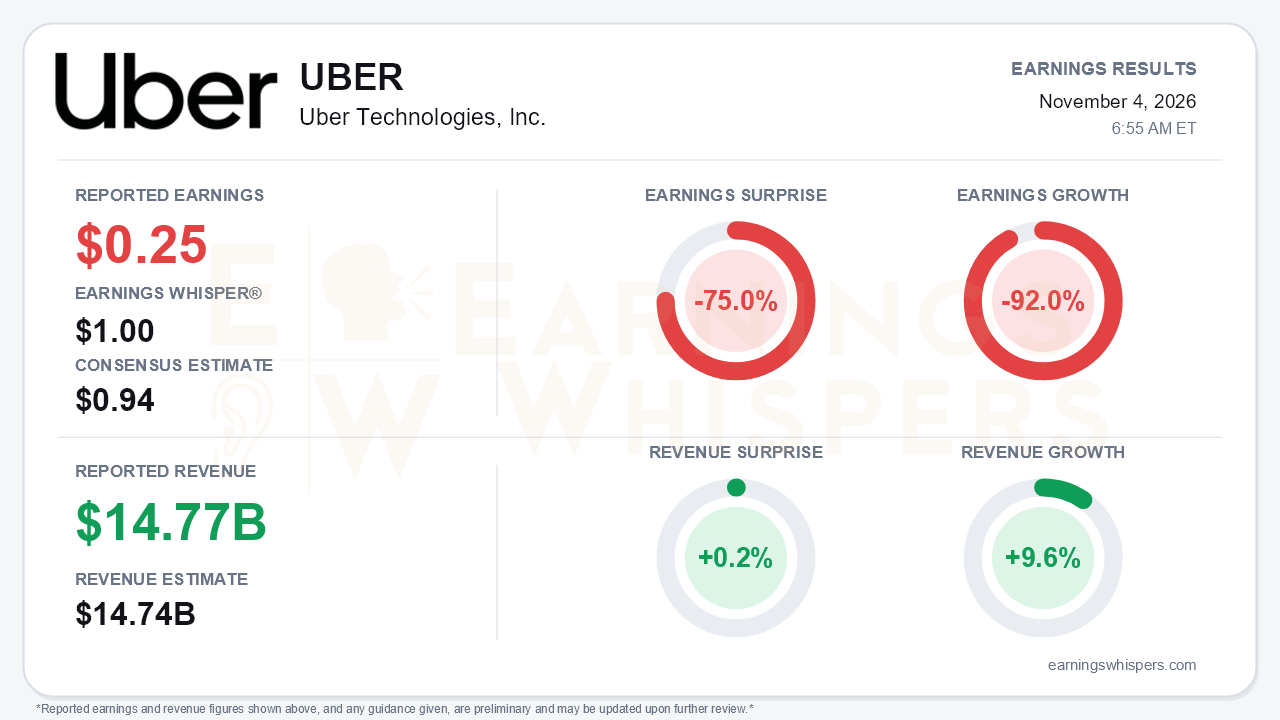
Uber Technologies reported third-quarter earnings of $0.25 per share, well below the $0.94 consensus and the $1.00 Earnings Whisper number. That is a 75.0% miss, and earnings fell 92.0% from a year ago. Revenue of $14.766 billion edged past the $14.74 billion consensus by 0.2% and grew 9.6% year over year. The headline earnings comparison is distorted. The $0.25 is a GAAP figure, while the consensus appears to sit on a non-GAAP basis. Non-GAAP EPS was $0.88, up 35%. Even on that friendlier measure, Uber fell short of both the consensus and the whisper. The central tension is that the operating engine kept compounding while the quarter failed to clear the bar investors had set, and its most important franchise, Mobility, showed real strain.
The collapse in GAAP earnings is mostly an accounting comparison problem rather than an operating one. Last year's third quarter included a $4.9 billion tax valuation allowance release and a $1.5 billion gain from revaluing equity investments. This year's quarter absorbed a $476 million loss on those same investments. GAAP income from operations rose 30% to $1.4 billion, even after several charges:
- $484 million in legal and regulatory reserve changes;
- $186 million in restructuring charges, up from $3 million a year ago;
- a $50 million settlement of legacy awards.
Underlying profitability improved meaningfully. Non-GAAP operating income climbed 38% to $2.3 billion, and margin reached a record 3.9% of gross bookings, up from 3.4%. Free cash flow was $2.5 billion, and trailing twelve-month free cash flow hit a record $10.4 billion. Gross bookings grew 20% to $59.8 billion. Revenue growth was half that, which the company attributed to business model changes that cut eight percentage points from reported revenue growth.
The call shifted the narrative from broad-based acceleration to a supply problem in Mobility. Mobility bookings rose 18% (17% in constant currency), but Mobility revenue declined 2%. Management acknowledged growth came in below internal expectations because driver supply lagged demand. In the prior quarter that issue was largely confined to Brazil. It has now broadened:
- fuel-cost-driven shortages in Brazil and India, tied to the Middle East conflict;
- immigration-related constraints in Canada;
- some moderation in U.S. Mobility after it was touted as accelerating in the first half.
The Q4 response, shifting incentives from riders to drivers, will pressure take rate and could raise rider prices. Bears have legitimate ammunition there. Delivery was the offset. Bookings grew 22% (23% in constant currency), with organic and U.S. growth accelerating for a second straight quarter. Grocery and retail reached a $15 billion run rate growing 40%. Uber One rose to roughly 55 million members, monthly active platform consumers reached 215 million, and business travel (U4B) grew almost 50%.
The forward catalysts became more concrete, particularly in autonomy. Management replaced city-count targets with vehicle counts:
- about 700 fully driverless vehicles on Uber by year-end;
- more than 2,000 in 2027;
- tens of thousands in 2028 and beyond.
Zoox launches in Las Vegas this month, Motional should follow there, and Nuro and Avride are slated for 2027. The company also signaled more third-party financing for autonomous fleets, using its $1 billion Santander facility as the template. Competitively, a DoorDash-Instacart combination creates a larger rival, though management sees potential leverage with merchants seeking alternatives. Other risks worth tracking:
- Courier supply is also lagging Delivery demand.
- President Jill Hazelbaker is departing for OpenAI.
- Long-term debt rose to $15.7 billion from $10.5 billion at the start of the year.
- Quarterly buybacks fell to $750 million from $1.46 billion a year earlier.
- M&A is being deprioritized for 2027 while Uber integrates Delivery Hero, Getir, Blacklane and EasyCater.
Guidance was reaffirming rather than inspiring. Q4 gross bookings are guided to $63.25 billion to $65.25 billion, or 18% to 22% growth in constant currency, which centers slightly below Q2's 22% pace. Non-GAAP EPS guidance of $0.95 to $0.99 implies about 37% growth at the midpoint, a modest improvement on the 35% delivered in each of the last two quarters.
The market had already priced in skepticism. As of November 3, shares sat at $66.60, down 3.5% since the open after the August report. That leaves them 9.0% below the 200-day moving average and 19.1% below the August 26 inter-earnings high of $82.37. The stock set a 52-week low of $64.04 on October 29, less than a week before the report. Investor sentiment was essentially unchanged and still negative, moving from -0.3103 to -0.3043. The Earnings Whispers trend readings are split: sequential growth and momentum are positive, while price and AVWAP trends remain negative.
The bottom line is that Uber's miss is less severe than the GAAP figures suggest but more substantive than an accounting quirk. Non-GAAP EPS still fell short of expectations, and Mobility supply constraints are spreading across markets. Delivery momentum, record cash generation and sharper autonomous targets keep the long-term growth story credible. With shares near their lows and sentiment negative, the next quarter likely hinges on whether driver incentives fix Mobility supply without eroding the margin expansion that has carried the story.
Read our earnings preview for Uber Technologies, Inc.: https://www.earningswhispers.com/article/UBER/21753
This earnings review was originally published on Earnings Whispers.
This article is for informational purposes only and is not investment advice. Earnings Whispers and its staff may hold positions in the securities mentioned. It is AI-assisted, based on proprietary Earnings Whispers data and company reports, and edited by Earnings Whispers staff.
Mentioned In This Article
Latest News
| 55 min | |
| 1 hour | |
| 2 hours | |
| 4 hours | |
| 4 hours | |
| 5 hours | |
| 5 hours | |
| 5 hours | |
| 6 hours | |
| 6 hours | |
| 6 hours |
Uber Stock Rises As Q3 Earnings Beat Despite Slower Bookings Growth
UBER +6.68%
Investor's Business Daily
|
| 6 hours | |
| 7 hours |
Uber's Revenue Growth Slows Amid Headwinds From Fuel Prices, Tighter Driver Supply
UBER +6.68%
The Wall Street Journal
|
| 7 hours | |
| 8 hours |
